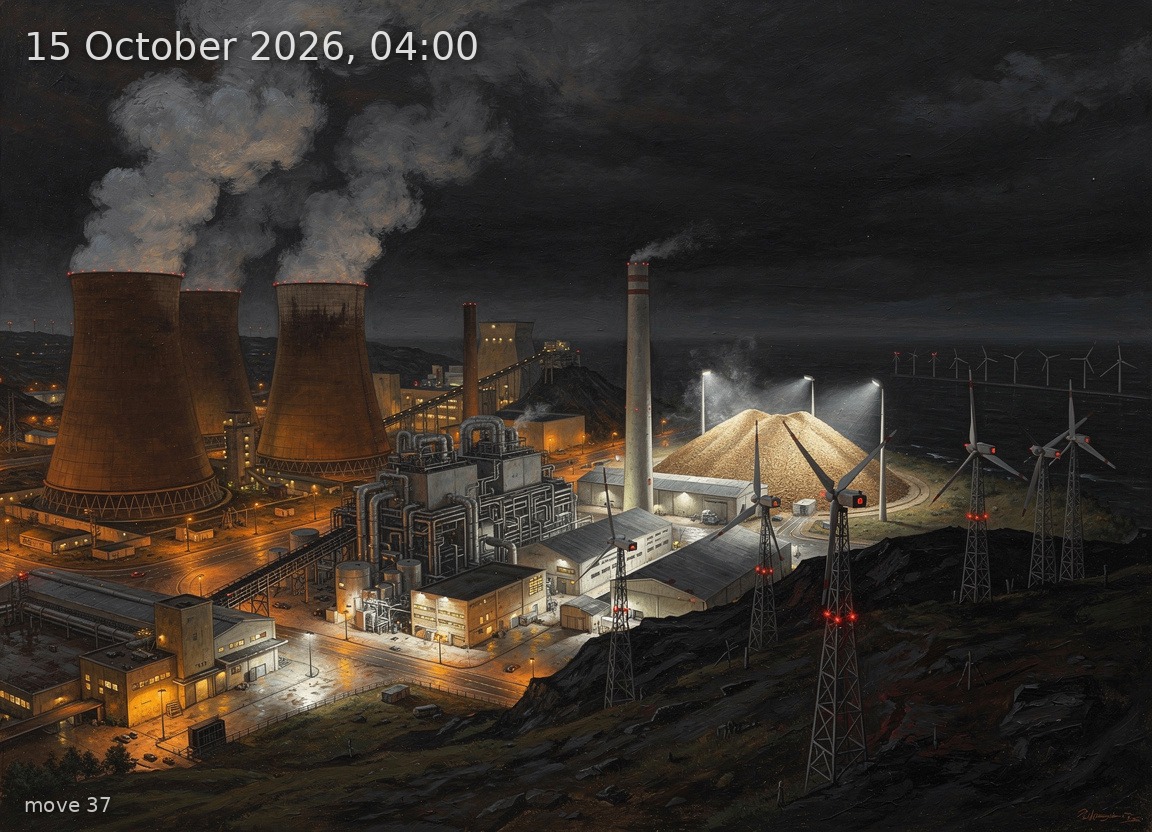
Brown coal and gas anchor overnight supply as moderate wind and net imports meet autumn demand at elevated prices.
Generation mix
Wind onshore 19%
Wind offshore 12%
Biomass 10%
Hydro 2%
Natural gas 19%
Hard coal 9%
Brown coal 28%
44%
Renewable share
12.5 GW
Wind (on + offshore)
0.0 GW
Solar
39.3 GW
Total generation
4.9 GW
Net import
166.2 EUR/MWh
Day-ahead price
6.4°C / 6 km/h
Temp / Wind speed
Open-Meteo, Kassel (51.3°N 9.5°E) · surface estimate from 100 m wind
100.0% / 0.0 W/m²
Cloud cover / Radiation
390
gCO₂/kWh
Image prompt
Brown coal 11.2 GW dominates the left third of the scene as a massive lignite power station with four hyperbolic cooling towers belching thick white-grey steam plumes into the black night sky, lit from below by orange sodium lamps; natural gas 7.4 GW fills the centre-left as a compact CCGT facility with twin tall exhaust stacks emitting thin vapour, surrounded by glowing control buildings and amber floodlights; wind onshore 7.6 GW spans the centre-right as a cluster of tall three-blade turbines on lattice towers turning slowly on a dark ridge, their red aviation warning lights blinking; wind offshore 4.9 GW appears in the far right background as a line of turbines standing in a black sea barely visible except for their blinking red nacelle lights; biomass 3.9 GW is rendered as a mid-ground industrial plant with a tall chimney and a pile of wood chips under floodlights; hard coal 3.5 GW appears as a second thermal station in the left background with a single large cooling tower and conveyor belts visible under yellow industrial lighting; hydro 1.0 GW is depicted as a small illuminated dam structure in a valley in the far centre background with water cascading. The sky is completely dark, 100% overcast, no moon, no stars, a deep oppressive charcoal-black ceiling pressing down — conveying the 166.2 EUR/MWh tension. Temperature is 6.4 °C: autumn vegetation is sparse and browning, bare-branched trees frame the foreground. Frost glistens faintly on grass under artificial light. No solar panels anywhere, no sunlight. Style: highly detailed oil painting in the tradition of 19th-century German Romantic landscape painters such as Caspar David Friedrich crossed with industrial realism — rich impasto brushwork, deep chiaroscuro, atmospheric sfumato in the steam plumes, precise engineering detail on every turbine nacelle, cooling tower curvature, and stack geometry. Dramatic, moody, masterwork quality. No text, no labels.