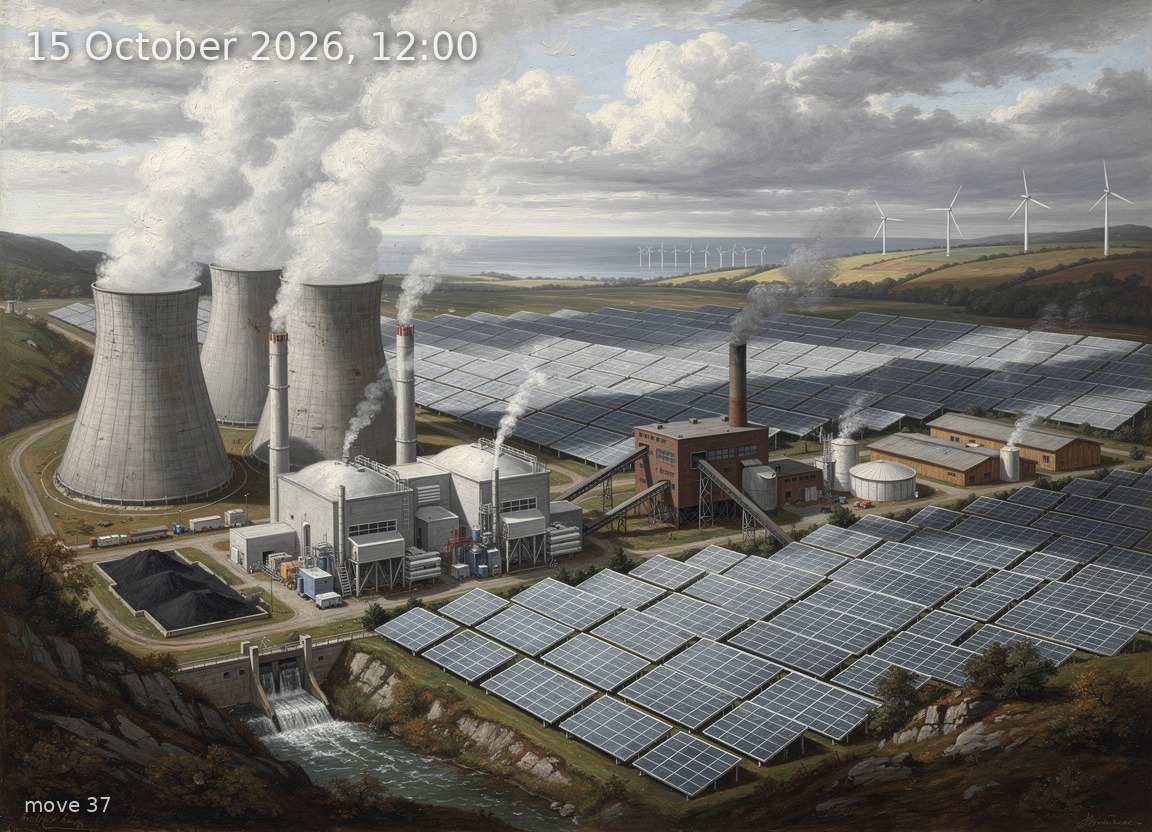
Solar leads at 35.3 GW under overcast skies; brown coal and gas provide firm backup; 11 GW net export.
Generation mix
Wind onshore 7%
Wind offshore 7%
Solar 47%
Biomass 6%
Hydro 1%
Natural gas 12%
Hard coal 5%
Brown coal 15%
68%
Renewable share
10.6 GW
Wind (on + offshore)
35.3 GW
Solar
74.5 GW
Total generation
+11.0 GW
Net export
113.7 EUR/MWh
Day-ahead price
12.0°C / 9 km/h
Temp / Wind speed
Open-Meteo, Kassel (51.3°N 9.5°E) · surface estimate from 100 m wind
75.0% / 125.0 W/m²
Cloud cover / Radiation
216
gCO₂/kWh
Image prompt
Solar 35.3 GW dominates the centre and right of the composition as vast rolling fields of aluminium-framed crystalline silicon PV panels stretching toward the horizon, catching diffuse white light through clouds; brown coal 11.0 GW occupies the left foreground as a cluster of massive hyperbolic cooling towers with thick white-grey steam plumes billowing upward; natural gas 8.7 GW sits centre-left as a pair of modern combined-cycle gas turbine plants with tall slender exhaust stacks and heat-recovery boilers emitting thin vapour trails; wind onshore 5.1 GW appears as a line of three-blade turbines with lattice towers on distant rolling hills at the far right, blades turning slowly; wind offshore 5.4 GW is suggested by a row of white monopile turbines visible on a hazy horizon beyond a strip of grey North Sea; hard coal 3.8 GW is a single dark-brick power station with conveyor belts and a square chimney trailing smoke, positioned behind the gas plant; biomass 4.2 GW appears as a modest wood-clad plant with a rounded silo and low stack near the coal station; hydro 1.1 GW is a small concrete dam visible in a valley at the far left edge. The sky is 75% covered by layered grey-white clouds typical of mid-October central Germany, with patches of pale blue and muted sunlight filtering through — full midday brightness but diffuse and flat, casting soft shadows. The atmosphere feels heavy and slightly oppressive, reflecting the high electricity price: the air is thick, the clouds press low. Autumn landscape with trees in yellow-orange-brown foliage, grass still green but fading, temperature around 12°C suggested by a cool mist clinging to the valley. Painted in the style of a highly detailed 19th-century German Romantic oil painting — rich, layered colours, visible impasto brushwork, atmospheric aerial perspective, Caspar David Friedrich's sense of scale meeting industrial sublime — but with meticulous engineering accuracy on every turbine nacelle, every cooling tower's parabolic curve, every PV panel's grid pattern. No text, no labels.