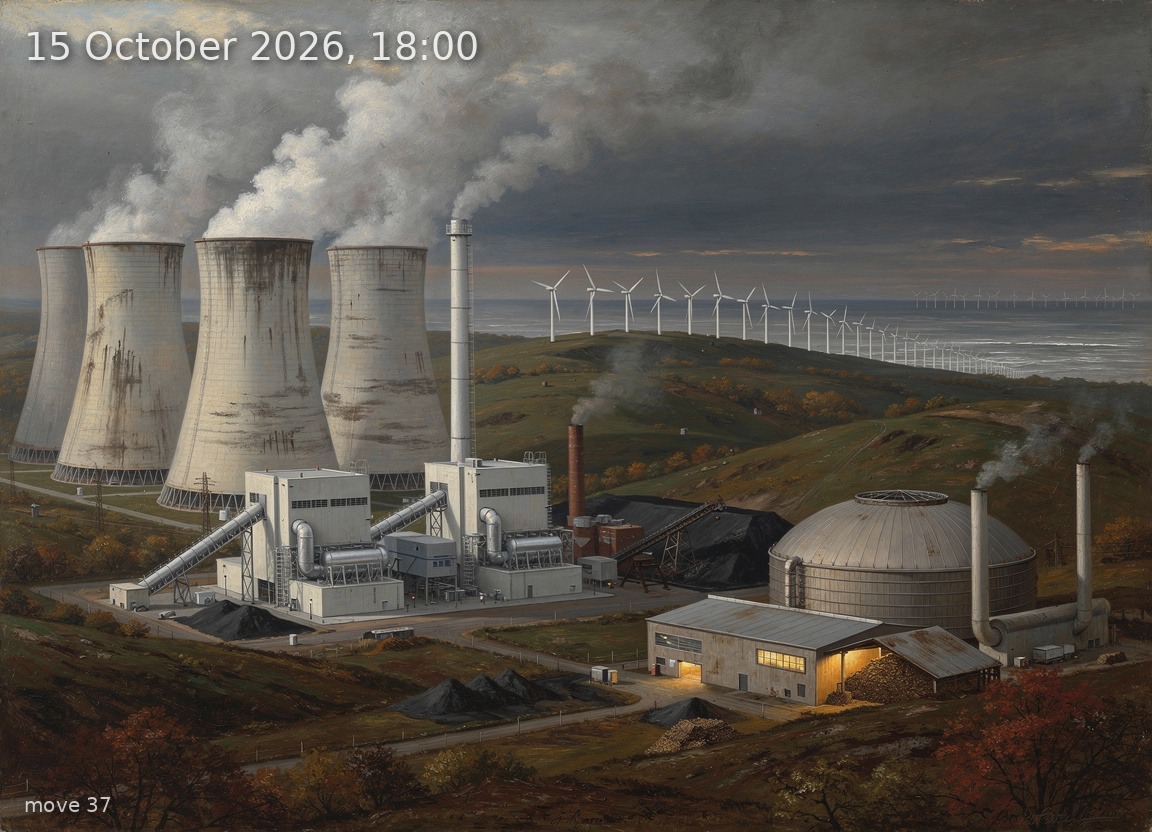
Brown coal and wind dominate generation as large net imports fill a 21 GW gap during the autumn evening peak.
Generation mix
Wind onshore 20%
Wind offshore 15%
Solar 1%
Biomass 11%
Hydro 3%
Natural gas 16%
Hard coal 7%
Brown coal 29%
48%
Renewable share
13.4 GW
Wind (on + offshore)
0.4 GW
Solar
39.3 GW
Total generation
21.0 GW
Net import
245.5 EUR/MWh
Day-ahead price
14.9°C / 15 km/h
Temp / Wind speed
Open-Meteo, Kassel (51.3°N 9.5°E) · surface estimate from 100 m wind
100.0% / 17.0 W/m²
Cloud cover / Radiation
365
gCO₂/kWh
Image prompt
Brown coal 11.3 GW dominates the left third of the scene as a cluster of massive hyperbolic cooling towers with thick white-grey steam plumes merging into the overcast sky; wind onshore 7.7 GW appears as a long line of three-blade turbines on rolling hills in the centre-right middle distance, rotors turning steadily; wind offshore 5.7 GW is suggested by a row of offshore turbines on a grey, flat horizon at far right; natural gas 6.3 GW occupies the centre-left as two compact CCGT power stations with tall single exhaust stacks emitting thin heat shimmer; hard coal 2.6 GW appears as a smaller coal plant with conveyor belts and a single squat chimney trailing dark smoke, positioned between the lignite towers and gas units; biomass 4.1 GW is rendered as a medium-sized industrial facility with a wood-chip storage dome and modest flue, placed in the right foreground; hydro 1.0 GW appears as a small weir and powerhouse along a river in the lower foreground; solar 0.4 GW is represented only as a tiny cluster of aluminium-framed crystalline PV panels on a nearby rooftop, panels dark and unreflective under the overcast sky. The time is 18:00 in mid-October in central Germany — dusk: the sky is a heavy, oppressive blanket of 100% cloud cover with a fading orange-red glow along the lower western horizon, the upper sky darkening rapidly to slate grey and indigo. The atmosphere feels heavy, dense, and costly — air thick with moisture and industrial haze. The landscape is mid-autumn: trees with thinning amber and rust-brown foliage, green-brown pastures, temperature around 15°C suggesting damp coolness. Wind at 15 km/h stirs the grass and moves branches visibly. Style: highly detailed oil painting in the tradition of 19th-century German Romantic landscape painters such as Caspar David Friedrich and Carl Blechen — rich, moody colour palette of umber, ochre, slate blue, and deep orange; visible confident brushwork; atmospheric depth with layers of industrial haze receding into the distance; meticulous engineering accuracy on all turbine nacelles, lattice towers, cooling tower geometries, gas turbine exhaust stacks, and coal conveyors. The scene conveys monumental industrial sublime — human energy infrastructure set against a vast, darkening autumn sky. No text, no labels, no people prominent.