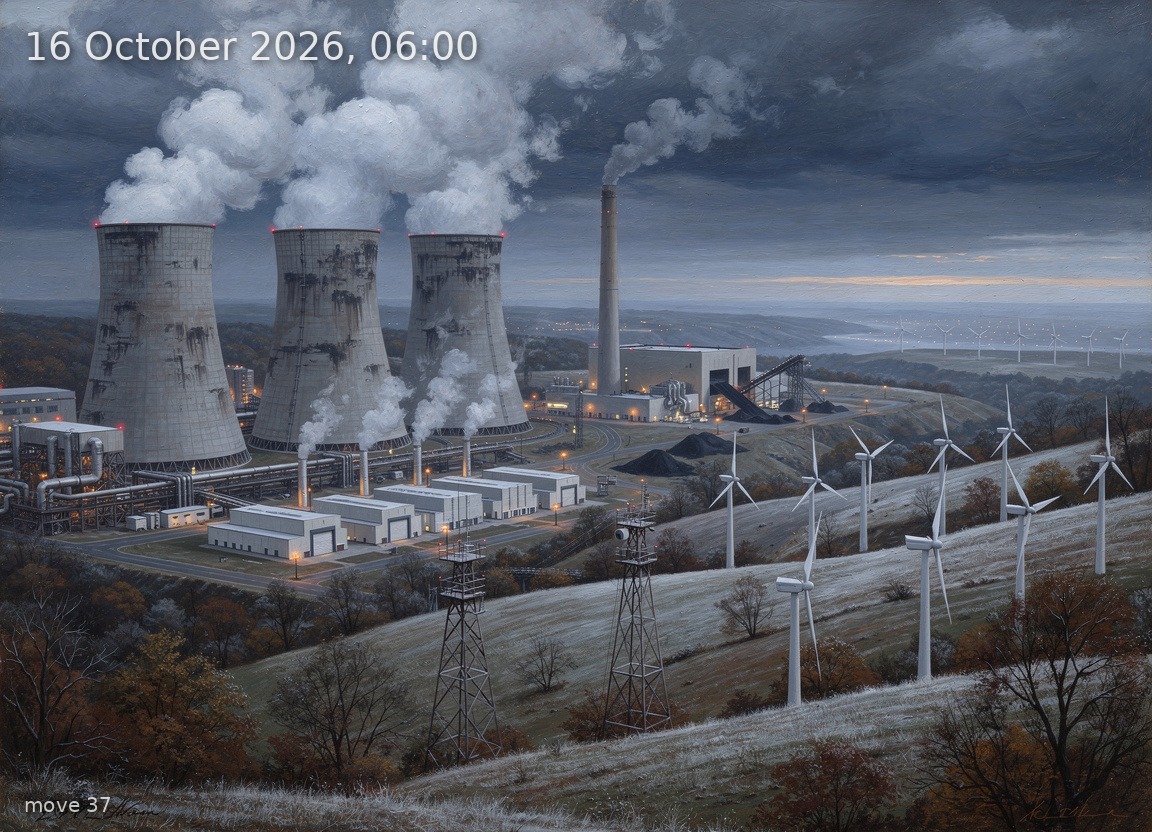
Brown coal and gas dominate pre-dawn generation as zero solar and high imports drive prices to 230 EUR/MWh.
Generation mix
Wind onshore 21%
Wind offshore 10%
Biomass 9%
Hydro 2%
Natural gas 23%
Hard coal 8%
Brown coal 27%
42%
Renewable share
13.1 GW
Wind (on + offshore)
0.0 GW
Solar
42.5 GW
Total generation
12.5 GW
Net import
230.4 EUR/MWh
Day-ahead price
6.5°C / 10 km/h
Temp / Wind speed
Open-Meteo, Kassel (51.3°N 9.5°E) · surface estimate from 100 m wind
42.0% / 0.0 W/m²
Cloud cover / Radiation
392
gCO₂/kWh
Image prompt
Brown coal 11.4 GW dominates the left third of the scene as a massive lignite power station with four hyperbolic cooling towers emitting thick white steam plumes into the pre-dawn sky; natural gas 9.7 GW fills the centre-left as a row of compact CCGT units with tall single exhaust stacks venting shimmering heat; wind onshore 8.8 GW stretches across the centre-right as dozens of three-blade turbines on lattice and tubular towers set on rolling autumn hills, blades turning slowly in moderate breeze; wind offshore 4.3 GW appears in the far right background as ghostly turbines standing in a dark grey North Sea glimpsed through a gap in terrain; biomass 4.0 GW is rendered as a medium-sized wood-chip-fired plant with a modest rectangular stack and a fuel yard of timber piles in the right foreground; hard coal 3.5 GW appears as a coal-fired station with a single large chimney and conveyor belts just behind the lignite complex on the left; hydro 1.0 GW is a small dam and powerhouse nestled in a valley in the distant centre background. The sky is deep blue-grey pre-dawn, no direct sunlight, only the faintest pale steel-blue glow along the eastern horizon; no solar panels anywhere. Temperature is 6.5°C — thin frost on grass, bare-branching deciduous trees with a few remaining brown and amber leaves, late-autumn vegetation. The atmosphere is heavy and oppressive, conveying the high electricity price: low clouds pressing down, a brooding industrial haze tinged yellowish by sodium lights illuminating the power stations. Scattered artificial lights — orange sodium lamps along access roads, lit control-room windows, red aviation warning lights atop cooling towers and turbine nacelles — provide the only warm colour against the cold pre-dawn palette. Highly detailed oil painting in the tradition of 19th-century German Romantic landscape painters such as Caspar David Friedrich and Carl Blechen, with rich colour, visible impasto brushwork, atmospheric depth, and meticulous engineering accuracy on every turbine nacelle, cooling tower, and exhaust stack. No text, no labels.