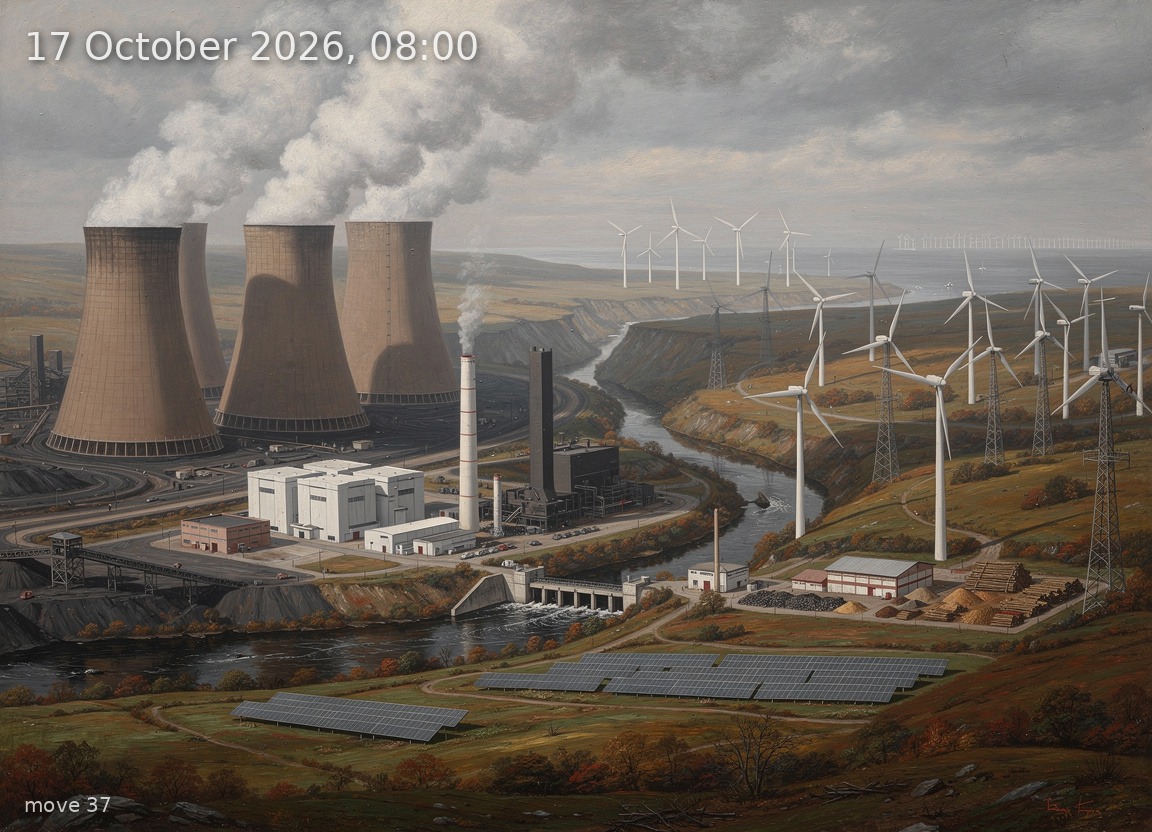
Wind leads at 22.4 GW but full overcast and morning demand drive 3.6 GW net imports and elevated prices.
Generation mix
Wind onshore 36%
Wind offshore 14%
Solar 4%
Biomass 9%
Hydro 2%
Natural gas 12%
Hard coal 5%
Brown coal 19%
64%
Renewable share
22.4 GW
Wind (on + offshore)
1.7 GW
Solar
45.0 GW
Total generation
3.6 GW
Net import
186.7 EUR/MWh
Day-ahead price
10.6°C / 18 km/h
Temp / Wind speed
Open-Meteo, Kassel (51.3°N 9.5°E) · surface estimate from 100 m wind
100.0% / 0.0 W/m²
Cloud cover / Radiation
254
gCO₂/kWh
Image prompt
Brown coal 8.7 GW dominates the left quarter of the scene as a cluster of massive hyperbolic cooling towers with thick white-grey steam plumes rising into the overcast sky, surrounded by conveyor belts and lignite stockpiles; natural gas 5.2 GW appears left-of-centre as three compact CCGT power blocks with slender exhaust stacks emitting thin heat shimmer; hard coal 2.3 GW sits just right of the gas plant as a smaller coal-fired station with a single rectangular stack and coal bunkers; wind onshore 16.3 GW fills the entire right half and background as dozens of three-blade turbines on tall lattice and tubular towers stretching across rolling autumnal hills, blades visibly rotating in moderate wind; wind offshore 6.1 GW is suggested on the far-right horizon as a line of turbines standing in a grey sea glimpsed through a gap in the terrain; biomass 3.8 GW appears as a mid-ground wood-chip-fuelled CHP plant with a modest stack and timber storage yard; hydro 0.8 GW is a small run-of-river weir with a low concrete powerhouse along a river in the middle distance; solar 1.7 GW is rendered as a small field of aluminium-framed crystalline silicon panels in the foreground, their surfaces dull and reflective-grey under the overcast — no sunshine glinting, no shadows. The sky is entirely blanketed in heavy, low stratiform clouds at 100% cover, lit by diffuse October morning daylight at 08:00 — pale, flat, slightly warm grey light with no direct sun and no blue sky visible. The atmosphere feels oppressive and heavy, reflecting the high electricity price: the air is thick, slightly hazy, the cloud deck pressing down. Vegetation is mid-autumn — yellowing grasses, sparse brown-leafed trees, damp fields at about 10°C. The river below the hydro station is dark and slow. The entire composition is rendered as a highly detailed oil painting in the tradition of 19th-century German Romantic landscape painters such as Caspar David Friedrich and Carl Blechen — rich, layered colour with visible impasto brushwork, atmospheric depth through sfumato haze between foreground industrial structures and distant turbine rows, dramatic tonal contrast between the pale steam plumes and the heavy grey sky. Every technology is painted with meticulous engineering accuracy: turbine nacelles with three correctly proportioned blades, hyperbolic cooling tower geometry, CCGT exhaust stack proportions, PV panel aluminium frames. No text, no labels, no people prominent — the landscape and its machines are the subject.