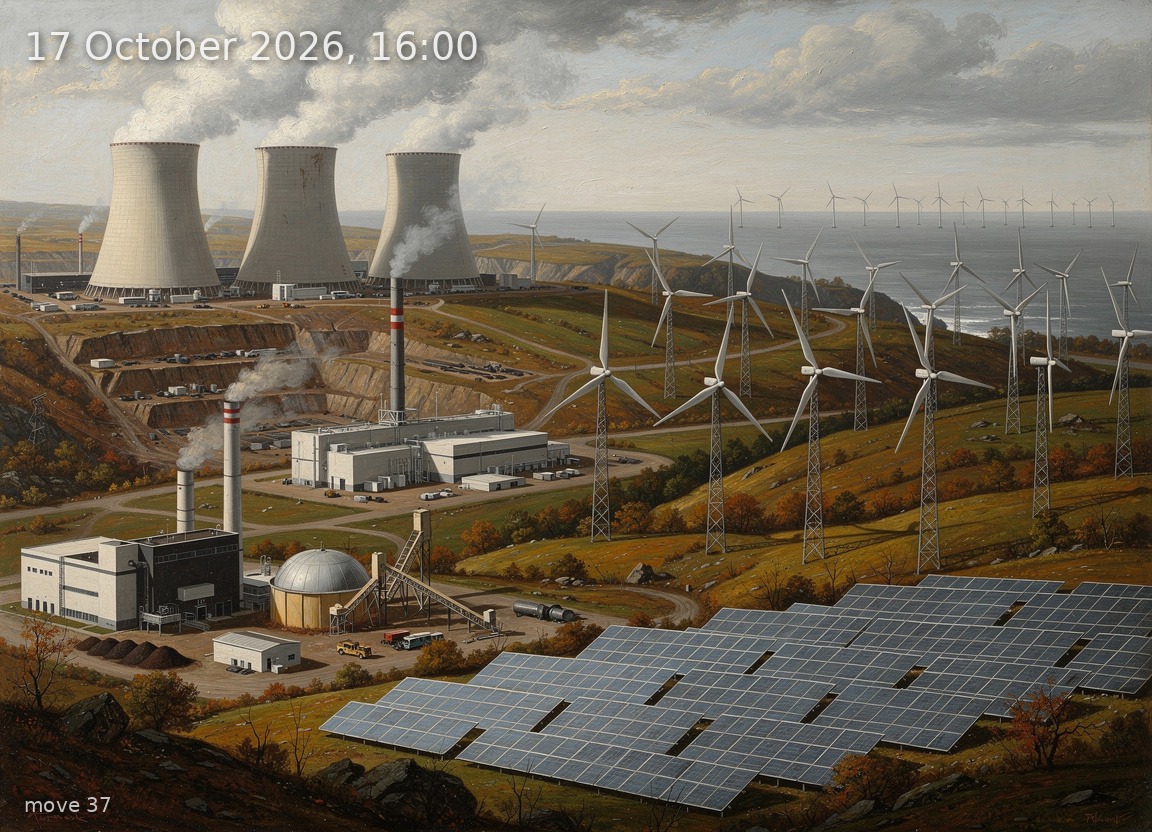
Wind leads at 20.4 GW with coal and gas bridging a 5.9 GW net import gap under elevated prices.
Generation mix
Wind onshore 33%
Wind offshore 14%
Solar 16%
Biomass 9%
Hydro 2%
Natural gas 9%
Hard coal 5%
Brown coal 14%
73%
Renewable share
20.4 GW
Wind (on + offshore)
7.0 GW
Solar
44.0 GW
Total generation
5.9 GW
Net import
166.9 EUR/MWh
Day-ahead price
12.7°C / 21 km/h
Temp / Wind speed
Open-Meteo, Kassel (51.3°N 9.5°E) · surface estimate from 100 m wind
44.0% / 149.0 W/m²
Cloud cover / Radiation
191
gCO₂/kWh
Image prompt
Wind onshore 14.5 GW dominates the right half of the canvas as dozens of tall three-blade turbines on lattice towers stretching across rolling autumn hills with amber-brown and olive-green vegetation, blades visibly rotating in brisk wind; wind offshore 5.9 GW appears as a distant row of turbines on the far-right horizon over a grey-blue sea glimpsed through a valley. Brown coal 5.9 GW occupies the left quarter as three massive hyperbolic cooling towers emitting thick white-grey steam plumes, with open-pit mine terraces visible below. Natural gas 3.8 GW sits centre-left as two compact CCGT power blocks with slim cylindrical exhaust stacks releasing thin transparent heat haze. Hard coal 2.3 GW appears as a single smaller coal plant with a rectangular boiler house and smokestack behind the gas units. Biomass 3.8 GW is rendered as a mid-sized industrial facility with a wood-chip storage dome and short stack near the centre. Solar 7.0 GW fills the centre-right foreground as large fields of aluminium-framed crystalline silicon panels angled toward the low autumn sun. Hydro 0.8 GW is a small run-of-river weir and powerhouse nestled along a stream in the lower-left foreground. The sky is 44% cloud-covered: partial cumulus clouds with gaps allowing slanting late-afternoon golden light at roughly 30° elevation, direct radiation casting warm amber tones across the landscape; the atmosphere feels heavy and slightly oppressive despite the partial sun, reflecting high electricity prices—haze thickens the air, muting distant features. Temperature 12.7 °C: autumn coolness, some trees showing red-gold foliage, others bare. Painted in the style of a highly detailed 19th-century German Romantic oil painting—rich impasto brushwork, dramatic atmospheric depth, luminous Caspar David Friedrich-like sky—but with meticulous engineering accuracy on every turbine nacelle, panel frame, cooling tower curvature, and exhaust stack. No text, no labels.