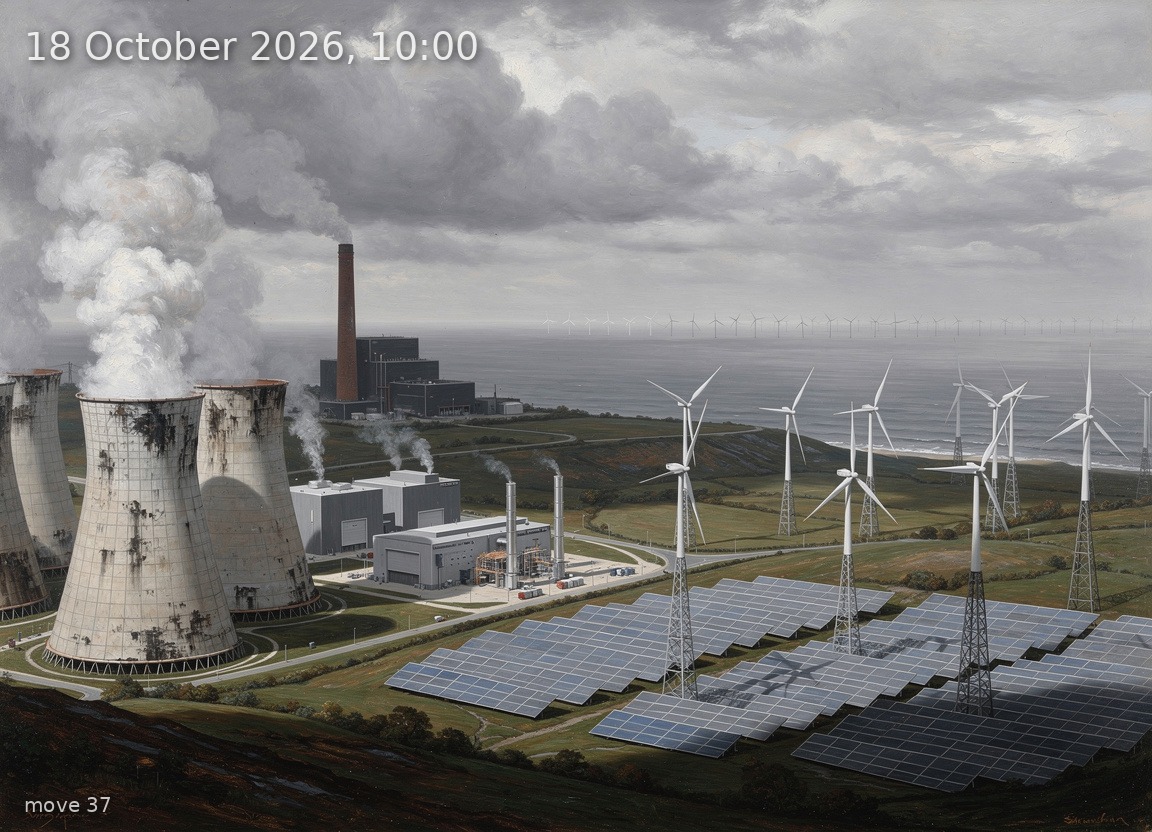
Wind leads at 19 GW but heavy overcast limits solar, keeping coal and gas in strong dispatch at elevated prices.
Generation mix
Wind onshore 25%
Wind offshore 13%
Solar 14%
Biomass 8%
Hydro 2%
Natural gas 14%
Hard coal 6%
Brown coal 18%
63%
Renewable share
19.1 GW
Wind (on + offshore)
7.1 GW
Solar
49.3 GW
Total generation
0.9 GW
Net import
194.5 EUR/MWh
Day-ahead price
9.4°C / 3 km/h
Temp / Wind speed
Open-Meteo, Kassel (51.3°N 9.5°E) · surface estimate from 100 m wind
100.0% / 2.0 W/m²
Cloud cover / Radiation
257
gCO₂/kWh
Image prompt
Wind onshore 12.4 GW dominates the right half of the scene as dozens of three-blade turbines on lattice towers stretching across rolling hills into atmospheric haze; wind offshore 6.6 GW appears in the far-right background as a distant offshore wind farm on a grey North Sea horizon. Brown coal 8.8 GW occupies the left quarter as a massive lignite power station with four hyperbolic concrete cooling towers emitting thick white steam plumes. Natural gas 6.8 GW sits left of centre as a pair of modern CCGT plants with slender exhaust stacks and smaller vapour trails. Solar 7.1 GW is rendered centre-right as extensive fields of aluminium-framed crystalline silicon panels reflecting only dull grey light under total overcast. Biomass 3.8 GW appears as a mid-ground wood-chip-fired plant with a squat smokestack and woodpile yard. Hard coal 2.9 GW is a single coal-fired station with a tall brick chimney slightly behind the lignite complex. Hydro 0.9 GW is a small run-of-river weir with a concrete spillway visible at the bottom-left edge near a river. The sky is 100% overcast—a heavy, oppressive, unbroken ceiling of grey-white stratus clouds pressing down on the landscape, with no blue sky or sun visible anywhere; diffuse flat daylight illuminates the scene evenly at mid-morning brightness but without shadows. The atmosphere feels dense and weighty, conveying the high electricity price through visual heaviness. Autumn vegetation: muted ochre and rust-coloured deciduous trees, damp dark-green grass, 9 °C chill suggested by condensation and mist hanging in low valleys. Style: highly detailed oil painting in the tradition of Caspar David Friedrich and Carl Blechen—rich tonal depth, visible confident brushwork, Romantic atmospheric perspective—yet every turbine nacelle, PV module frame, cooling tower shell, and CCGT stack is rendered with meticulous engineering accuracy. No text, no labels.