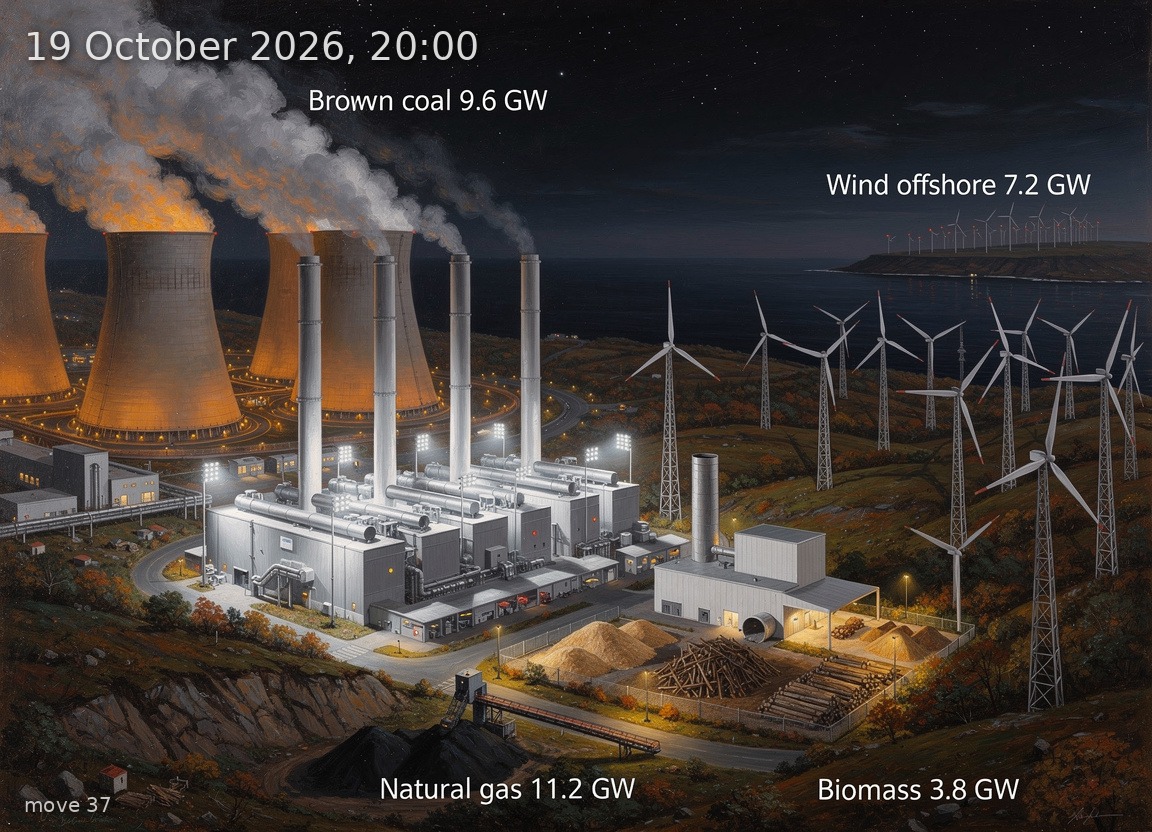
Strong wind output leads generation but high thermal dispatch and tight supply keep evening prices elevated.
Generation mix
Wind onshore 40%
Wind offshore 12%
Biomass 6%
Hydro 1%
Natural gas 19%
Hard coal 6%
Brown coal 16%
59%
Renewable share
31.1 GW
Wind (on + offshore)
0.0 GW
Solar
60.3 GW
Total generation
0.2 GW
Net import
216.7 EUR/MWh
Day-ahead price
8.2°C / 9 km/h
Temp / Wind speed
Open-Meteo, Kassel (51.3°N 9.5°E) · surface estimate from 100 m wind
0.0% / 0.0 W/m²
Cloud cover / Radiation
268
gCO₂/kWh
Image prompt
Wind onshore 23.9 GW dominates the right half of the scene as dozens of towering three-blade turbines with white lattice towers stretching across rolling autumnal hills, rotors turning steadily. Wind offshore 7.2 GW appears in the far-right background as a cluster of turbines rising from a dark sea glimpsed beyond a coastal ridge. Brown coal 9.6 GW fills the left foreground as massive hyperbolic cooling towers emitting thick white steam plumes, illuminated from below by amber sodium lights of a sprawling lignite complex. Natural gas 11.2 GW occupies the centre-left as a row of compact CCGT plants with tall single exhaust stacks venting thin transparent heat shimmer, lit by industrial floodlights. Hard coal 3.7 GW appears as a smaller coal-fired station with a rectangular chimney and coal conveyor belt, glowing dimly beside the gas units. Biomass 3.8 GW is rendered as a modest wood-chip-fueled power station with a short cylindrical stack and timber-pile yard, positioned between the gas and wind zones. Hydro 0.8 GW is a small dam and penstock visible in a valley notch at far left. The sky is completely dark—a deep navy-to-black autumn night, no twilight, no sky glow, stars barely visible through a perfectly clear atmosphere (0% cloud cover). The air feels cold at 8°C; bare-branched oaks and fading grass show late October. A moderate ground-level breeze ripples puddles. The atmosphere is heavy and oppressive despite the clear sky, conveying the tension of high electricity prices—an almost electric density in the air. Sodium-orange and cool-white industrial lighting casts dramatic pools of light and deep shadows across the terrain. Style: highly detailed oil painting in the tradition of 19th-century German Romantic landscape painters such as Caspar David Friedrich and Carl Blechen, with rich impasto brushwork, deep chiaroscuro, luminous atmospheric depth, but meticulous engineering accuracy for every turbine nacelle, cooling tower profile, and exhaust stack. No text, no labels.