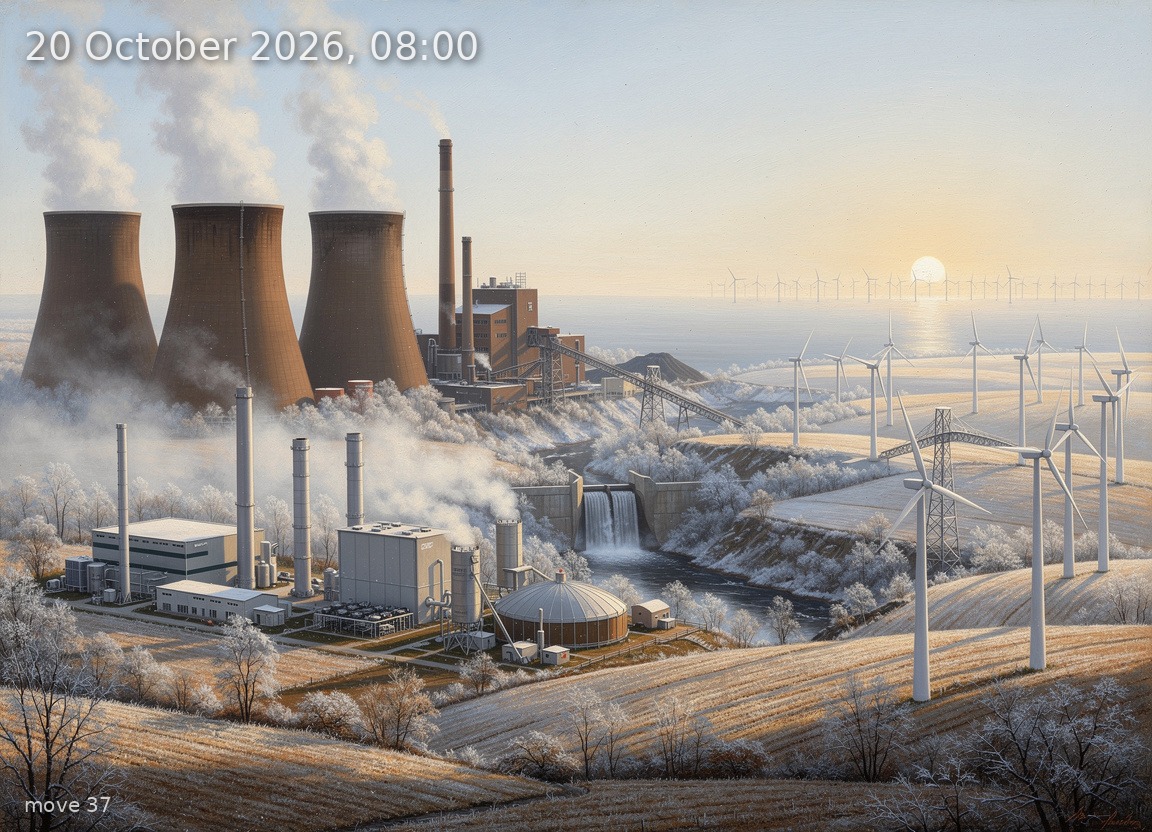
Wind leads at 23.9 GW but cold-driven 63 GW demand forces heavy thermal dispatch and 9.2 GW net imports.
Generation mix
Wind onshore 32%
Wind offshore 13%
Solar 5%
Biomass 7%
Hydro 2%
Natural gas 17%
Hard coal 6%
Brown coal 19%
58%
Renewable share
23.9 GW
Wind (on + offshore)
2.6 GW
Solar
53.8 GW
Total generation
9.2 GW
Net import
242.9 EUR/MWh
Day-ahead price
2.1°C / 7 km/h
Temp / Wind speed
Open-Meteo, Kassel (51.3°N 9.5°E) · surface estimate from 100 m wind
0.0% / 0.0 W/m²
Cloud cover / Radiation
286
gCO₂/kWh
Image prompt
Brown coal 10.5 GW dominates the left quarter as a cluster of massive hyperbolic cooling towers with thick white steam plumes rising into cold clear air; natural gas 9.1 GW fills the centre-left as compact CCGT plants with tall single exhaust stacks emitting thin grey plumes; wind onshore 17.0 GW spans the entire right half as dozens of three-blade turbines on lattice and tubular towers stretching across rolling frost-covered hills into the distance; wind offshore 6.9 GW appears as a line of turbines on the far-right horizon above a sliver of grey sea; hard coal 3.1 GW sits behind the brown coal as a smaller conventional power station with twin stacks and a coal conveyor; biomass 3.8 GW is rendered as a mid-sized industrial plant with a wood-chip storage dome and modest chimney near the centre; hydro 0.8 GW appears as a small concrete dam with a thin waterfall in the middle distance; solar 2.6 GW is shown as a modest array of aluminium-framed crystalline silicon panels on a south-facing slope catching the first weak rays. The sky is crisp, entirely cloudless, pale blue-white near the low eastern sun which casts long golden-orange shadows across frost-whitened stubble fields and bare deciduous trees — early-morning October light, sun just above the horizon. Temperature is near freezing: breath-like mist rises from the ground, rime coats fence posts and grass. The atmosphere feels heavy and oppressive despite the clear sky, with a faint haze of industrial exhaust hanging low, evoking the high electricity price. Painted in the style of a highly detailed 19th-century German Romantic oil painting — rich impasto brushwork, luminous atmospheric depth, Caspar David Friedrich's sense of sublime scale — but with meticulous engineering accuracy on every turbine nacelle, cooling tower curvature, and panel frame. No text, no labels.