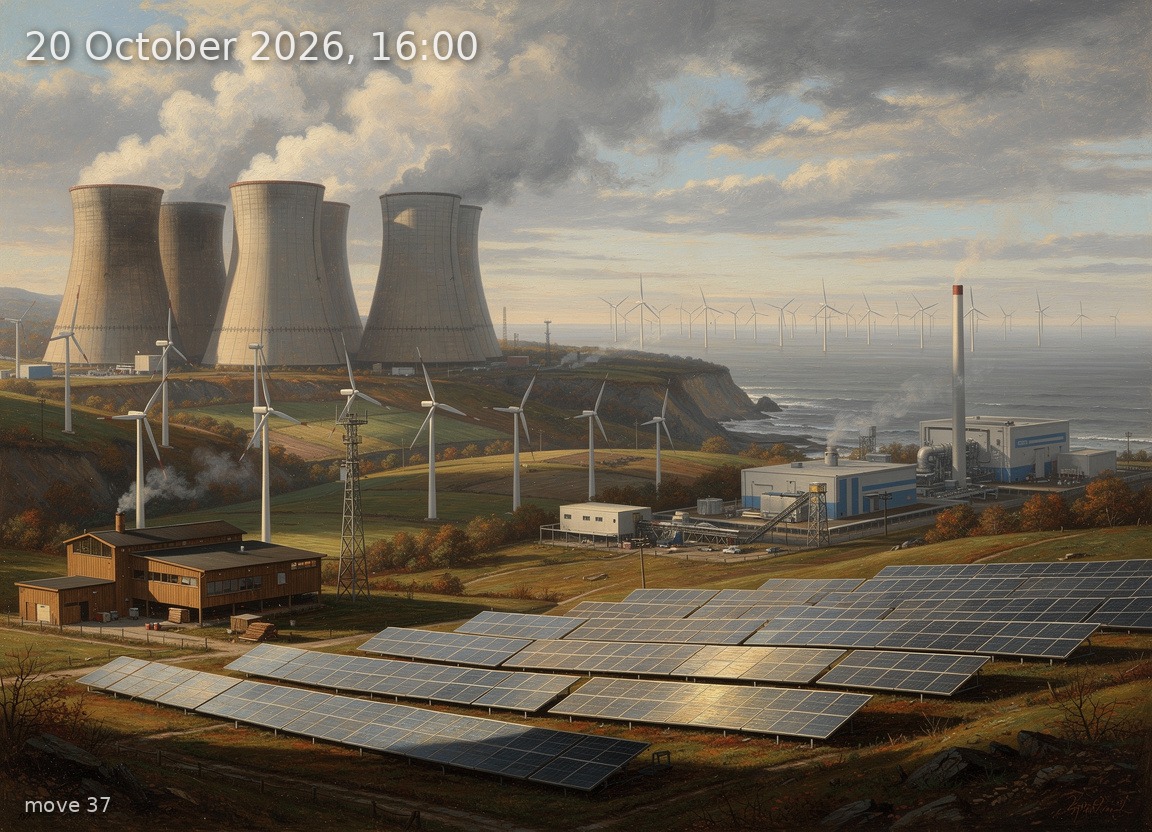
Wind and brown coal anchor generation while 6.9 GW net imports bridge a gap under elevated prices.
Generation mix
Wind onshore 21%
Wind offshore 13%
Solar 17%
Biomass 7%
Hydro 2%
Natural gas 14%
Hard coal 6%
Brown coal 20%
60%
Renewable share
17.8 GW
Wind (on + offshore)
9.0 GW
Solar
52.8 GW
Total generation
7.0 GW
Net import
205.9 EUR/MWh
Day-ahead price
11.0°C / 10 km/h
Temp / Wind speed
Open-Meteo, Kassel (51.3°N 9.5°E) · surface estimate from 100 m wind
53.0% / 173.0 W/m²
Cloud cover / Radiation
278
gCO₂/kWh
Image prompt
Brown coal 10.7 GW dominates the left quarter as a cluster of massive hyperbolic cooling towers with thick white-grey steam plumes rising into a partly cloudy sky; wind onshore 11.2 GW stretches across the centre-left as dozens of three-blade turbines on lattice and tubular towers arrayed across rolling autumnal hills with fading green-brown grass; wind offshore 6.6 GW appears in the distant right background as a formation of turbines standing in a grey sea glimpsed beyond low coastal bluffs; solar 9.0 GW fills the centre-right foreground as extensive fields of aluminium-framed crystalline silicon panels angled toward a sun partially veiled by clouds, catching warm but weakening late-afternoon light; natural gas 7.5 GW sits in the mid-ground right as a pair of compact CCGT plants with tall single exhaust stacks emitting thin transparent heat shimmer; hard coal 3.0 GW appears as a smaller coal-fired station with a single rectangular boiler house and squat chimney near the brown coal complex; biomass 3.8 GW is rendered as a modest timber-clad plant with a short stack and wood-chip storage yard at the far left edge; hydro 0.9 GW is a small run-of-river weir on a stream in the foreground corner. The time is 16:00 in late October — the sun sits low in the west-southwest, casting long amber-gold shadows across the landscape; the sky is roughly half covered in mid-level stratocumulus clouds with patches of pale blue; the atmosphere feels heavy and oppressive, hazy, almost brooding, reflecting the high electricity price. Autumn foliage — muted ochre, russet, and olive — dresses scattered deciduous trees; temperature around 11°C gives a cool, damp feel with faint mist in low terrain. Rendered as a highly detailed oil painting in the tradition of 19th-century German Romantic landscape masters such as Caspar David Friedrich and Carl Blechen — rich, layered colour, visible confident brushwork, atmospheric aerial perspective lending depth, dramatic chiaroscuro from the low sun breaking through clouds. Every technology is painted with meticulous engineering accuracy: three-blade rotor geometry, nacelle housings, PV cell grid patterns, cooling tower parabolic profiles, CCGT exhaust geometry. No text, no labels, no people prominent — a masterwork industrial landscape of a nation bridging old and new energy.