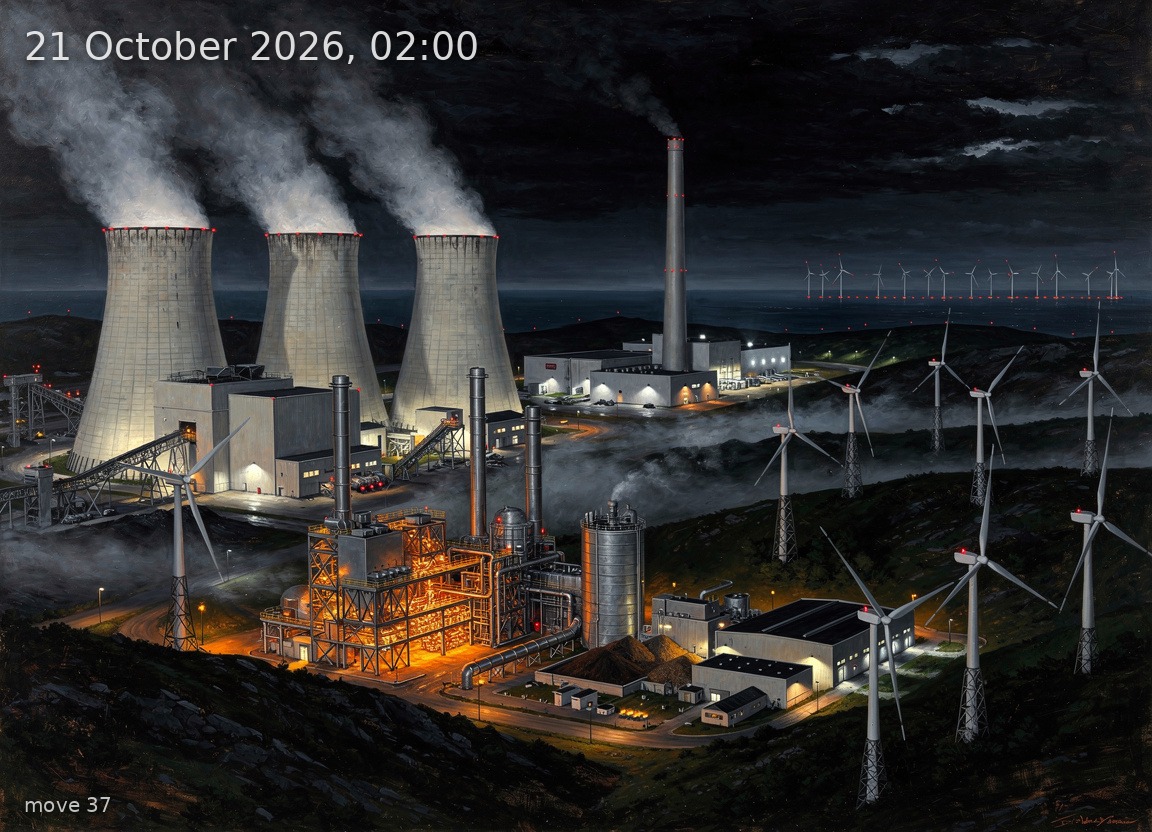
Brown coal, wind, and gas dominate a tight overnight grid requiring net imports at elevated prices.
Generation mix
Wind onshore 23%
Wind offshore 16%
Biomass 9%
Hydro 2%
Natural gas 18%
Hard coal 8%
Brown coal 25%
50%
Renewable share
16.2 GW
Wind (on + offshore)
0.0 GW
Solar
42.4 GW
Total generation
2.7 GW
Net import
168.3 EUR/MWh
Day-ahead price
8.3°C / 9 km/h
Temp / Wind speed
Open-Meteo, Kassel (51.3°N 9.5°E) · surface estimate from 100 m wind
100.0% / 0.0 W/m²
Cloud cover / Radiation
349
gCO₂/kWh
Image prompt
Brown coal 10.5 GW dominates the left third of the scene as a massive lignite power station with four hyperbolic cooling towers emitting heavy steam plumes into the black sky; wind onshore 9.6 GW fills the centre-right background as dozens of three-blade turbines on lattice and tubular towers spread across dark rolling hills, their red aviation warning lights blinking; wind offshore 6.6 GW appears as a distant line of turbines on the far-right horizon above a dark sea glimpsed between hills; natural gas 7.7 GW occupies the centre-left as a compact CCGT facility with tall narrow exhaust stacks and warm orange sodium lighting illuminating its steel framework; hard coal 3.2 GW sits beside the lignite plant as a smaller conventional station with a single large smokestack trailing grey exhaust; biomass 3.8 GW appears as a mid-sized industrial plant with a wood-chip silo and modest chimney, lit by floodlights, in the middle ground; hydro 0.9 GW is a small dam and powerhouse nestled in a forested valley at far right, barely visible. The sky is completely dark, deep black-navy, 100% overcast with no stars and no moon visible, an oppressive low cloud ceiling reflecting the orange industrial glow from below. Temperature is 8.3°C: autumn deciduous trees in the foreground have sparse brown and amber leaves, damp ground, a faint mist hangs in the valleys. The atmosphere is heavy and brooding, conveying expensive, strained power. Highly detailed oil painting in the tradition of 19th-century German Romantic landscape painters such as Caspar David Friedrich and Carl Blechen — rich saturated colour, visible textured brushwork, dramatic chiaroscuro between the glowing industrial facilities and the surrounding darkness, atmospheric depth with layered fog. Every technology rendered with meticulous engineering accuracy: three-blade rotor nacelles, aluminium cooling tower profiles, CCGT heat-recovery casings. No text, no labels.