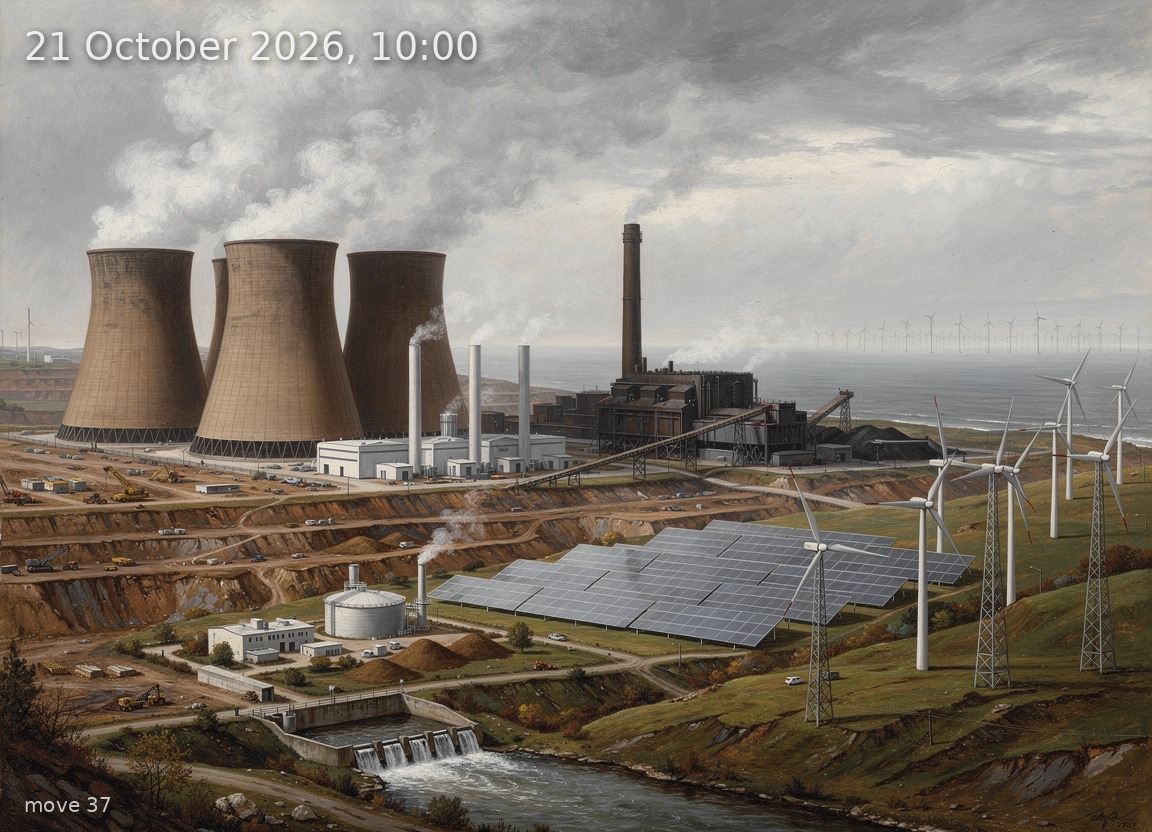
Coal and gas dominate thermal output while 14 GW net imports fill the gap under full overcast.
Generation mix
Wind onshore 14%
Wind offshore 10%
Solar 14%
Biomass 8%
Hydro 1%
Natural gas 22%
Hard coal 9%
Brown coal 22%
48%
Renewable share
11.9 GW
Wind (on + offshore)
7.0 GW
Solar
49.4 GW
Total generation
14.0 GW
Net import
228.4 EUR/MWh
Day-ahead price
8.7°C / 4 km/h
Temp / Wind speed
Open-Meteo, Kassel (51.3°N 9.5°E) · surface estimate from 100 m wind
100.0% / 0.0 W/m²
Cloud cover / Radiation
351
gCO₂/kWh
Image prompt
Brown coal 10.7 GW occupies the left quarter as a cluster of massive hyperbolic cooling towers with thick white-grey steam plumes merging into the overcast sky, surrounded by open-pit lignite mines with terraced brown earth; natural gas 10.7 GW fills the centre-left as several compact CCGT power stations with tall slender exhaust stacks emitting translucent heat shimmer; hard coal 4.4 GW appears centre-right as a dark industrial coal plant with conveyor belts and a single large smokestack; wind onshore 7.0 GW spans the right third as rows of three-blade turbines on lattice and tubular towers across rolling hills, blades barely turning in light wind; wind offshore 4.9 GW is visible in the far-right background as a distant offshore wind farm on a grey North Sea horizon; solar 7.0 GW appears as a mid-ground field of aluminium-framed crystalline silicon panels reflecting only dull grey light, no sunshine reaching them; biomass 3.8 GW is rendered as a modest wood-chip-fed power plant with a rounded silo and low steam vent near the coal facilities; hydro 0.7 GW is a small run-of-river station with a concrete weir on a stream in the foreground. Time is 10:00 AM in late October: full daylight but entirely diffused through a 100% unbroken low stratus cloud ceiling, no shadows anywhere, flat grey-white sky pressing down oppressively. Temperature is 8.7°C: autumn landscape with yellowing and half-bare deciduous trees, damp ground, muted earth tones. Wind is light at 4.5 km/h, grass barely stirring. The heavy cloud cover and high electricity price create a dense, oppressive, claustrophobic atmosphere with muted palette dominated by greys, ochres, and industrial browns. High-voltage transmission lines with lattice pylons cross the scene, symbolizing the import flows. Style: highly detailed oil painting in the tradition of 19th-century German Romantic landscape painters—Caspar David Friedrich meets industrial sublime—rich impasto brushwork, atmospheric aerial perspective, meticulous engineering detail on every turbine nacelle, every cooling tower hyperbolic curve, every PV panel frame. No text, no labels.