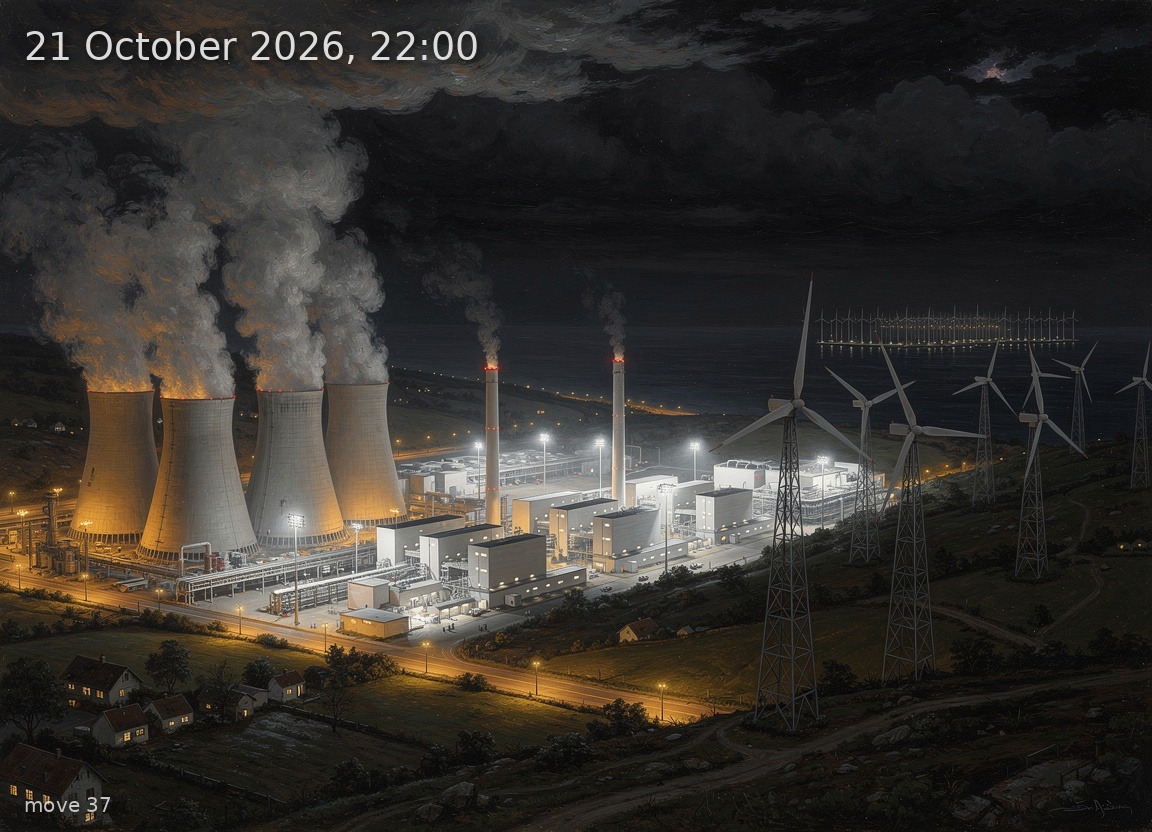
Strong wind and persistent coal and gas thermal generation meet late-evening demand under full cloud cover.
Generation mix
Wind onshore 36%
Wind offshore 10%
Biomass 8%
Hydro 2%
Natural gas 17%
Hard coal 7%
Brown coal 20%
56%
Renewable share
24.7 GW
Wind (on + offshore)
0.0 GW
Solar
53.9 GW
Total generation
+0.4 GW
Net export
182.5 EUR/MWh
Day-ahead price
9.8°C / 19 km/h
Temp / Wind speed
Open-Meteo, Kassel (51.3°N 9.5°E) · surface estimate from 100 m wind
100.0% / 0.0 W/m²
Cloud cover / Radiation
301
gCO₂/kWh
Image prompt
Wind onshore 19.2 GW dominates the right half and background as dozens of tall three-blade turbines on lattice towers stretching across rolling hills, their rotors turning briskly in moderate wind; wind offshore 5.5 GW appears as a distant cluster of turbines on the far-right horizon over a dark sea. Brown coal 10.6 GW occupies the left foreground as a massive lignite power station with four hyperbolic cooling towers emitting thick white steam plumes lit from below by sodium-orange industrial lights. Natural gas 9.3 GW fills the centre-left as a row of compact CCGT plants with tall single exhaust stacks venting thin heat shimmer, their facades illuminated by harsh white floodlights. Hard coal 4.0 GW appears as a smaller coal-fired station behind the gas plants, with a single large chimney and a visible coal conveyor belt. Biomass 4.4 GW is rendered as a wood-chip-fed generating facility with a modest stack and timber storage yard in the centre-right middle ground. Hydro 1.0 GW appears as a small run-of-river station with a weir along a dark river in the lower foreground. Time is 22:00 — completely dark sky, deep black with no twilight, no sky glow, full 100% overcast so no stars or moon visible, the sky feels heavy and oppressive reflecting the high electricity price. All illumination comes from artificial sources: sodium streetlamps casting amber pools, industrial floodlights on the power stations, small lit windows in distant villages. Autumn vegetation: bare-branching oaks and beeches with a few remaining brown leaves, damp ground. Temperature near 10°C conveyed through mist and condensation around the cooling towers. The atmosphere is dense, brooding, weighted. Style: highly detailed oil painting in the tradition of 19th-century German Romantic landscape painters — rich chiaroscuro, visible impasto brushwork, deep atmospheric perspective — rendered with meticulous engineering accuracy on every turbine nacelle, cooling tower curvature, CCGT exhaust stack, and conveyor structure. The scene evokes Caspar David Friedrich reinterpreted for the industrial age. No text, no labels.