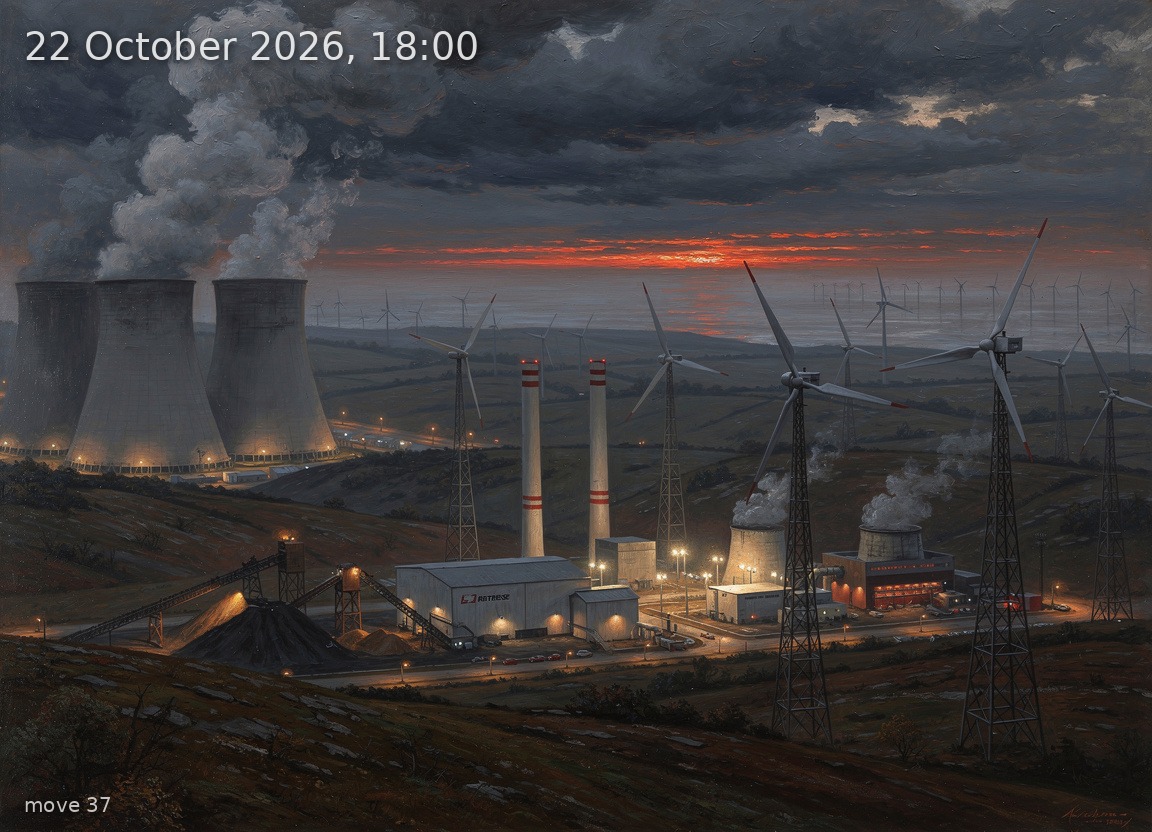
Strong onshore wind leads generation but 18 GW net imports needed at dusk to meet autumn evening peak demand.
Generation mix
Wind onshore 53%
Wind offshore 8%
Solar 0%
Biomass 9%
Hydro 2%
Natural gas 8%
Hard coal 4%
Brown coal 15%
73%
Renewable share
26.5 GW
Wind (on + offshore)
0.1 GW
Solar
43.5 GW
Total generation
18.0 GW
Net import
261.9 EUR/MWh
Day-ahead price
10.5°C / 24 km/h
Temp / Wind speed
Open-Meteo, Kassel (51.3°N 9.5°E) · surface estimate from 100 m wind
97.0% / 0.8 W/m²
Cloud cover / Radiation
194
gCO₂/kWh
Image prompt
Wind onshore 23.0 GW dominates the scene as vast rows of three-blade turbines with lattice towers stretching across rolling hills from the centre to the right two-thirds of the composition, their rotors spinning vigorously in strong wind; brown coal 6.6 GW occupies the far left as a cluster of massive hyperbolic cooling towers emitting thick white-grey steam plumes into the heavy sky; natural gas 3.5 GW appears as compact CCGT plants with tall single exhaust stacks and visible heat shimmer just left of centre; biomass 4.0 GW is rendered as a mid-sized industrial facility with wood-chip conveyors and a broad smokestack with faint pale exhaust, positioned between the coal plant and gas units; hard coal 1.7 GW appears as a smaller conventional power station with a single cooling tower and coal bunker behind the biomass plant; wind offshore 3.5 GW is suggested on the distant horizon as faint turbine silhouettes rising from a grey sea glimpsed through a gap between hills; hydro 1.1 GW is a small dam and penstock visible in a valley in the lower right foreground. No solar panels anywhere — no sunshine. Time is 18:00 late October dusk: the sky is rapidly darkening, a narrow band of deep orange-red light clings to the lowest horizon in the west, the upper sky transitions through slate grey to near-black, heavy 97% overcast clouds press down oppressively conveying the extreme 261.9 EUR/MWh price. Temperature is a cool 10.5°C: autumn vegetation — bare-branched oaks, fading brown grasses, damp earth. Wind at 24.4 km/h bends the grass and stirs the remaining leaves. Transmission towers and high-voltage lines cross the midground, symbolising the massive 18 GW import flow. Style: highly detailed oil painting in the tradition of Caspar David Friedrich and Carl Blechen — rich, moody colour palette of burnt umber, Prussian blue, ochre, and lamp black, visible impasto brushwork, dramatic atmospheric depth and chiaroscuro lighting from the fading horizon glow and scattered sodium-orange industrial lights beginning to illuminate the power stations. Meticulous engineering detail on every turbine nacelle, cooling tower profile, and exhaust stack. No text, no labels.