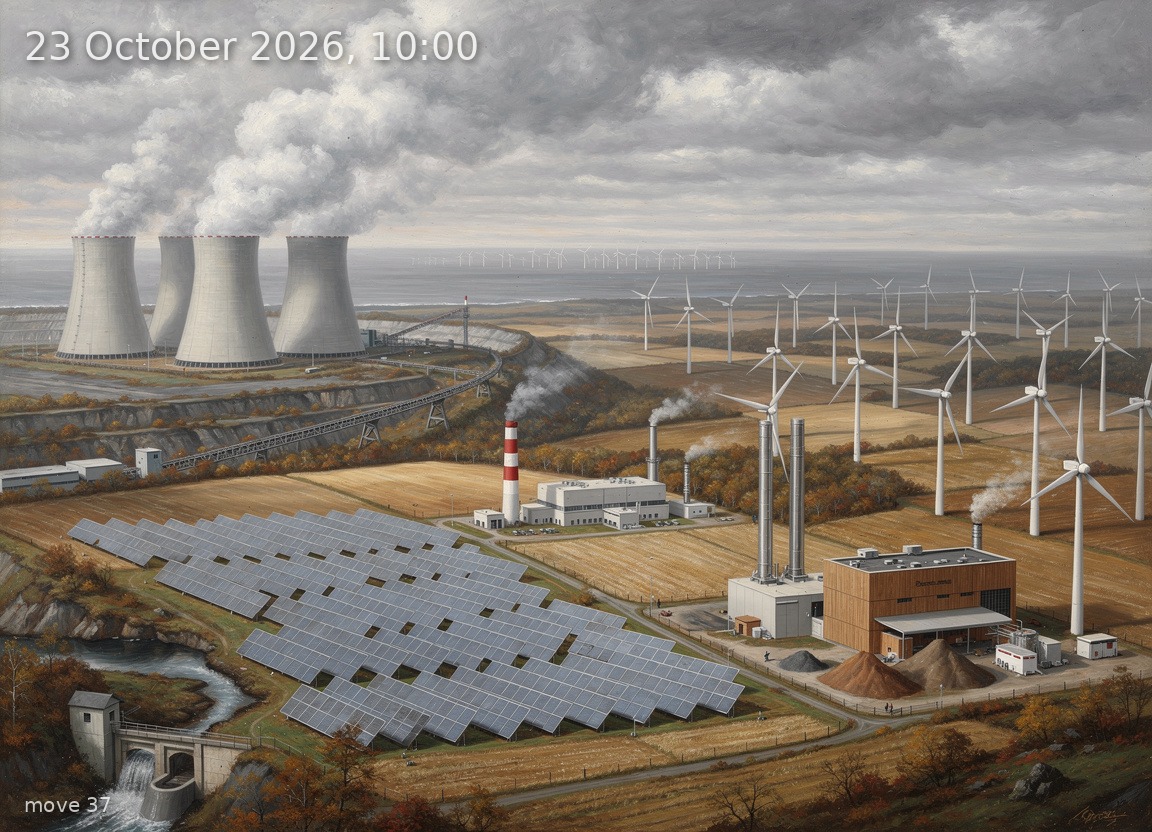
Strong onshore wind leads at 25.9 GW under full overcast, with lignite and gas providing substantial thermal support at elevated prices.
Generation mix
Wind onshore 39%
Wind offshore 9%
Solar 14%
Biomass 6%
Hydro 2%
Natural gas 10%
Hard coal 5%
Brown coal 14%
70%
Renewable share
31.8 GW
Wind (on + offshore)
9.2 GW
Solar
65.7 GW
Total generation
+2.5 GW
Net export
151.2 EUR/MWh
Day-ahead price
10.3°C / 18 km/h
Temp / Wind speed
Open-Meteo, Kassel (51.3°N 9.5°E) · surface estimate from 100 m wind
100.0% / 0.0 W/m²
Cloud cover / Radiation
204
gCO₂/kWh
Image prompt
Wind onshore 25.9 GW dominates the right two-fifths of the scene as vast rows of modern three-blade wind turbines with white tubular towers and detailed nacelles, blades visibly turning in moderate wind, stretching across rolling autumn farmland with faded ochre and brown stubble fields; brown coal 9.2 GW occupies the left quarter as a cluster of massive hyperbolic cooling towers emitting thick white steam plumes that merge into the grey sky, alongside a lignite conveyor belt and ash-grey open-pit edge; solar 9.2 GW appears in the centre-left foreground as an extensive field of aluminium-framed crystalline silicon panels arranged in neat rows, their surfaces dull and reflective under diffuse light, no direct sun whatsoever; natural gas 6.8 GW sits centre-right as two compact CCGT power blocks with slim silver exhaust stacks releasing thin transparent heat shimmer; wind offshore 5.9 GW is visible in the far background as a line of larger turbines on a grey North Sea horizon barely distinguishable from the heavy sky; hard coal 3.4 GW appears as a smaller conventional power station with a single red-and-white striped chimney stack and modest steam; biomass 4.2 GW is rendered as a timber-clad industrial plant with wood chip piles and a low exhaust; hydro 1.1 GW is a small dam structure with spillway nestled in a valley fold at the far left edge. The sky is entirely overcast with a thick, oppressive layer of uniform grey-white stratus clouds — no blue sky visible, no sun disk, no shadows — conveying a heavy, high-price atmosphere. Full mid-morning daylight diffuses evenly, flat and cool at about 10°C, the landscape lit but shadowless. Trees at field edges show late-October foliage in muted amber and rust, some branches bare. The air feels damp and dense. Highly detailed oil painting in the tradition of 19th-century German Romantic landscape painters — rich layered colour, visible confident brushwork, deep atmospheric perspective — rendered with meticulous engineering accuracy for every turbine nacelle, cooling tower curvature, panel frame, and exhaust stack. No text, no labels.