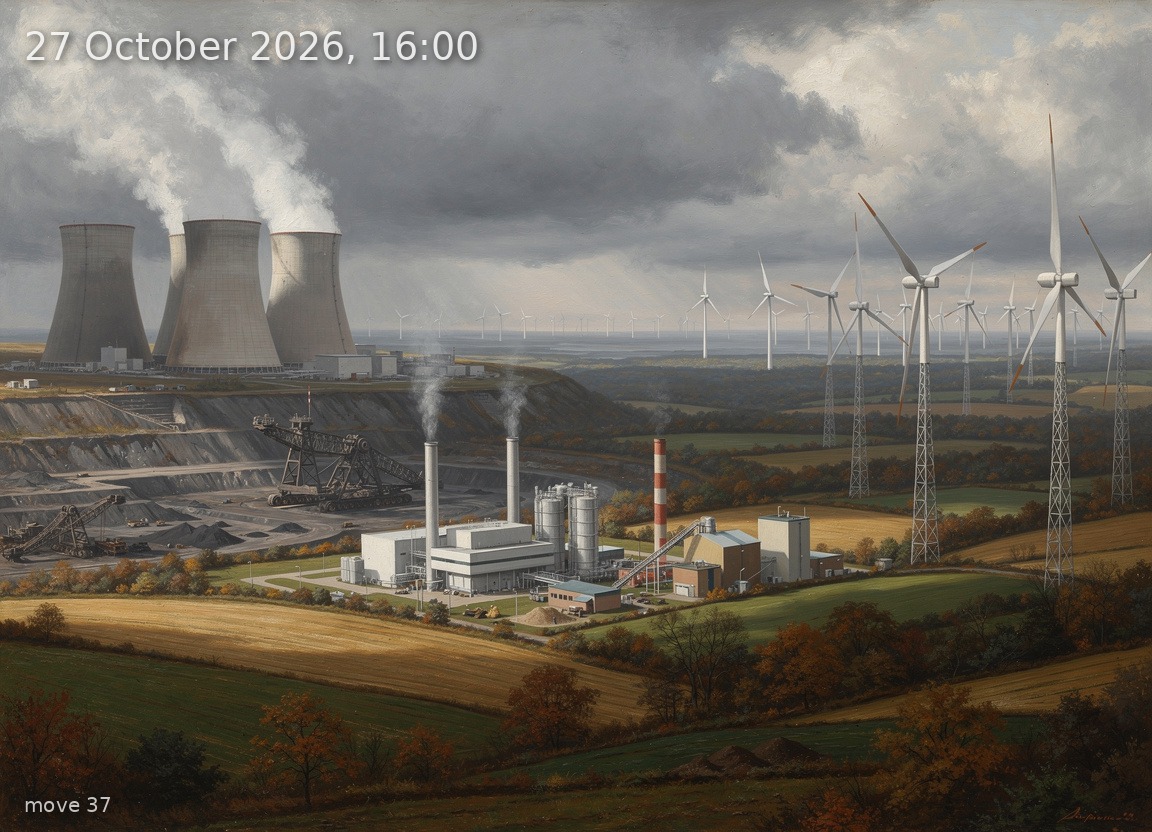
Strong wind leads generation but 11 GW net imports and brown coal baseload drive prices to 225 EUR/MWh under heavy cloud.
Generation mix
Wind onshore 38%
Wind offshore 14%
Solar 6%
Biomass 8%
Hydro 3%
Natural gas 9%
Hard coal 5%
Brown coal 18%
69%
Renewable share
25.2 GW
Wind (on + offshore)
3.2 GW
Solar
48.8 GW
Total generation
10.9 GW
Net import
225.0 EUR/MWh
Day-ahead price
14.2°C / 16 km/h
Temp / Wind speed
Open-Meteo, Kassel (51.3°N 9.5°E) · surface estimate from 100 m wind
80.0% / 17.3 W/m²
Cloud cover / Radiation
223
gCO₂/kWh
Image prompt
Wind onshore 18.5 GW dominates the right half of the scene as dozens of tall three-blade turbines with white lattice towers stretching across rolling autumn hills, blades spinning visibly in moderate wind. Wind offshore 6.7 GW appears as a distant line of turbines on the grey horizon above a sliver of North Sea. Brown coal 8.6 GW fills the left quarter as massive hyperbolic cooling towers emitting thick white steam plumes, beside open lignite pits with excavators. Natural gas 4.2 GW sits in the centre-left as a compact CCGT plant with slender exhaust stacks and thin heat haze. Biomass 4.0 GW is rendered as a cluster of industrial biomass boiler buildings with wood chip conveyors and a single modest smokestack. Solar 3.2 GW appears as a small field of aluminium-framed crystalline silicon panels in the mid-ground, catching almost no light under the overcast sky. Hard coal 2.4 GW shows as a smaller coal plant with a single large stack and coal conveyor belt. Hydro 1.2 GW is a modest dam and spillway nestled in a valley at the far right edge. The sky is late-afternoon October daylight at 16:00 — heavy 80% overcast grey clouds pressing low, diffuse pale light with no visible sun, an oppressive and weighty atmosphere reflecting the high electricity price. The landscape is mid-autumn central German terrain: fields with fading green and yellow-brown stubble, scattered deciduous trees with orange and rust-coloured leaves, temperature around 14°C suggesting damp mild air. Style: a highly detailed oil painting in the tradition of 19th-century German Romantic landscape masters like Caspar David Friedrich — rich, brooding colour palette of slate greys, burnt umber, muted ochre and forest green, visible confident brushwork, atmospheric depth with haze between layers, dramatic scale contrasting human industry with vast clouded sky. Meticulous engineering accuracy on all turbine nacelles, cooling tower geometry, PV panel framing, and gas plant stacks. No text, no labels.