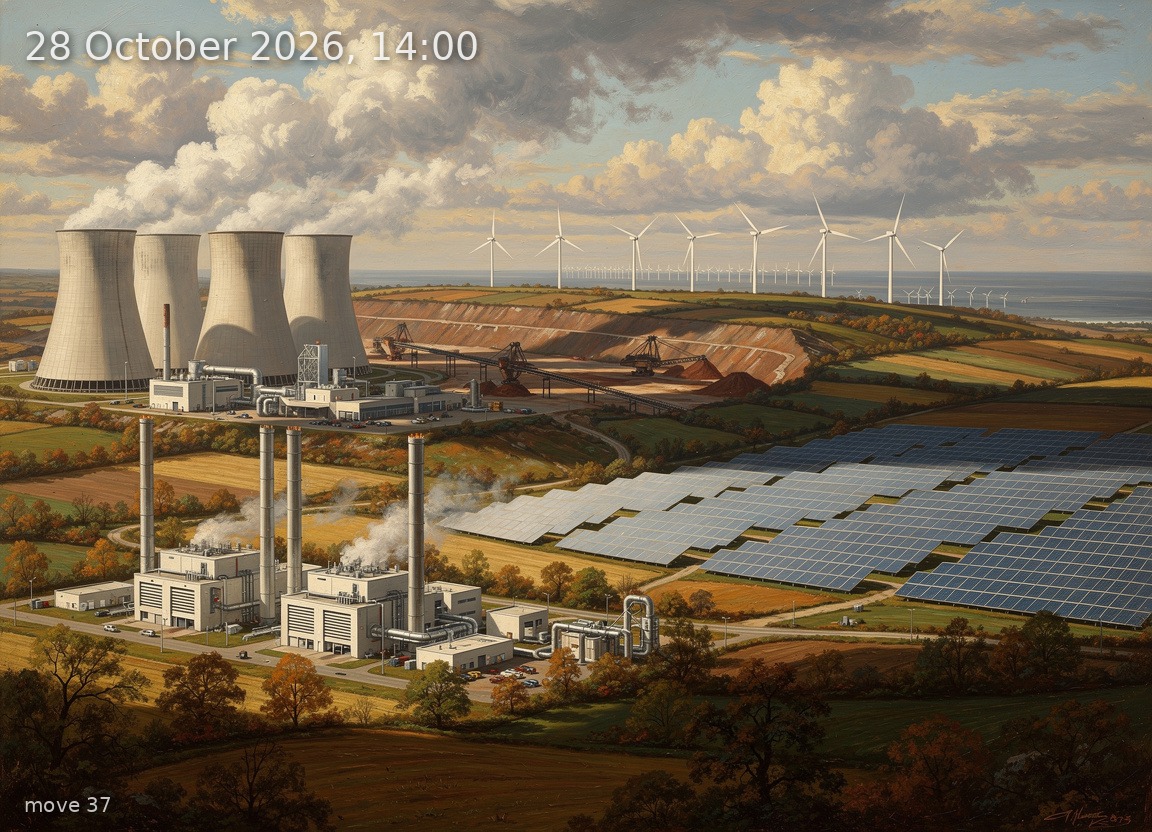
Solar, gas, brown coal, and wind share the load as Germany imports 6.3 GW at elevated prices.
Generation mix
Wind onshore 13%
Wind offshore 8%
Solar 27%
Biomass 7%
Hydro 2%
Natural gas 19%
Hard coal 6%
Brown coal 18%
57%
Renewable share
12.0 GW
Wind (on + offshore)
15.4 GW
Solar
56.4 GW
Total generation
6.3 GW
Net import
190.7 EUR/MWh
Day-ahead price
13.4°C / 10 km/h
Temp / Wind speed
Open-Meteo, Kassel (51.3°N 9.5°E) · surface estimate from 100 m wind
45.0% / 181.8 W/m²
Cloud cover / Radiation
284
gCO₂/kWh
Image prompt
Solar 15.4 GW dominates the right third of the scene as vast fields of aluminium-framed crystalline silicon PV panels stretching across rolling farmland, angled south, catching direct afternoon sunlight through broken clouds. Brown coal 10.0 GW occupies the left quarter as a massive lignite power station with four hyperbolic concrete cooling towers emitting thick white steam plumes, conveyor belts carrying dark brown fuel from an open-pit mine visible in the background. Natural gas 10.7 GW fills the centre-left as a cluster of modern CCGT plants with tall slender exhaust stacks and compact turbine halls, thin heat shimmer rising from their vents. Wind onshore 7.2 GW appears as a line of three-blade turbines on a distant ridge behind the solar fields, rotors turning slowly in light breeze. Wind offshore 4.7 GW is suggested by a row of turbines on the far horizon where land meets a sliver of grey sea. Biomass 4.0 GW shows as a modest wood-chip-fired plant with a single squat smokestack and timber storage yard near the coal station. Hard coal 3.4 GW appears as a smaller coal plant with a pair of rectangular cooling towers beside a rail siding of black coal wagons. Hydro 1.0 GW is a small run-of-river weir with a concrete powerhouse at a stream crossing the middle ground. The lighting is full mid-afternoon October daylight at 14:00 in central Germany: sun at moderate altitude in the south-southwest, casting warm but not intense golden light; 45% cloud cover creates a patchwork of cumulus shadows drifting across the landscape. Autumn foliage — muted amber, russet, fading green — on scattered deciduous trees; temperature around 13°C suggested by figures in light jackets. The atmosphere feels heavy and somewhat oppressive, with a faint industrial haze thickening the air near the thermal plants, reflecting the high electricity price. Overhead high-voltage transmission lines on lattice steel pylons cross the scene, symbolising interconnector flows. Highly detailed oil painting in the tradition of 19th-century German Romantic landscape painters — Caspar David Friedrich meets industrial realism — rich saturated colour palette, visible confident brushwork, deep atmospheric perspective, dramatic cloud formations with shafts of sunlight breaking through, meticulous engineering detail on every turbine nacelle, every panel frame, every cooling tower's parabolic curve. No text, no labels.