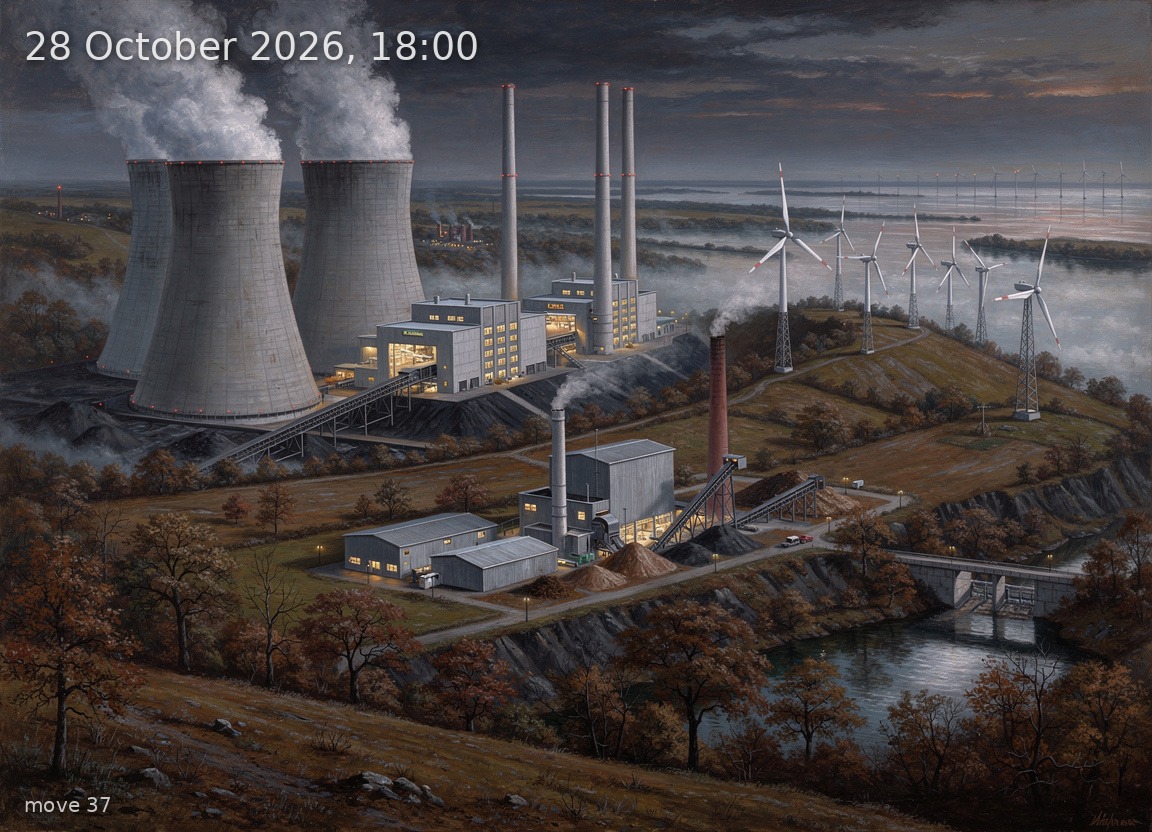
Brown coal, natural gas, and wind dominate generation as 18.9 GW net imports cover the autumn evening peak.
Generation mix
Wind onshore 17%
Wind offshore 11%
Biomass 10%
Hydro 2%
Natural gas 27%
Hard coal 7%
Brown coal 26%
39%
Renewable share
12.5 GW
Wind (on + offshore)
0.0 GW
Solar
45.0 GW
Total generation
18.9 GW
Net import
343.1 EUR/MWh
Day-ahead price
9.9°C / 3 km/h
Temp / Wind speed
Open-Meteo, Kassel (51.3°N 9.5°E) · surface estimate from 100 m wind
19.0% / 0.0 W/m²
Cloud cover / Radiation
403
gCO₂/kWh
Image prompt
Brown coal 11.8 GW dominates the left third of the scene as a massive lignite power station with four hyperbolic cooling towers emitting thick white-grey steam plumes; natural gas 12.2 GW fills the centre-left as a cluster of modern CCGT plants with tall slender exhaust stacks and visible heat shimmer; wind onshore 7.6 GW stretches across the centre-right as rows of three-blade turbines on lattice and tubular towers turning slowly in near-still air; wind offshore 4.9 GW appears in the far right distance as a line of turbines on the hazy horizon beyond a river estuary; biomass 4.3 GW is rendered as a mid-ground industrial wood-chip plant with a single smokestack and conveyor belts feeding fuel; hard coal 3.3 GW appears as a smaller coal station with a pair of chimneys trailing smoke behind the lignite complex; hydro 0.9 GW is a modest dam structure visible in a valley fold at far right. The scene is set at dusk in late October — the sky above is deepening to dark blue-grey, with only a thin band of fading orange-red glow along the low western horizon. No sunshine, no solar panels anywhere. The landscape is autumnal central German rolling hills with sparse deciduous trees showing brown and amber leaves, some bare branches, damp meadows at roughly 10°C. The atmosphere is heavy and oppressive, conveying the extreme electricity price — a brooding, dense quality to the air with low haze clinging to the industrial structures. Overhead transmission lines with steel lattice pylons run across the scene suggesting massive power imports. Stars are just beginning to appear in the upper sky. Rendered as a highly detailed oil painting in the tradition of 19th-century German Romantic landscape art — rich impasto brushwork, dramatic chiaroscuro lighting from the glowing industrial facilities against the darkening sky, atmospheric perspective with receding depth. Every technology is painted with meticulous engineering accuracy: turbine nacelles and three-blade rotors, aluminium-bodied CCGT modules, hyperbolic concrete cooling towers with internal condensation visible, steel conveyor structures. The painting evokes Caspar David Friedrich meeting industrial sublime. No text, no labels.