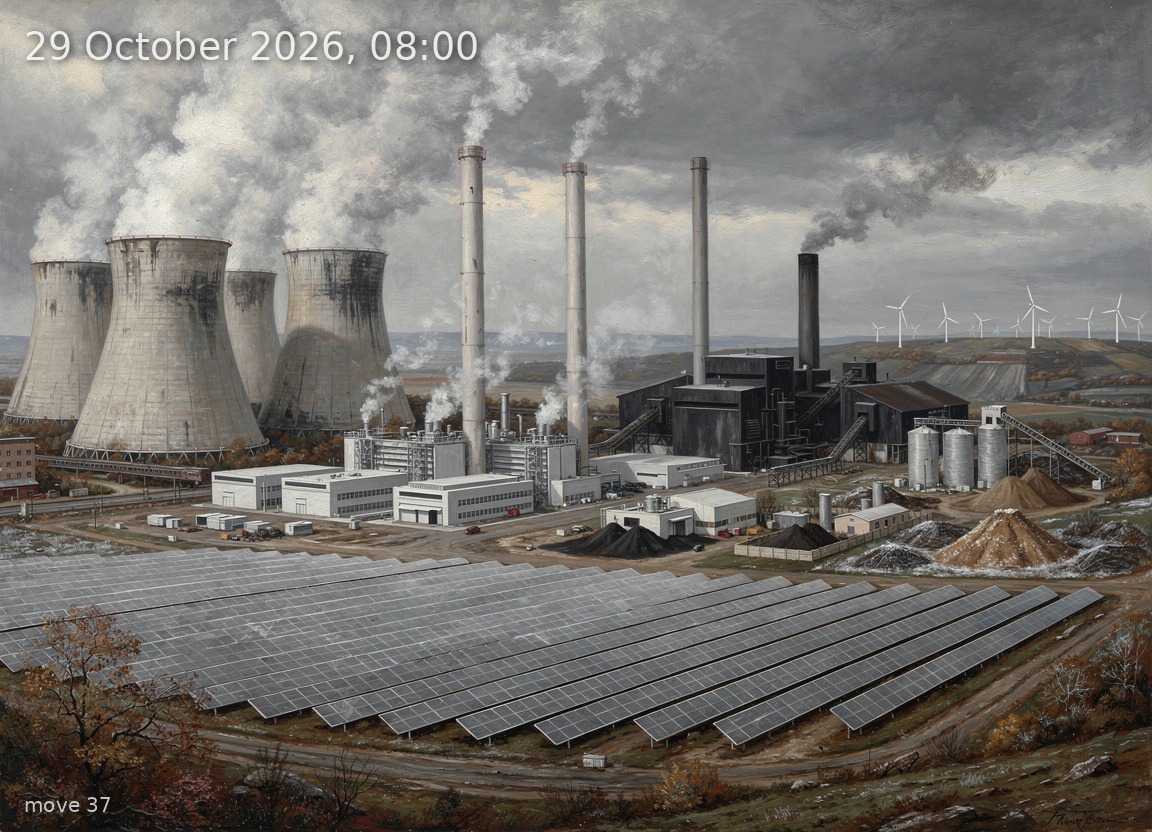
Brown coal, gas, and hard coal dominate as weak wind and overcast skies drive heavy imports and extreme prices.
Generation mix
Wind onshore 7%
Wind offshore 1%
Solar 16%
Biomass 10%
Hydro 2%
Natural gas 25%
Hard coal 10%
Brown coal 29%
36%
Renewable share
3.6 GW
Wind (on + offshore)
6.7 GW
Solar
43.1 GW
Total generation
20.2 GW
Net import
381.9 EUR/MWh
Day-ahead price
4.6°C / 8 km/h
Temp / Wind speed
Open-Meteo, Kassel (51.3°N 9.5°E) · surface estimate from 100 m wind
100.0% / 0.0 W/m²
Cloud cover / Radiation
435
gCO₂/kWh
Image prompt
Brown coal 12.5 GW dominates the left third of the scene as a vast complex of hyperbolic cooling towers with thick white-grey steam plumes merging into the overcast sky; natural gas 10.8 GW fills the centre-left as a row of compact CCGT plants with tall single exhaust stacks trailing heat shimmer; hard coal 4.2 GW appears centre-right as a dark industrial block with conveyor belts and a broad smokestack; solar 6.7 GW is represented in the mid-ground as large fields of aluminium-framed crystalline silicon PV panels reflecting only the flat grey light, no sunshine visible; biomass 4.1 GW appears as a cluster of smaller wood-chip-fed power stations with squat chimneys and woodchip piles; wind onshore 3.1 GW is shown as a sparse line of three-blade turbines on a distant ridge, rotors barely turning in the still air; wind offshore 0.5 GW appears as faint turbine silhouettes on the far horizon; hydro 1.0 GW is a small dam structure with modest water flow at the far right edge. The sky is entirely overcast with a heavy, oppressive ceiling of low stratocumulus clouds in shades of slate grey and pewter — no blue sky, no sun breaking through, no shadows on the ground. Morning daylight at 08:00 in late October: diffuse, cold, pale illumination with no directional sunlight. The landscape is late-autumn central German — bare deciduous trees with last brown leaves clinging, frost-touched stubble fields, muted brown and grey-green tones. Temperature near freezing is suggested by frost on metal railings, condensation, and the workers' visible breath. High-voltage transmission pylons march across the background carrying heavy cables, emphasising the massive import flows. The atmosphere feels heavy and weighty, befitting the extreme electricity price. Style: highly detailed oil painting in the tradition of 19th-century German Romantic landscape painting — rich impasto brushwork, atmospheric sfumato depth, dramatic tonal contrasts — yet with meticulous engineering accuracy on every turbine nacelle, cooling tower hyperbolic curve, PV panel frame, and exhaust stack. No text, no labels.