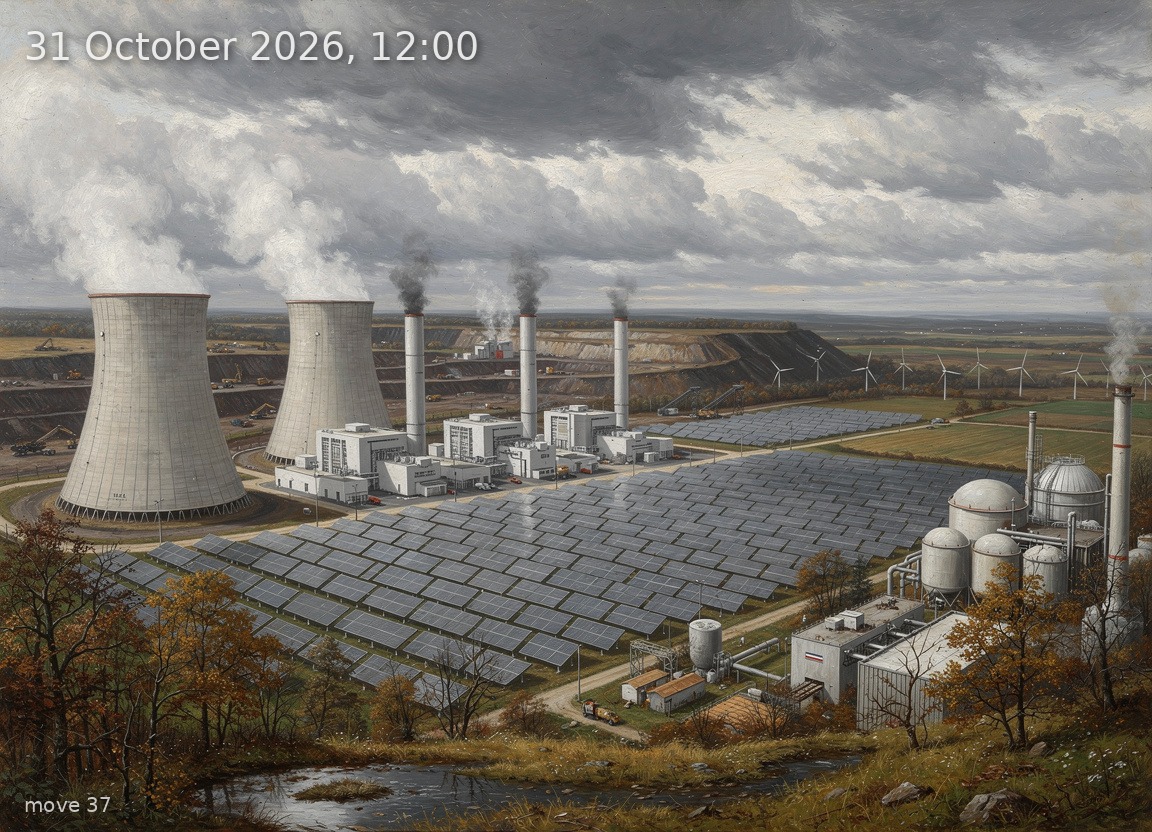
Gas, brown coal, and muted solar dominate under near-total overcast with minimal wind, driving elevated prices.
Generation mix
Wind onshore 4%
Wind offshore 0%
Solar 34%
Biomass 8%
Hydro 2%
Natural gas 22%
Hard coal 8%
Brown coal 22%
48%
Renewable share
2.3 GW
Wind (on + offshore)
18.1 GW
Solar
53.1 GW
Total generation
0.9 GW
Net import
220.2 EUR/MWh
Day-ahead price
8.7°C / 6 km/h
Temp / Wind speed
Open-Meteo, Kassel (51.3°N 9.5°E) · surface estimate from 100 m wind
99.0% / 11.0 W/m²
Cloud cover / Radiation
344
gCO₂/kWh
Image prompt
Solar 18.1 GW occupies the centre-right as vast fields of aluminium-framed crystalline silicon PV panels stretching across flat farmland, their surfaces dull and reflecting only grey light; natural gas 11.8 GW fills the centre-left as a cluster of compact CCGT power stations with tall single exhaust stacks emitting pale heat shimmer; brown coal 11.6 GW dominates the far left as massive hyperbolic concrete cooling towers with thick white steam plumes rising heavily into still air, alongside open-pit mine terraces visible behind; hard coal 4.0 GW appears as a smaller conventional power station with twin stacks and darker smoke between the gas and lignite plants; biomass 4.2 GW is rendered as a mid-sized industrial facility with rounded fuel silos and a single modest smokestack on the right edge; wind onshore 2.2 GW shows as a sparse handful of three-blade turbines on distant hills, rotors barely turning; hydro 1.1 GW appears as a small concrete dam with a sliver of water spilling, tucked in a valley at far right. The sky is entirely blanketed in heavy, oppressive, low-hanging stratiform cloud at noon — full diffuse daylight but no direct sun, no shadows, a flat milky-white ceiling pressing down. The atmosphere feels thick and weighty, matching the 220 EUR/MWh price. Autumn landscape: bare deciduous trees with last brown-orange leaves clinging to branches, faded grass, 8–9°C chill implied by frost-tinged edges on puddles. Air is dead still — no motion in flags or vegetation. Painted in the style of a highly detailed 19th-century German Romantic oil painting — rich, sombre colour palette of slate greys, ochres, and muted greens, visible impasto brushwork, atmospheric aerial perspective fading distant cooling towers into haze — yet every piece of energy infrastructure rendered with meticulous engineering accuracy: turbine nacelles, lattice towers, panel junction boxes, cooling tower ribbed concrete. No text, no labels.