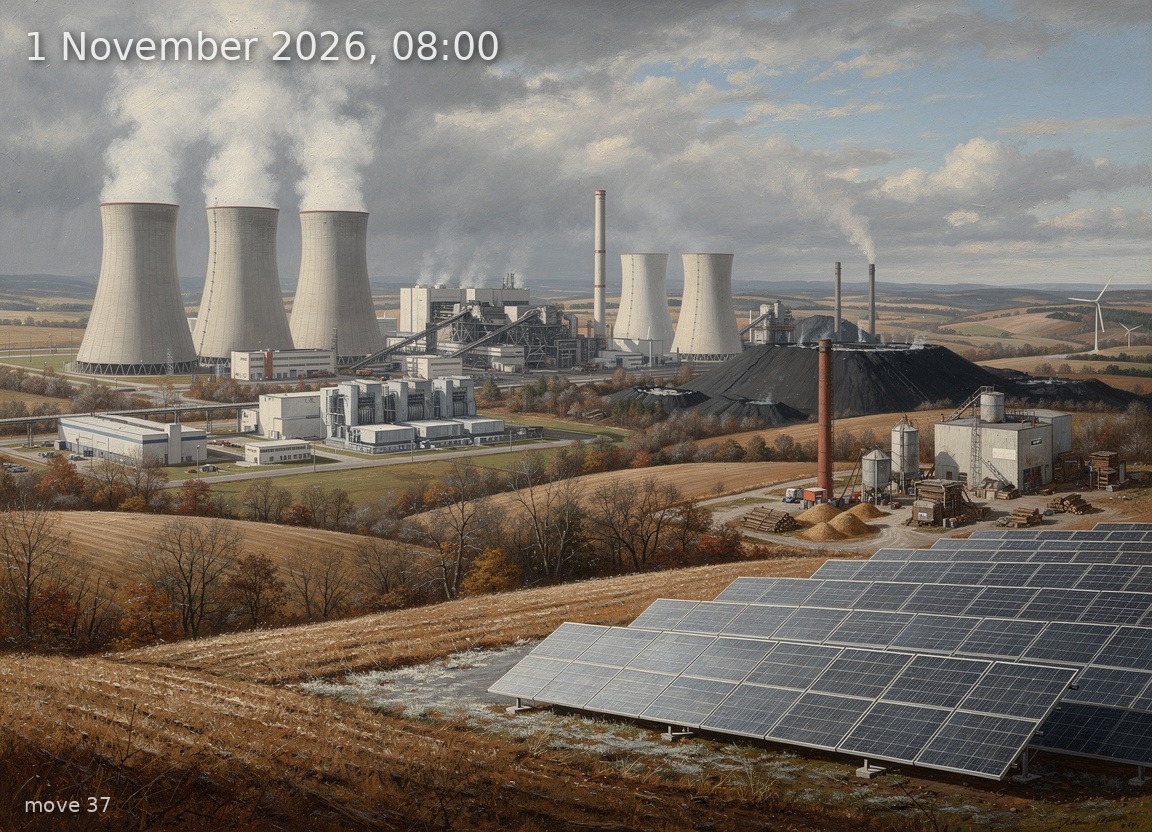
Brown coal and natural gas dominate generation while weak wind and tight supply drive 247 EUR/MWh prices and 6.7 GW net imports.
Generation mix
Wind onshore 6%
Wind offshore 0%
Solar 12%
Biomass 10%
Hydro 2%
Natural gas 30%
Hard coal 11%
Brown coal 28%
32%
Renewable share
2.7 GW
Wind (on + offshore)
5.0 GW
Solar
40.6 GW
Total generation
6.8 GW
Net import
247.4 EUR/MWh
Day-ahead price
6.7°C / 8 km/h
Temp / Wind speed
Open-Meteo, Kassel (51.3°N 9.5°E) · surface estimate from 100 m wind
35.0% / 2.5 W/m²
Cloud cover / Radiation
454
gCO₂/kWh
Image prompt
Brown coal 11.3 GW dominates the left third of the scene as a massive lignite power station complex with four hyperbolic cooling towers emitting thick white steam plumes; natural gas 12.0 GW fills the centre-left as a row of modern CCGT plants with tall single exhaust stacks and visible heat shimmer; hard coal 4.3 GW appears centre-right as a smaller conventional coal plant with stockpile and two shorter cooling towers; biomass 4.2 GW is rendered as a cluster of wood-chip-fed CHP facilities with modest chimneys and timber storage yards at the right-centre; solar 5.0 GW occupies the right foreground as extensive fields of aluminium-framed crystalline silicon PV panels catching diffuse grey-blue light under partly cloudy skies; wind onshore 2.6 GW appears as a sparse line of slow-turning three-blade turbines on lattice towers along a distant ridge, barely rotating; hydro 0.9 GW is a small run-of-river weir glimpsed in a river in the far background. Time is 08:00 on a November morning: full but muted daylight, the sun low in the east behind thin clouds, casting weak pale light across the landscape with soft shadows. Sky is roughly 35% covered by mid-level clouds with patches of pale blue, but the overall atmosphere feels heavy, oppressive, and brooding — reflecting an extremely high electricity price. The landscape is late-autumn central German rolling terrain with bare deciduous trees, brown stubble fields, and patches of frost on grass at 6.7°C. Air is still, very little wind motion in vegetation. Rendered as a highly detailed oil painting in the tradition of 19th-century German Romantic landscape masters — rich earth tones, visible impasto brushwork, dramatic atmospheric depth and chiaroscuro, meticulous engineering accuracy on every turbine nacelle, cooling tower hyperbolic curve, PV panel frame, and exhaust stack. Industrial sublime grandeur. No text, no labels.