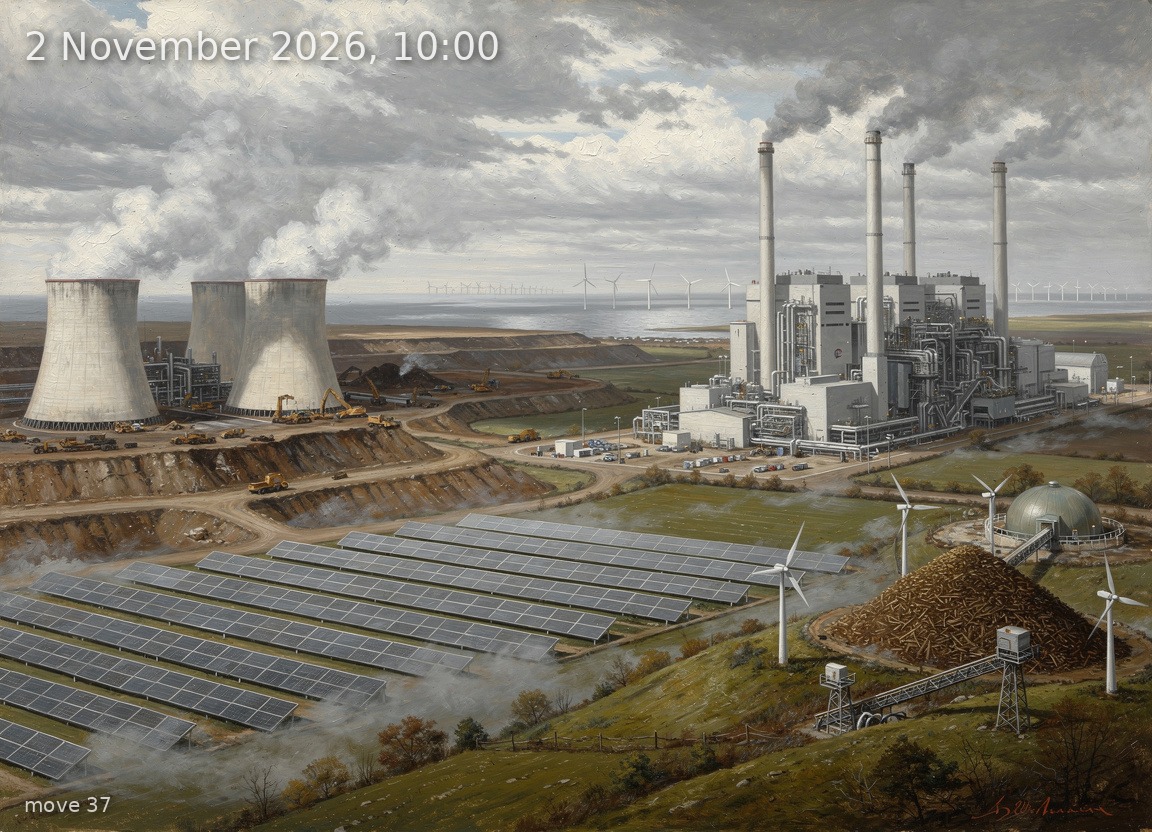
Gas, brown coal, and diffuse solar dominate as calm winds and cold weather tighten the supply-demand balance.
Generation mix
Wind onshore 3%
Wind offshore 8%
Solar 28%
Biomass 8%
Hydro 1%
Natural gas 23%
Hard coal 7%
Brown coal 22%
49%
Renewable share
6.7 GW
Wind (on + offshore)
16.5 GW
Solar
58.0 GW
Total generation
6.8 GW
Net import
243.6 EUR/MWh
Day-ahead price
5.2°C / 1 km/h
Temp / Wind speed
Open-Meteo, Kassel (51.3°N 9.5°E) · surface estimate from 100 m wind
94.0% / 10.8 W/m²
Cloud cover / Radiation
338
gCO₂/kWh
Image prompt
Natural gas 13.1 GW dominates the centre-right as a cluster of modern CCGT power stations with tall single exhaust stacks venting pale plumes; brown coal 12.5 GW occupies the left third as massive hyperbolic cooling towers emitting thick white steam columns beside open-pit lignite mines with exposed brown earth; solar 16.5 GW appears across the mid-ground as vast fields of aluminium-framed crystalline silicon PV panels stretching across gently rolling farmland, their surfaces dull and matte under heavy overcast with no sun glint; wind offshore 4.8 GW is visible in the far distance as a line of three-blade turbines standing in a grey North Sea barely turning; wind onshore 1.9 GW shows as a small cluster of lattice-tower turbines on a low hill, rotors nearly motionless; biomass 4.4 GW appears as a mid-sized industrial plant with a wood-chip storage dome and a modest smokestack; hard coal 3.8 GW sits as a coal-fired station with conveyor belts and a single large stack; hydro 0.9 GW is a small dam and powerhouse nestled in a wooded valley at the far right edge. The sky is 94% overcast, a heavy oppressive blanket of uniform grey-white stratus pressing low, allowing only faint diffuse daylight at 10:00 AM — no sun disc visible, no shadows, flat illumination. Temperature is 5.2°C: bare deciduous trees, frost-tinged brown grass, late-autumn barren fields. The atmosphere feels weighty and close, haze mingling with industrial steam, conveying the tension of a high-price hour. Highly detailed oil painting in the tradition of 19th-century German Romantic landscape painters — Caspar David Friedrich meets industrial sublime — rich muted earth tones, ochre, slate grey, and dull olive, visible impasto brushwork, atmospheric depth with layers of mist between foreground infrastructure and distant horizon. Meticulous engineering detail on every turbine nacelle, cooling tower, PV module frame, and exhaust stack. No text, no labels.