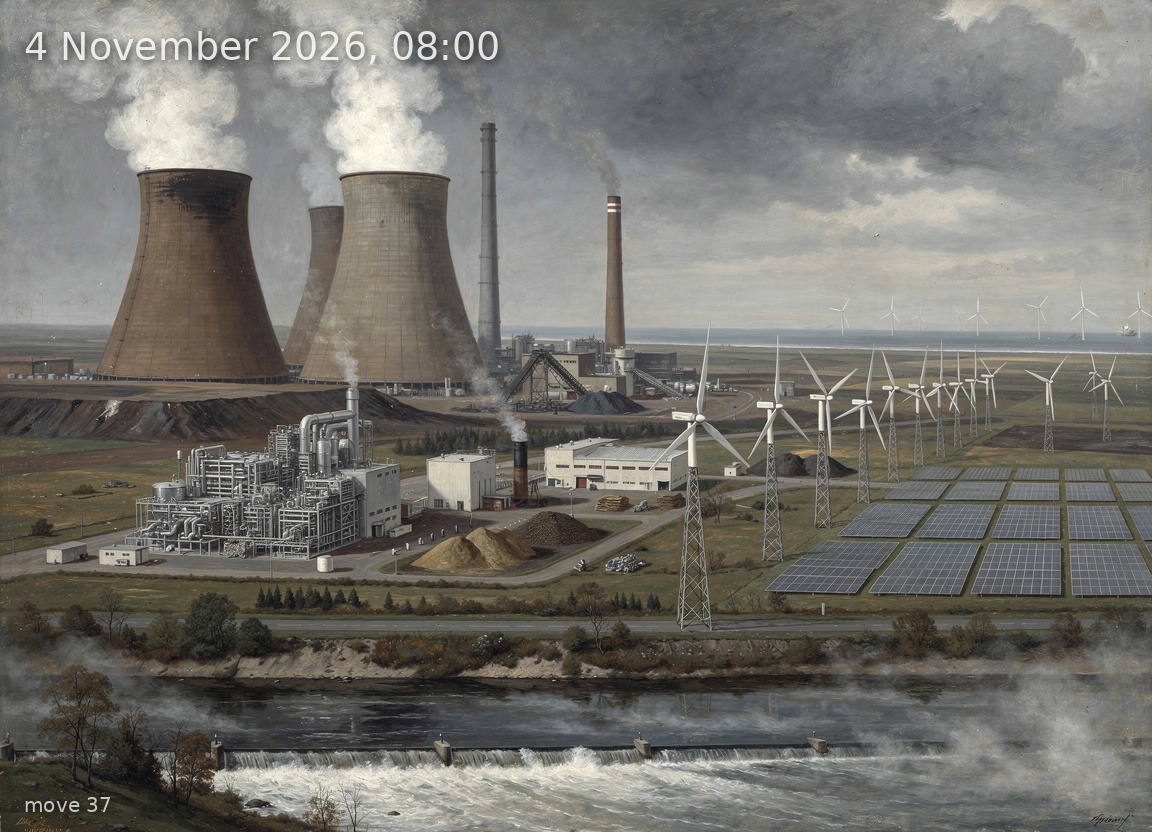
Gas, brown coal, and onshore wind dominate as full overcast, cold temperatures, and 10.3 GW net imports drive prices near 300 EUR/MWh.
Generation mix
Wind onshore 26%
Wind offshore 2%
Solar 9%
Biomass 8%
Hydro 2%
Natural gas 24%
Hard coal 8%
Brown coal 21%
47%
Renewable share
15.0 GW
Wind (on + offshore)
5.0 GW
Solar
53.9 GW
Total generation
10.3 GW
Net import
299.9 EUR/MWh
Day-ahead price
6.1°C / 12 km/h
Temp / Wind speed
Open-Meteo, Kassel (51.3°N 9.5°E) · surface estimate from 100 m wind
100.0% / 0.3 W/m²
Cloud cover / Radiation
352
gCO₂/kWh
Image prompt
Brown coal 11.6 GW occupies the left quarter as a massive lignite power station with four hyperbolic cooling towers emitting thick white steam plumes into a heavy grey sky; natural gas 12.9 GW fills the centre-left as a sprawling CCGT complex with tall slender exhaust stacks venting thin heat shimmer; hard coal 4.2 GW appears behind the gas plant as a smaller conventional station with a single large smokestack and coal conveyor; wind onshore 13.9 GW spans the entire right half of the composition as dozens of three-blade turbines on lattice and tubular towers stretching across a flat North German plain, blades turning moderately in the wind; wind offshore 1.1 GW is suggested by a few distant turbines on the far-right horizon above a grey sea sliver; solar 5.0 GW appears as a field of aluminium-framed crystalline silicon panels in the mid-ground, their surfaces reflecting only dull grey light, generating weakly; biomass 4.2 GW is a modest wood-chip-fed plant with a low industrial building and single chimney emitting pale smoke near the centre; hydro 1.0 GW is a small run-of-river weir visible along a dark river in the foreground. The time is 8:00 AM on a November morning—full daylight but deeply overcast with 100% cloud cover, a uniformly iron-grey sky pressing low, no direct sunlight anywhere, diffuse flat illumination. Temperature is 6°C: bare deciduous trees, brown and withered grass, patches of frost on the ground, a raw chill implied by mist clinging to the river. The atmosphere feels heavy, oppressive, and costly, reflecting the extreme electricity price. Rendered as a highly detailed oil painting in the tradition of 19th-century German Romantic landscape painting—rich sombre colour palette of slate greys, umber browns, and muted olive greens, visible textured brushwork, atmospheric depth with haze softening distant turbines, dramatic chiaroscuro from the industrial steam against the dark sky. Every technology rendered with meticulous engineering accuracy: three-blade rotor nacelles, cooling tower parabolic profiles, CCGT heat-recovery units. No text, no labels.