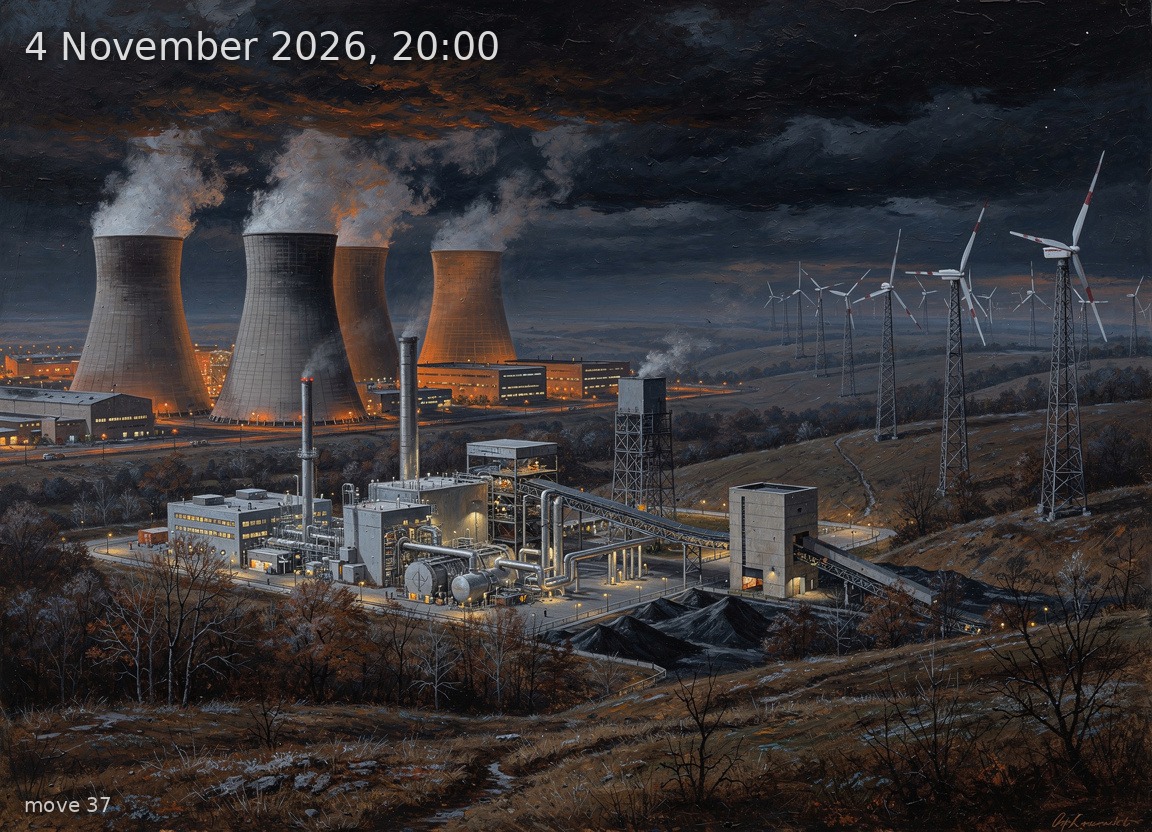
Wind and coal-gas thermal fleets share the load equally on a dark, cold November evening with elevated prices.
Generation mix
Wind onshore 33%
Wind offshore 5%
Biomass 8%
Hydro 2%
Natural gas 23%
Hard coal 9%
Brown coal 20%
47%
Renewable share
22.2 GW
Wind (on + offshore)
0.0 GW
Solar
58.6 GW
Total generation
2.9 GW
Net import
268.9 EUR/MWh
Day-ahead price
6.9°C / 14 km/h
Temp / Wind speed
Open-Meteo, Kassel (51.3°N 9.5°E) · surface estimate from 100 m wind
93.0% / 0.0 W/m²
Cloud cover / Radiation
349
gCO₂/kWh
Image prompt
Wind onshore 19.5 GW dominates the right half of the scene as dozens of tall three-blade turbines on lattice towers stretching across rolling hills into the distance, blades visibly turning in moderate wind. Brown coal 11.9 GW occupies the left third as a massive lignite power station with four hyperbolic cooling towers emitting thick white steam plumes lit from below by orange sodium lights. Natural gas 13.6 GW fills the centre-left as a cluster of compact CCGT units with tall single exhaust stacks venting thin heat shimmer, surrounded by illuminated industrial piping. Hard coal 5.4 GW appears as a smaller conventional power station with a single square cooling tower and coal conveyors, positioned between the gas plant and the lignite station. Biomass 4.7 GW is rendered as a mid-sized wood-chip burning facility with a modest stack and warm amber glow from its building windows, nestled at the base of the turbine-covered hills. Hydro 0.9 GW is a small run-of-river weir visible in the foreground along a dark river reflecting the industrial lights. Wind offshore 2.7 GW appears as a faint cluster of red aviation warning lights on the far horizon, suggesting turbines far out at sea. Time is 20:00 in November: the sky is completely black to deep navy, no twilight glow whatsoever, no moon visible, heavy 93% cloud cover creating an oppressive low overcast ceiling faintly illuminated by the orange industrial glow below. Temperature is near 7°C: late-autumn bare deciduous trees, brown dead grass, patches of frost on the ground. The atmosphere feels heavy and pressing, reflecting the high electricity price — the clouds seem to weigh down on the industrial landscape. Sodium-vapor streetlights cast pools of amber along a road in the foreground. Style: highly detailed oil painting in the tradition of 19th-century German Romantic landscape painting — rich, dark palette of deep blues, blacks, warm oranges and ambers, visible impasto brushwork, atmospheric depth with industrial haze, meticulous engineering detail on each turbine nacelle, cooling tower curvature, and CCGT exhaust geometry. The scene evokes Caspar David Friedrich's sublime darkness combined with precise industrial realism. No text, no labels.