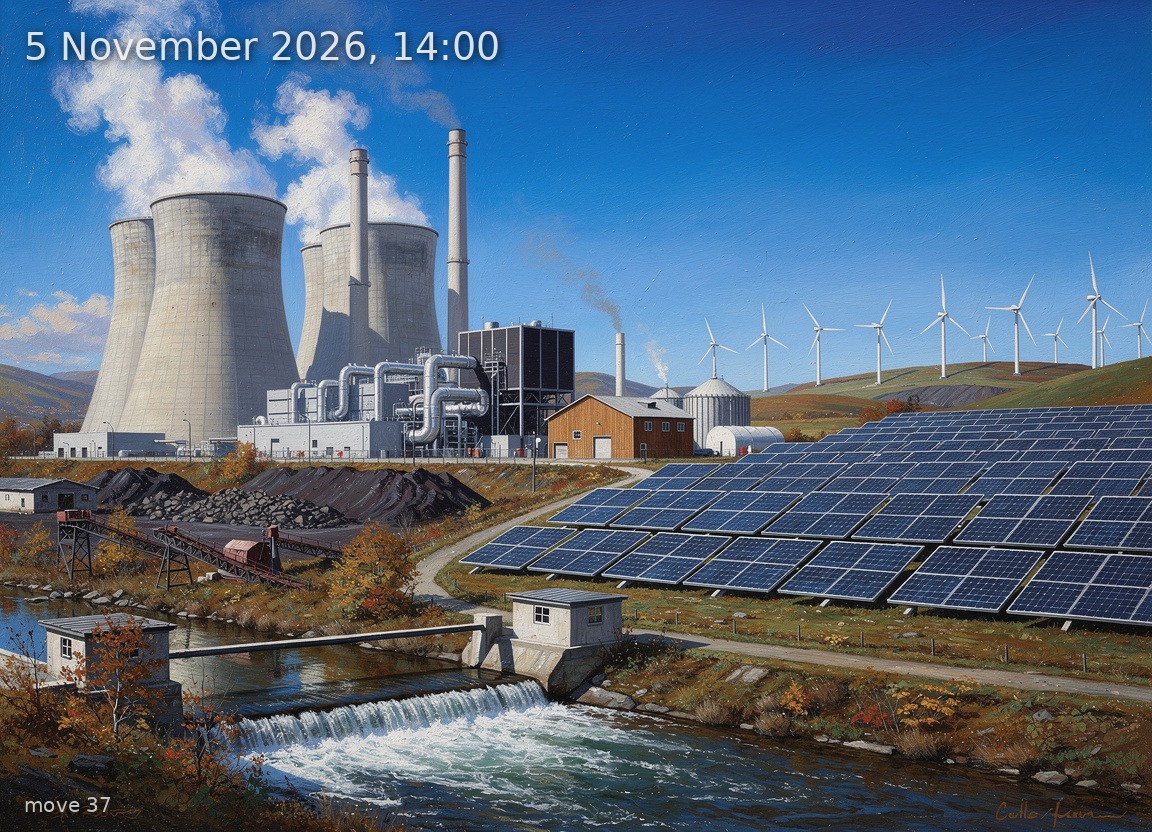
Solar leads at 20 GW under clear skies, but gas and lignite remain heavily dispatched amid tight supply and high prices.
Generation mix
Wind onshore 12%
Wind offshore 4%
Solar 33%
Biomass 7%
Hydro 2%
Natural gas 19%
Hard coal 6%
Brown coal 16%
58%
Renewable share
10.0 GW
Wind (on + offshore)
20.1 GW
Solar
60.9 GW
Total generation
1.7 GW
Net import
228.1 EUR/MWh
Day-ahead price
10.6°C / 8 km/h
Temp / Wind speed
Open-Meteo, Kassel (51.3°N 9.5°E) · surface estimate from 100 m wind
0.0% / 227.5 W/m²
Cloud cover / Radiation
276
gCO₂/kWh
Image prompt
Solar 20.1 GW dominates the right half of the scene as vast fields of aluminium-framed crystalline silicon photovoltaic panels gleaming under a brilliant, cloudless midday autumn sun, their blue-black surfaces reflecting sharp highlights. Brown coal 9.8 GW occupies the far left as a cluster of massive hyperbolic concrete cooling towers with thick white steam plumes rising vertically in the still air, flanked by conveyor belts carrying dark lignite. Natural gas 11.8 GW fills the left-centre as several modern combined-cycle gas turbine plants with tall slender exhaust stacks emitting thin heat shimmer. Hard coal 3.9 GW appears as a smaller coal-fired station with a single rectangular boiler house and chimney releasing a faint grey plume. Wind onshore 7.5 GW is rendered as a line of three-blade turbines on gentle hills in the centre-right middle distance, their rotors turning slowly in light wind. Wind offshore 2.4 GW appears as a small cluster of turbines visible on a far hazy horizon suggesting the North Sea coast. Biomass 4.2 GW is a modest wood-clad industrial facility with a short stack and pale vapour near the centre. Hydro 1.0 GW is a small concrete run-of-river weir and powerhouse nestled along a river in the foreground. The sky is completely clear, deep cerulean blue, with full bright November midday sunlight casting short, crisp shadows. Vegetation is late-autumn: bare deciduous trees with a few remaining brown and amber leaves, pale dry grass, muted green conifers on distant ridges. The atmosphere feels heavy and oppressive despite the clear sky — a faint amber-brown industrial haze clings at the horizon, evoking the strain of high electricity prices. Rendered as a highly detailed oil painting in the tradition of 19th-century German Romantic landscape painters such as Caspar David Friedrich and Carl Blechen — rich impasto colour, visible confident brushwork, dramatic atmospheric depth and luminous sky treatment — but with meticulous engineering accuracy in every turbine nacelle, every cooling tower's parabolic curve, every PV module's gridlines. No text, no labels.