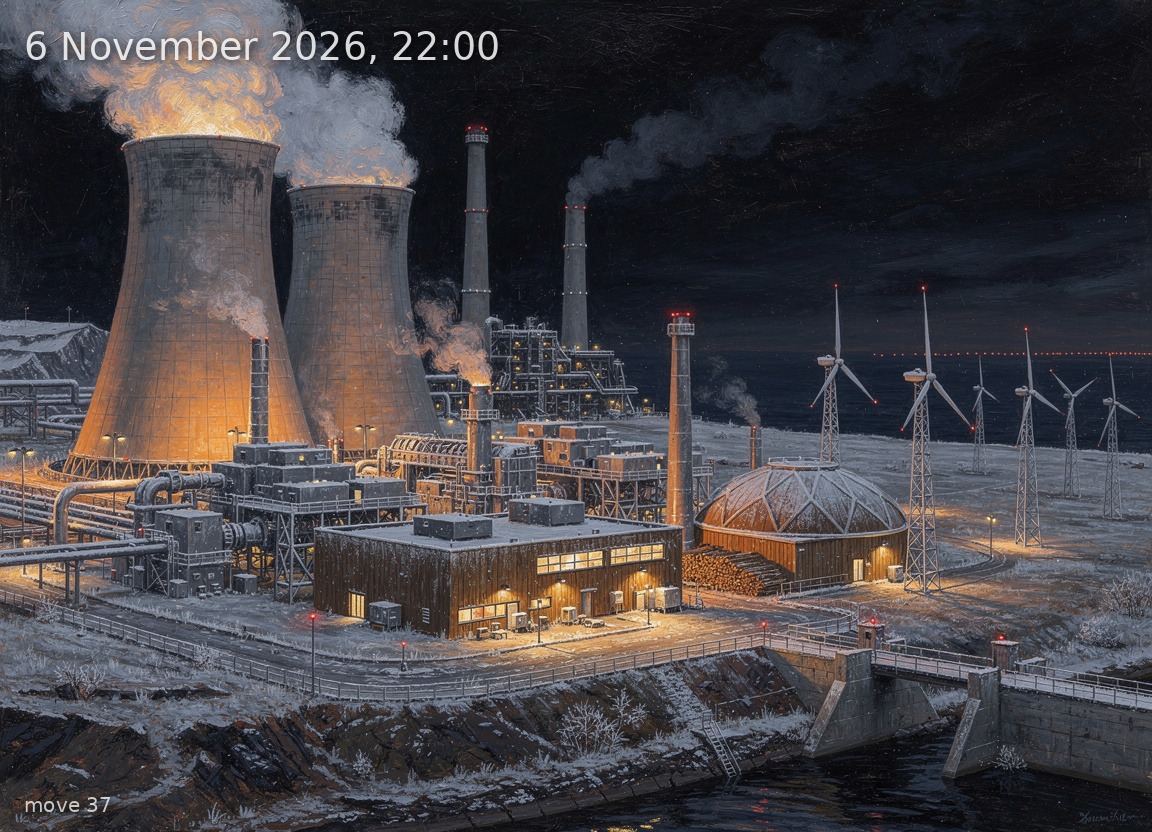
Gas, brown coal, and wind anchor a cold November night as tight supply margins push prices to 276 EUR/MWh.
Generation mix
Wind onshore 23%
Wind offshore 6%
Biomass 9%
Hydro 2%
Natural gas 30%
Hard coal 9%
Brown coal 22%
39%
Renewable share
15.5 GW
Wind (on + offshore)
0.0 GW
Solar
53.3 GW
Total generation
0.9 GW
Net import
276.0 EUR/MWh
Day-ahead price
1.3°C / 1 km/h
Temp / Wind speed
Open-Meteo, Kassel (51.3°N 9.5°E) · surface estimate from 100 m wind
63.0% / 0.0 W/m²
Cloud cover / Radiation
392
gCO₂/kWh
Image prompt
Natural gas 15.9 GW dominates the centre of the composition as a sprawling complex of compact CCGT units with tall single exhaust stacks venting hot plumes into the frigid air, lit from below by sodium-orange industrial floodlights; brown coal 11.5 GW occupies the left third as massive hyperbolic cooling towers with thick white steam columns rising against a pitch-black sky, the towers' concrete surfaces faintly amber-lit by ground-level lights; hard coal 4.9 GW appears as a smaller coal-fired station behind the lignite plant, its single smokestack trailing grey exhaust; wind onshore 12.2 GW spans the right quarter as a receding line of three-blade turbines on lattice towers, their red aviation warning lights blinking against the darkness, rotors turning slowly; wind offshore 3.3 GW is suggested on the far right horizon as a faint cluster of red dots over an invisible sea; biomass 4.6 GW is rendered as a mid-ground timber-clad CHP plant with a modest chimney and a woodchip storage dome, warmly lit from within; hydro 0.9 GW appears as a small dam structure in the lower right with a sliver of dark water reflecting industrial light. The sky is completely black, deep navy at best, with no twilight, no moon — only 63% cloud cover dimly visible where steam plumes backlight them. The landscape is a flat late-autumn German plain, leafless birch and oak trees framing the foreground, frost glinting on dormant brown grass. The atmosphere is heavy and oppressive, suggesting expensive energy — haze and industrial steam create a thick, pressing canopy. Temperature near freezing is conveyed by visible breath-like condensation from the cooling towers and frost on metal railings. Highly detailed oil painting in the tradition of 19th-century German Romantic landscape painters — Caspar David Friedrich meets industrial sublime — rich colour palette of deep navy, burnt orange, ash grey, and coal black, visible impasto brushwork, atmospheric depth and chiaroscuro, meticulous engineering detail on every turbine nacelle, cooling tower, and exhaust stack. No text, no labels.