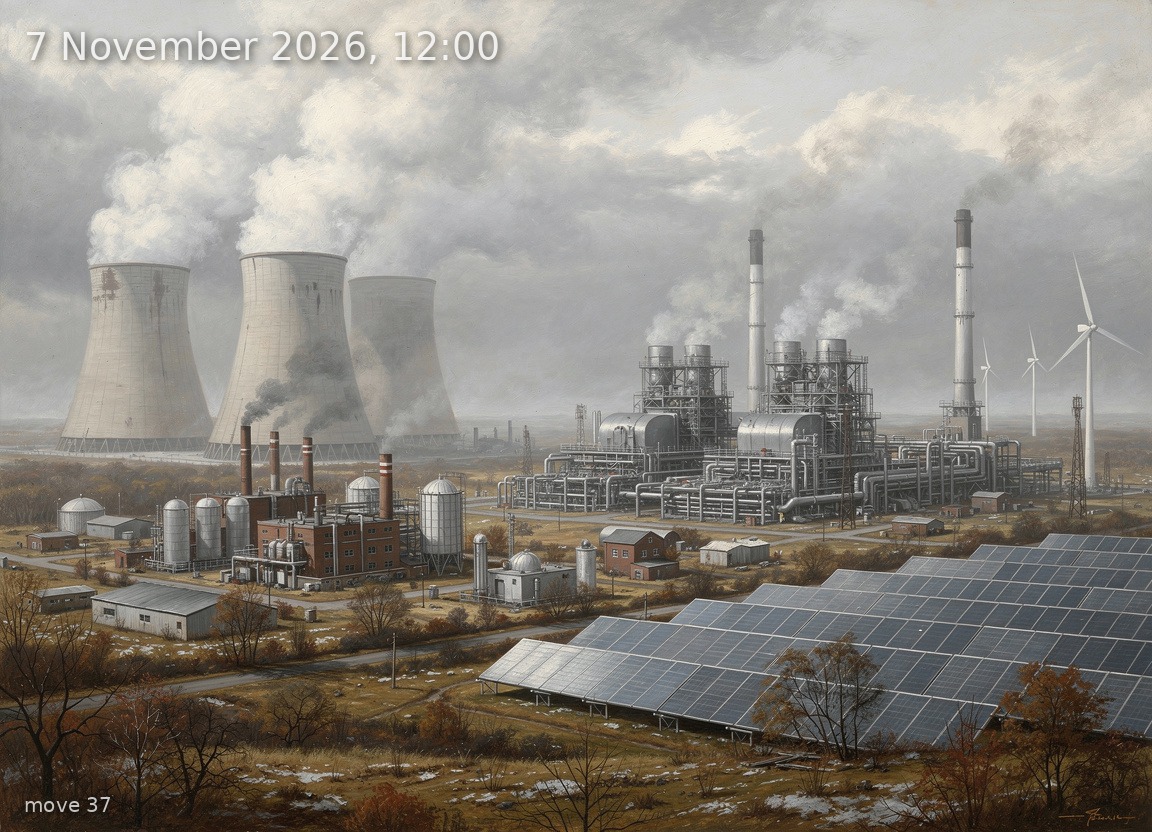
Gas, brown coal, and muted solar dominate a windless, overcast November midday driving prices above 227 EUR/MWh.
Generation mix
Wind onshore 4%
Wind offshore 2%
Solar 30%
Biomass 8%
Hydro 2%
Natural gas 25%
Hard coal 10%
Brown coal 20%
45%
Renewable share
3.0 GW
Wind (on + offshore)
16.3 GW
Solar
54.2 GW
Total generation
1.3 GW
Net import
227.1 EUR/MWh
Day-ahead price
4.8°C / 2 km/h
Temp / Wind speed
Open-Meteo, Kassel (51.3°N 9.5°E) · surface estimate from 100 m wind
100.0% / 4.5 W/m²
Cloud cover / Radiation
359
gCO₂/kWh
Image prompt
Natural gas 13.8 GW dominates the centre-right as a sprawling complex of compact CCGT units with tall single exhaust stacks venting white-grey plumes; brown coal 10.7 GW fills the left quarter with massive hyperbolic cooling towers releasing thick columns of steam; hard coal 5.2 GW appears as a cluster of smaller conventional boiler stacks with dark smoke just left of centre; solar 16.3 GW occupies the right third as vast fields of aluminium-framed crystalline silicon PV panels stretching toward a pale horizon, their surfaces reflecting only diffuse grey light; biomass 4.2 GW is rendered as mid-ground industrial facilities with cylindrical silos and modest chimneys trailing wispy smoke; wind onshore 2.0 GW appears as a small group of three-blade turbines with white lattice towers standing motionless on a low hill in the far background; wind offshore 1.0 GW is faintly visible as a tiny row of turbines on a hazy sea horizon at far right; hydro 1.0 GW shows as a concrete dam with modest spillway in a river valley at far left. The time is midday but the sky is entirely overcast with a low, oppressive ceiling of uniform grey-white cloud, no blue sky visible, no direct sun, light flat and diffuse. Temperature near 5 °C: late-autumn landscape with bare deciduous trees, brown and ochre grasses, patches of frost on shadowed ground. The air feels heavy and still — no motion in tree branches or turbine blades. The atmosphere conveys expensive, strained energy markets: a thick, brooding industrial haze hangs between the viewer and the horizon, merging steam plumes into cloud. Highly detailed oil painting in the tradition of 19th-century German Romantic landscape painters — Caspar David Friedrich's atmospheric depth combined with Adolph Menzel's industrial precision — rich muted colour palette of slate grey, burnt umber, dull gold, and iron oxide, visible confident brushwork, dramatic chiaroscuro despite the overcast light, meticulous engineering detail on every turbine nacelle, cooling tower, and PV panel frame. No text, no labels.