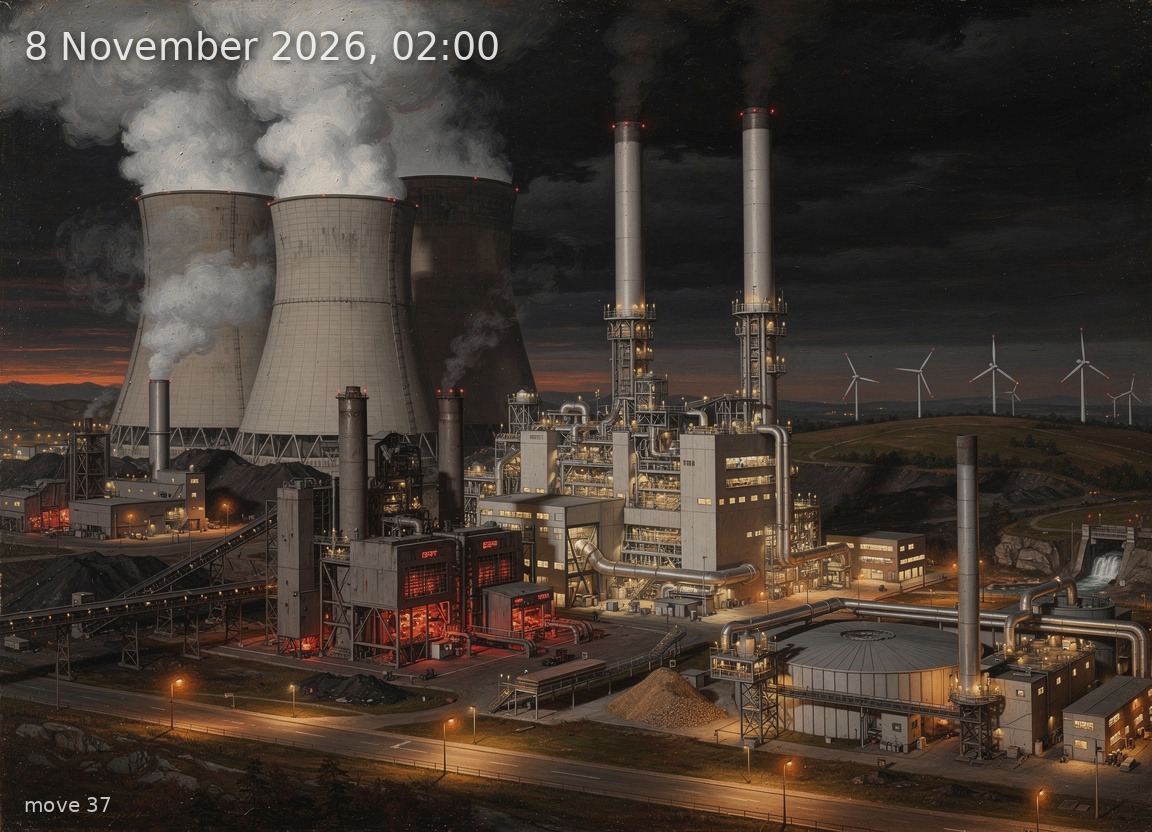
Gas and brown coal dominate overnight generation as low wind and cold weather push prices above 200 EUR/MWh.
Generation mix
Wind onshore 10%
Wind offshore 1%
Biomass 10%
Hydro 2%
Natural gas 35%
Hard coal 13%
Brown coal 29%
23%
Renewable share
4.7 GW
Wind (on + offshore)
0.0 GW
Solar
41.9 GW
Total generation
0.3 GW
Net import
214.9 EUR/MWh
Day-ahead price
4.4°C / 10 km/h
Temp / Wind speed
Open-Meteo, Kassel (51.3°N 9.5°E) · surface estimate from 100 m wind
99.0% / 0.0 W/m²
Cloud cover / Radiation
507
gCO₂/kWh
Image prompt
Natural gas 14.6 GW dominates the centre-right as a cluster of large CCGT power plants with tall single exhaust stacks venting pale plumes into the night; brown coal 12.3 GW occupies the left third as massive hyperbolic cooling towers with thick white steam columns rising from a sprawling lignite plant, conveyor belts carrying dark fuel visible at the base; hard coal 5.3 GW appears centre-left as a smaller coal-fired station with twin chimneys and reddish-glowing furnace light leaking from grated openings; wind onshore 4.3 GW is represented by a modest row of three-blade turbines on low hills in the right background, their red aviation warning lights blinking in the darkness, blades turning slowly; biomass 4.1 GW appears as a mid-sized industrial facility with a rounded wood-chip silo and a single modest smokestack near the right-centre; hydro 0.8 GW is suggested by a small dam structure barely visible in the far distance with faint spillway light; wind offshore 0.5 GW is a pair of distant turbines on the far horizon. The scene is set at 2 AM in deep November night — the sky is completely black with thick 99% overcast, no stars, no moon, no twilight glow whatsoever. The only illumination comes from sodium-orange streetlights along an access road in the foreground, the industrial flood-lighting of the power stations casting harsh white and amber pools on concrete and steel, and the dull red glow of furnace interiors. The ground shows late-autumn brown grass, bare deciduous trees with skeletal branches, and patches of frost glistening under artificial light, reflecting 4.4°C near-freezing conditions. The atmosphere feels heavy, oppressive, and dense — low clouds trapping the steam and industrial haze close to the ground, reflecting the orange glow back downward, conveying the weight of a 214.9 EUR/MWh price environment. Painted in the style of a highly detailed 19th-century German Romantic oil painting — rich impasto brushwork, deep chiaroscuro contrasts between the black sky and the fiery industrial glow, atmospheric sfumato in the steam and haze, meticulous engineering detail on turbine nacelles, lattice towers, cooling tower parabolic curves, and CCGT exhaust assemblies. The composition evokes Caspar David Friedrich's sublime darkness merged with Adolph Menzel's industrial realism. No text, no labels.