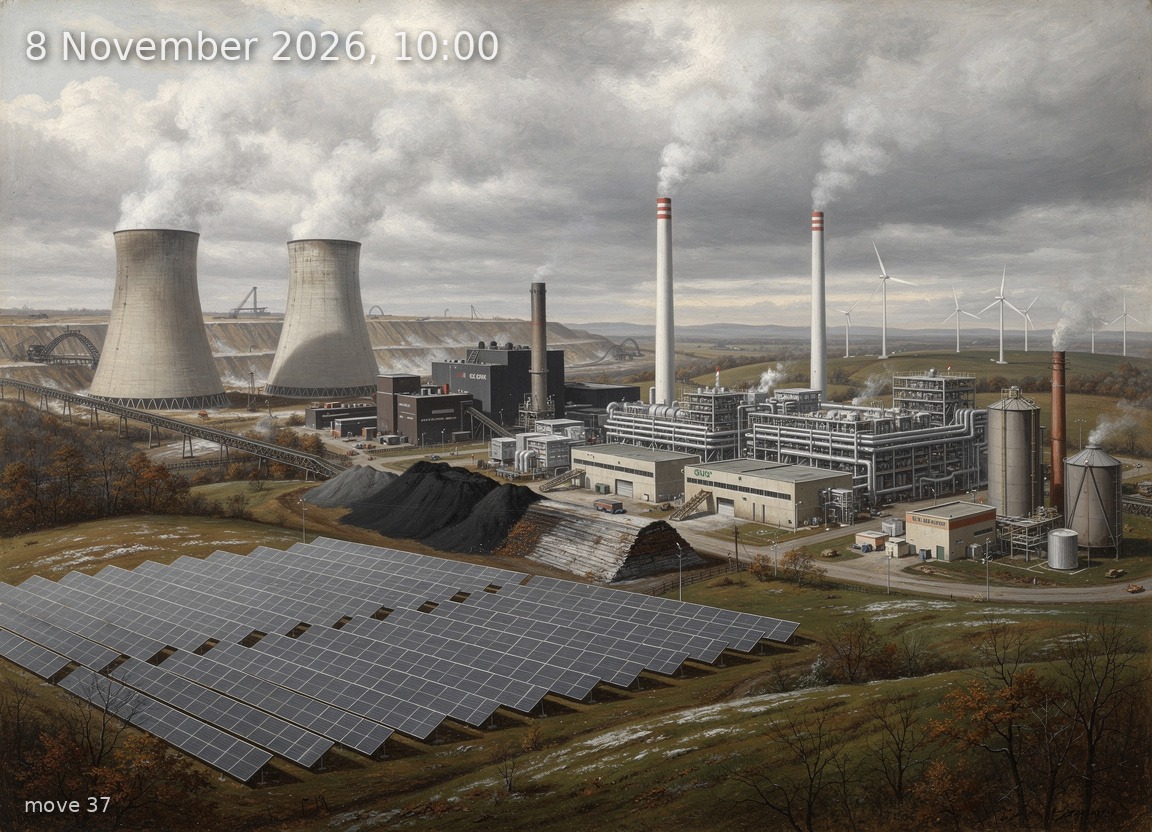
Gas, brown coal, and hard coal dominate as overcast skies and calm winds suppress renewable output on a cold November morning.
Generation mix
Wind onshore 5%
Wind offshore 2%
Solar 22%
Biomass 9%
Hydro 2%
Natural gas 28%
Hard coal 10%
Brown coal 23%
39%
Renewable share
3.3 GW
Wind (on + offshore)
11.6 GW
Solar
51.7 GW
Total generation
2.9 GW
Net import
211.9 EUR/MWh
Day-ahead price
5.8°C / 7 km/h
Temp / Wind speed
Open-Meteo, Kassel (51.3°N 9.5°E) · surface estimate from 100 m wind
100.0% / 7.0 W/m²
Cloud cover / Radiation
401
gCO₂/kWh
Image prompt
Natural gas 14.3 GW dominates the centre-right as a sprawling complex of combined-cycle gas turbine units with tall slender exhaust stacks trailing white plumes; brown coal 11.9 GW occupies the left quarter as massive hyperbolic cooling towers emitting thick steam columns beside open-pit conveyor belts and boiler houses; solar 11.6 GW appears in the centre-left foreground as extensive rows of aluminium-framed crystalline silicon panels on flat ground, their surfaces reflecting only the grey sky, producing no glint; hard coal 5.2 GW sits behind the solar field as a cluster of dark industrial buildings with a tall chimney stack and coal stockpile; biomass 4.5 GW appears as a mid-sized wood-chip-fired plant with a conical fuel silo and modest smokestack near the right edge; wind onshore 2.5 GW shows as a small group of three-blade turbines on a distant ridge, rotors barely turning; wind offshore 0.8 GW is glimpsed as tiny turbines on a far grey horizon line above a sliver of North Sea; hydro 0.8 GW is a small concrete dam with a thin waterfall tucked into a wooded valley at the far left edge. The sky is completely overcast with a thick, low, uniform blanket of grey-white stratus clouds pressing down oppressively—no blue sky visible, no direct sunlight, diffuse flat daylight typical of 10:00 in November. The landscape is late-autumn central German rolling terrain: bare deciduous trees with a few remaining brown leaves, dull green-brown meadows, patches of frost on shadowed ground, temperature near 6 °C. The atmosphere is heavy and brooding, conveying the economic pressure of high electricity prices. Painted in the style of a highly detailed 19th-century German Romantic oil painting—rich impasto brushwork, dramatic tonal contrasts, atmospheric aerial perspective with haze softening distant structures—yet every piece of energy infrastructure is rendered with meticulous engineering accuracy: three-blade rotor profiles, lattice tower geometry, cooling tower hyperboloid curves, CCGT exhaust stack proportions. No text, no labels.