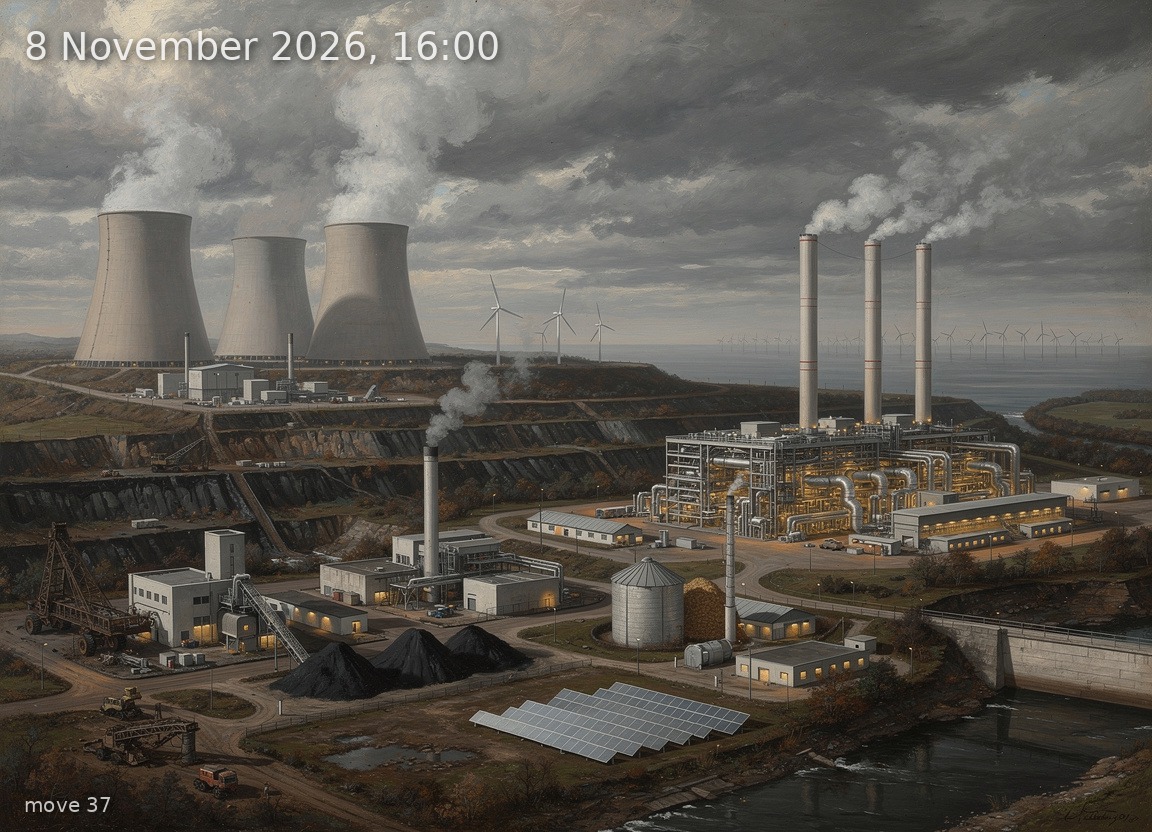
Gas, brown coal, and hard coal carry 80% of generation as wind and solar falter under November overcast.
Generation mix
Wind onshore 3%
Wind offshore 2%
Solar 2%
Biomass 10%
Hydro 2%
Natural gas 37%
Hard coal 13%
Brown coal 31%
20%
Renewable share
2.2 GW
Wind (on + offshore)
0.7 GW
Solar
39.9 GW
Total generation
15.2 GW
Net import
292.3 EUR/MWh
Day-ahead price
8.3°C / 7 km/h
Temp / Wind speed
Open-Meteo, Kassel (51.3°N 9.5°E) · surface estimate from 100 m wind
85.0% / 8.8 W/m²
Cloud cover / Radiation
529
gCO₂/kWh
Image prompt
Natural gas 14.7 GW dominates the centre-right of the composition as a sprawling complex of combined-cycle gas turbine units with tall single exhaust stacks trailing thin white plumes; brown coal 12.2 GW fills the left third as massive hyperbolic cooling towers with heavy steam columns rising into the overcast, surrounded by open-pit mine terraces with exposed dark lignite seams; hard coal 5.2 GW appears centre-left as a cluster of smaller coal plant buildings with conveyor belts and stockpiles of black coal, twin chimneys emitting grey smoke; biomass 4.2 GW is rendered as a mid-ground facility with cylindrical wood-chip silos and a modest smokestack; wind onshore 1.2 GW shown as a small group of three-blade turbines on a distant ridge, rotors barely turning; wind offshore 1.0 GW depicted as a faint row of turbines on a far grey horizon line above a sliver of sea; solar 0.7 GW represented by a tiny field of aluminium-framed crystalline silicon panels in the foreground, reflecting only dull grey light; hydro 0.8 GW as a small dam structure with a trickle of water visible at the far right edge. The sky is 85% overcast, thick stratiform clouds in shades of slate and pewter, late-afternoon November daylight at 4 PM — flat, diffuse, pale light with no visible sun, the horizon tinged with a faintly warmer grey hinting at dusk approaching. Temperature 8 degrees Celsius: bare deciduous trees with a few clinging brown leaves, damp autumn fields in muted ochre and umber. The atmosphere is heavy and oppressive, reflecting the extreme electricity price — the clouds seem to press down on the landscape, the air thick with industrial haze and condensation. Rendered as a highly detailed oil painting in the tradition of 19th-century German Romantic landscape painting — rich impasto brushwork, atmospheric depth through layered tonal recession, dramatic chiaroscuro between the glowing industrial facilities and the grey pall above. Meticulous engineering detail on every turbine nacelle, cooling tower, gas stack, and panel frame. The overall mood is of industrial grandeur under a brooding sky, a nation's energy infrastructure laboring under constraint. No text, no labels.