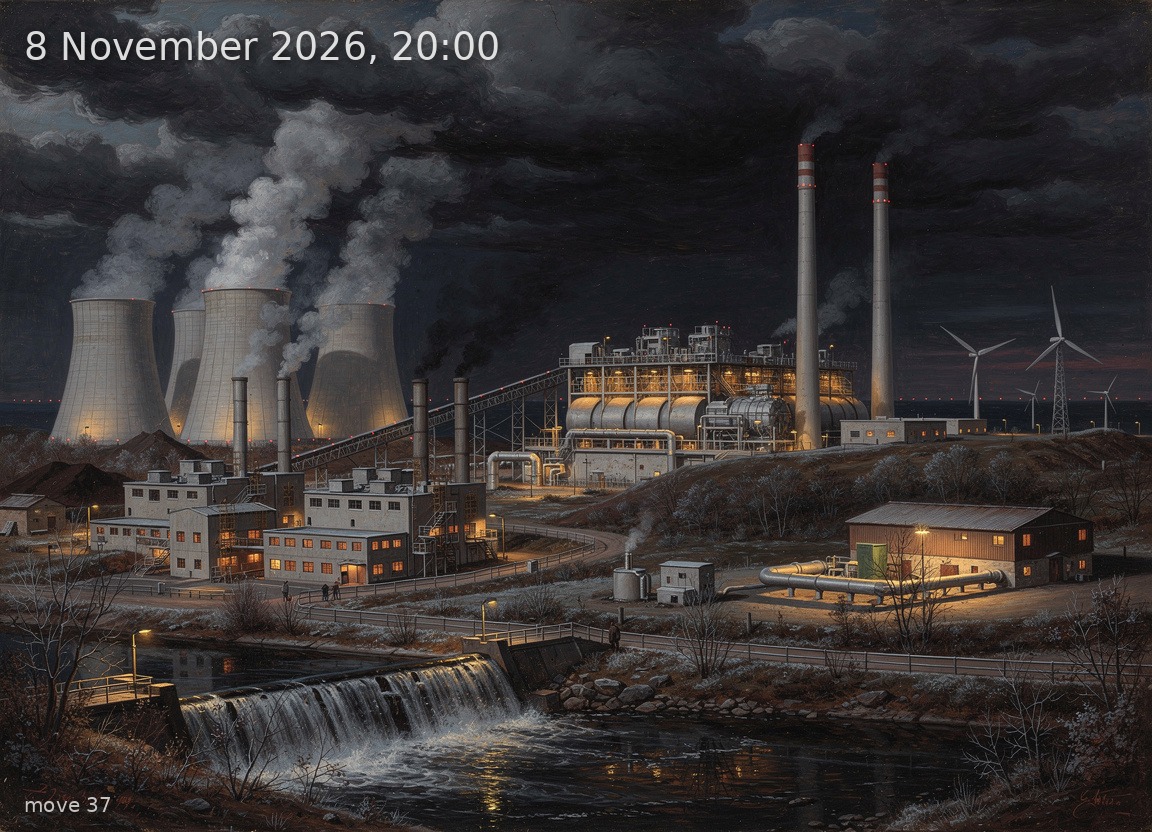
Gas, brown coal, and hard coal dominate as calm, cold, overcast conditions suppress wind and solar output.
Generation mix
Wind onshore 6%
Wind offshore 4%
Biomass 10%
Hydro 2%
Natural gas 36%
Hard coal 12%
Brown coal 30%
22%
Renewable share
4.5 GW
Wind (on + offshore)
0.0 GW
Solar
44.3 GW
Total generation
11.0 GW
Net import
303.3 EUR/MWh
Day-ahead price
5.9°C / 2 km/h
Temp / Wind speed
Open-Meteo, Kassel (51.3°N 9.5°E) · surface estimate from 100 m wind
95.0% / 0.0 W/m²
Cloud cover / Radiation
510
gCO₂/kWh
Image prompt
Natural gas 16.2 GW dominates the centre-right of the composition as a sprawling complex of compact CCGT power plants with tall single exhaust stacks venting pale flue gas, their turbine halls glowing with warm industrial sodium light. Brown coal 13.1 GW occupies the left third as a cluster of massive hyperbolic cooling towers emitting thick white steam plumes rising into the darkness, with conveyor belts carrying lignite visible under floodlights. Hard coal 5.3 GW appears centre-left as a pair of smaller conventional coal plants with rectangular boiler houses and twin stacks, lit by orange security lights. Biomass 4.6 GW sits in the mid-ground as a modest wood-chip-fed CHP facility with a single squat stack and a steaming district heat pipe, warmly lit. Wind onshore 2.7 GW is shown as a small group of three-blade turbines on a distant ridge, rotors barely turning, their red aviation warning lights blinking faintly. Wind offshore 1.7 GW is suggested far in the background as tiny red blinking lights on the black horizon line. Hydro 0.7 GW appears as a small run-of-river weir in the foreground, water gleaming under a bridge lamp. The sky is completely dark, a deep black-navy November night at 20:00, heavy 95% overcast obscuring all stars, no twilight or sky glow whatsoever. The atmosphere is oppressive and heavy, hinting at the extreme electricity price — a thick low ceiling of clouds faintly backlit by the industrial glow below. Temperature is near 6°C: bare deciduous trees with no leaves, frost forming on railings, breath-visible cold. The air is nearly still, no motion in flags or vegetation. Foreground shows damp autumn ground, fallen brown leaves, and puddles reflecting the orange industrial lights. Painted in the style of a highly detailed 19th-century German Romantic oil painting — rich, dark palette of deep ochres, umbers, burnt orange, and Prussian blue — with visible confident brushwork, atmospheric depth and chiaroscuro, yet every engineering detail rendered with technical precision: turbine nacelles, lattice towers, cooling tower reinforced-concrete ribs, CCGT exhaust diffusers. No text, no labels.