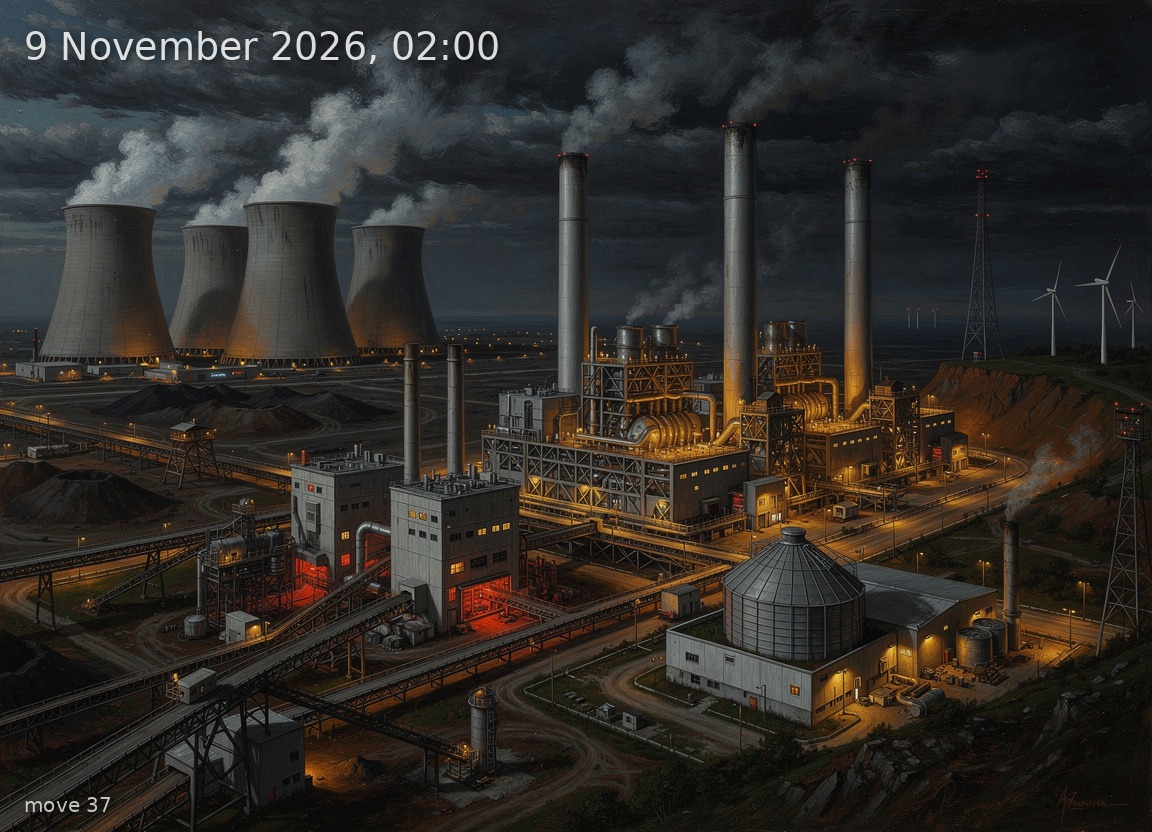
Gas, brown coal, and hard coal dominate a calm, cold night with minimal wind and net imports of 5.7 GW.
Generation mix
Wind onshore 4%
Wind offshore 3%
Biomass 10%
Hydro 2%
Natural gas 36%
Hard coal 13%
Brown coal 31%
19%
Renewable share
2.7 GW
Wind (on + offshore)
0.0 GW
Solar
38.8 GW
Total generation
5.7 GW
Net import
225.5 EUR/MWh
Day-ahead price
3.9°C / 1 km/h
Temp / Wind speed
Open-Meteo, Kassel (51.3°N 9.5°E) · surface estimate from 100 m wind
90.0% / 0.0 W/m²
Cloud cover / Radiation
532
gCO₂/kWh
Image prompt
Natural gas 14.1 GW dominates the centre-right as a cluster of large CCGT power stations with tall single exhaust stacks emitting pale vapour plumes, lit from below by sodium-orange industrial lighting. Brown coal 12.0 GW fills the left third with massive hyperbolic cooling towers releasing thick white steam columns into the darkness, surrounded by conveyor belts and lignite stockpiles. Hard coal 5.2 GW appears as a pair of conventional coal plants with rectangular boiler houses and twin chimneys in the centre-left, glowing ember-red from furnace light. Biomass 4.1 GW is rendered as a smaller industrial facility with a domed wood-chip storage silo and a single smokestack at mid-ground right. Wind onshore 1.7 GW shows a few distant three-blade turbines on a ridge to the far right, rotors barely turning, their red aviation warning lights blinking faintly. Wind offshore 1.0 GW is suggested by two or three offshore turbine silhouettes barely visible on a far dark horizon line. Hydro 0.7 GW appears as a small dam structure with a thin cascade of water in the far background. The sky is completely black to deep navy, 90% overcast with low heavy clouds faintly illuminated from below by the orange glow of industrial complexes — no moonlight, no stars, no twilight. The temperature is near freezing: bare deciduous trees with frost on dark branches frame the foreground, and thin frost covers the ground. The air feels heavy and oppressive, reflecting the 225.5 EUR/MWh price — a dense, brooding industrial atmosphere. No solar panels anywhere. Style: highly detailed oil painting in the tradition of 19th-century German Romantic landscape painters such as Caspar David Friedrich and Carl Blechen — rich deep colour palette of blacks, dark blues, warm oranges and industrial yellows, visible impasto brushwork, dramatic chiaroscuro, atmospheric depth with smoke and steam layering into the overcast night. Meticulous engineering accuracy on all technology details: lattice towers, nacelles, cooling tower parabolic curves, CCGT exhaust geometry. No text, no labels.