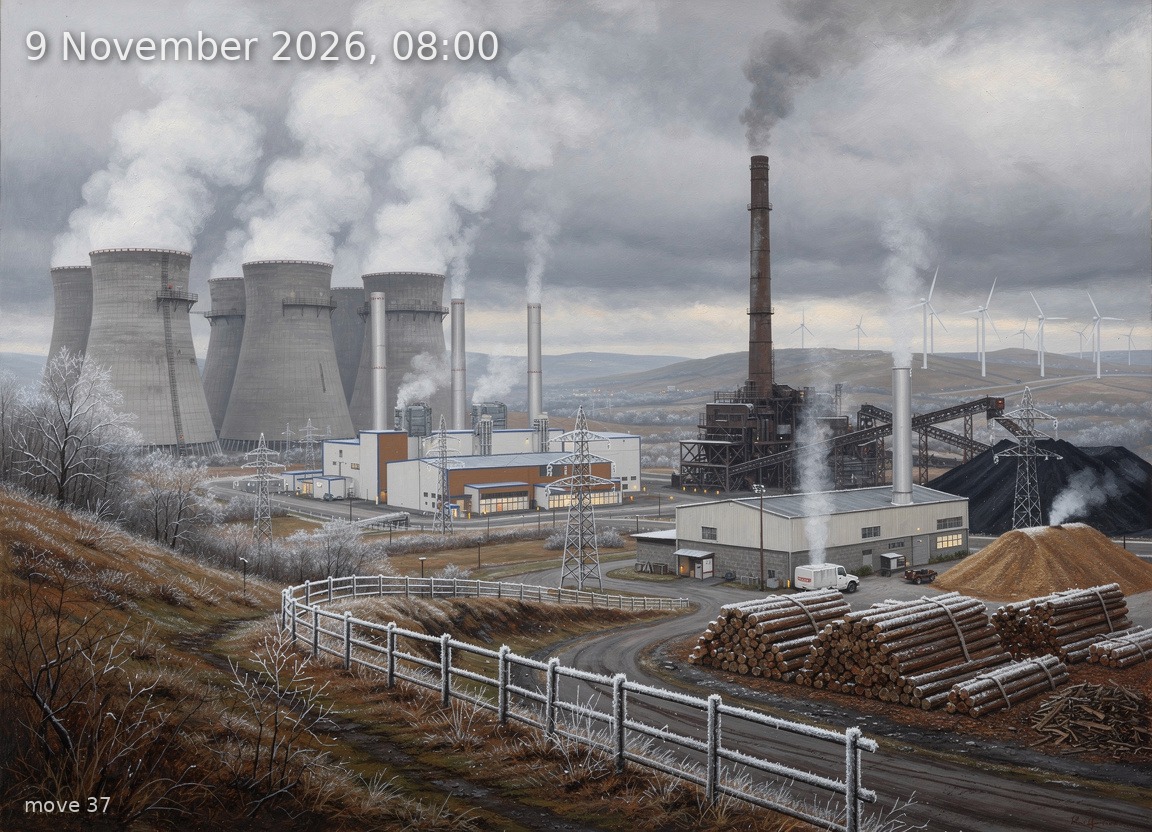
Gas, brown coal, and hard coal dominate as calm, overcast November cold drives 22.7 GW net imports.
Generation mix
Wind onshore 6%
Wind offshore 2%
Solar 7%
Biomass 9%
Hydro 2%
Natural gas 34%
Hard coal 11%
Brown coal 29%
25%
Renewable share
3.5 GW
Wind (on + offshore)
3.0 GW
Solar
44.6 GW
Total generation
22.7 GW
Net import
400.9 EUR/MWh
Day-ahead price
3.6°C / 2 km/h
Temp / Wind speed
Open-Meteo, Kassel (51.3°N 9.5°E) · surface estimate from 100 m wind
80.0% / 0.3 W/m²
Cloud cover / Radiation
492
gCO₂/kWh
Image prompt
Brown coal 13.1 GW occupies the left third of the scene as a cluster of massive hyperbolic cooling towers with thick white steam plumes rising into heavy overcast sky; natural gas 15.1 GW fills the centre-left as a row of modern CCGT plants with tall slender exhaust stacks emitting thin heat haze; hard coal 5.1 GW appears centre-right as a dark industrial power station with conveyor belts and a single large chimney; biomass 4.1 GW is rendered as a mid-sized wood-chip-fired plant with a modest stack and piled timber in its yard; wind onshore 2.6 GW shows a sparse line of three-blade turbines on distant hills, rotors barely turning; wind offshore 0.9 GW appears as faint turbine silhouettes on the far horizon; solar 3.0 GW is depicted as a field of aluminium-framed crystalline silicon panels in the right foreground, their surfaces dark and reflective under the overcast, producing weakly; hydro 0.7 GW appears as a small concrete run-of-river weir with modest water flow at the far right edge. Time is 08:00 on a November morning: full daylight but deeply overcast at 80% cloud cover, diffuse grey-white light with no shadows, no direct sun visible. Temperature is 3.6°C — frost clings to bare branches, dormant brown grass, and a thin rime on metal structures. The air is utterly still, no wind motion, smoke and steam rise straight upward. The atmosphere is heavy, oppressive, and brooding, reflecting the extreme 400.9 EUR/MWh electricity price — a palpable weight to the low clouds pressing down on the industrial landscape. High-voltage transmission pylons recede into the misty background, symbolising import flows. Style: highly detailed oil painting in the tradition of 19th-century German Romantic landscape painters — rich, sombre colour palette of greys, ochres, and muted earth tones, visible confident brushwork, atmospheric depth with sfumato haze in the distance, meticulous engineering detail on every turbine nacelle, cooling tower rib, PV panel frame, and smokestack. The scene evokes Caspar David Friedrich's sublime melancholy transposed onto a modern industrial tableau. No text, no labels.