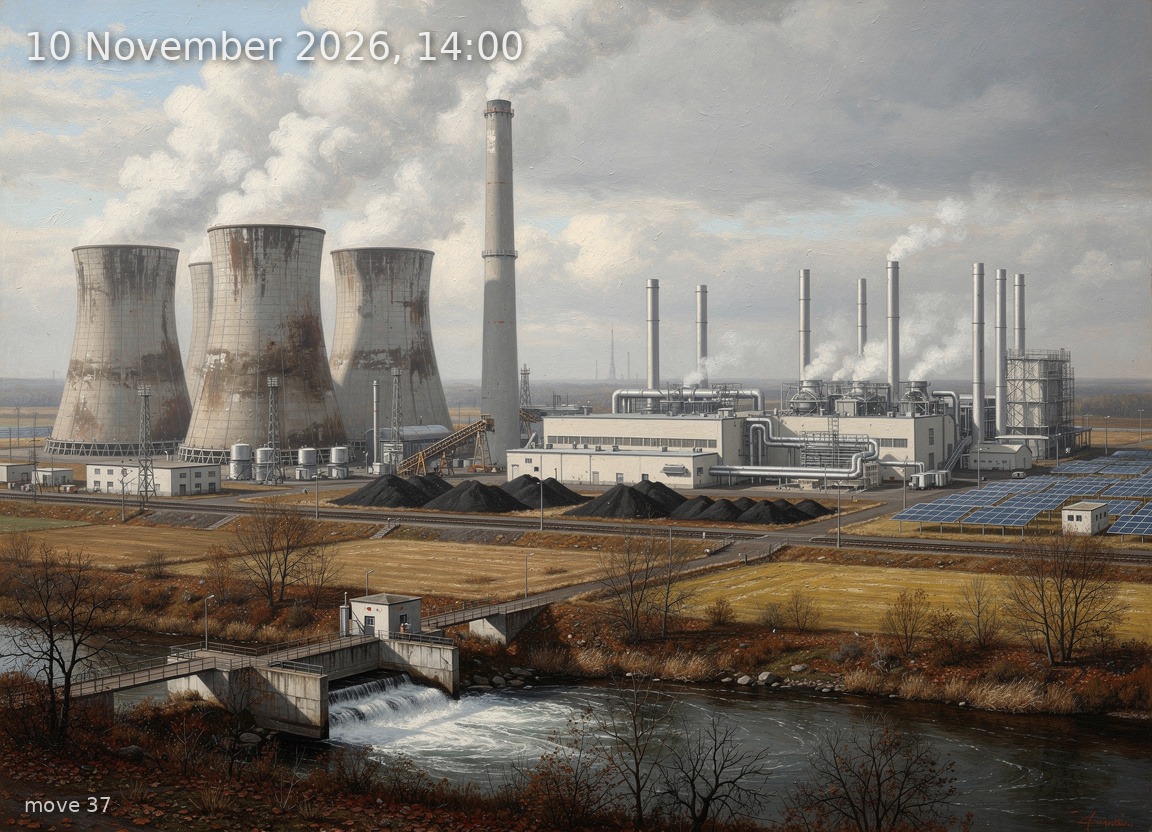
Gas and lignite dominate as near-zero wind and high demand drive 376 EUR/MWh prices and 11.3 GW net imports.
Generation mix
Wind onshore 3%
Wind offshore 2%
Solar 16%
Biomass 8%
Hydro 2%
Natural gas 34%
Hard coal 10%
Brown coal 24%
31%
Renewable share
2.5 GW
Wind (on + offshore)
8.3 GW
Solar
53.1 GW
Total generation
11.3 GW
Net import
376.0 EUR/MWh
Day-ahead price
8.0°C / 3 km/h
Temp / Wind speed
Open-Meteo, Kassel (51.3°N 9.5°E) · surface estimate from 100 m wind
61.0% / 145.5 W/m²
Cloud cover / Radiation
445
gCO₂/kWh
Image prompt
Natural gas 18.2 GW dominates the centre-right as a sprawling complex of compact CCGT units with tall single exhaust stacks venting shimmering heat haze; brown coal 13.0 GW occupies the left quarter as massive hyperbolic cooling towers with thick white steam plumes rising into the overcast; solar 8.3 GW appears as extensive fields of aluminium-framed crystalline silicon panels in the mid-ground, catching diffused afternoon light filtering through broken clouds; hard coal 5.4 GW sits as a smaller coal-fired plant with a single large smokestack and conveyor belt coal yard beside the lignite complex; biomass 4.4 GW is rendered as a modest wood-chip-fed facility with a green-tinged industrial building and thin exhaust; wind onshore 1.7 GW and offshore 0.8 GW appear as a sparse scattering of barely-turning three-blade turbines on lattice towers far in the background, rotors nearly still; hydro 1.2 GW is a small run-of-river weir visible along a river in the lower foreground. The time is 14:00 in November: full but muted daylight, 61% cloud cover creating a flat grey-white overcast with occasional breaks revealing pale blue sky, weak direct sunlight casting faint diffuse shadows. Temperature is 8°C: late-autumn landscape with bare deciduous trees, brown and rust-coloured fallen leaves, dormant fields of stubble, faded yellowed grass. The atmosphere feels heavy and oppressive, reflecting the extreme 376 EUR/MWh price — a leaden, brooding quality to the air with a slight industrial haze hanging low. The wind is nearly still, no motion in vegetation or flags. Highly detailed oil painting in the tradition of 19th-century German Romantic landscape painters — Caspar David Friedrich meets industrial sublime — with rich tonal depth, visible impasto brushwork, dramatic atmospheric perspective from foreground river through mid-ground solar and gas plants to distant cooling towers dissolving into haze. Each energy technology rendered with meticulous engineering accuracy: turbine nacelles, three-blade rotors, aluminium PV frames, hyperbolic concrete cooling tower geometry, CCGT exhaust stacks with heat distortion. No text, no labels.