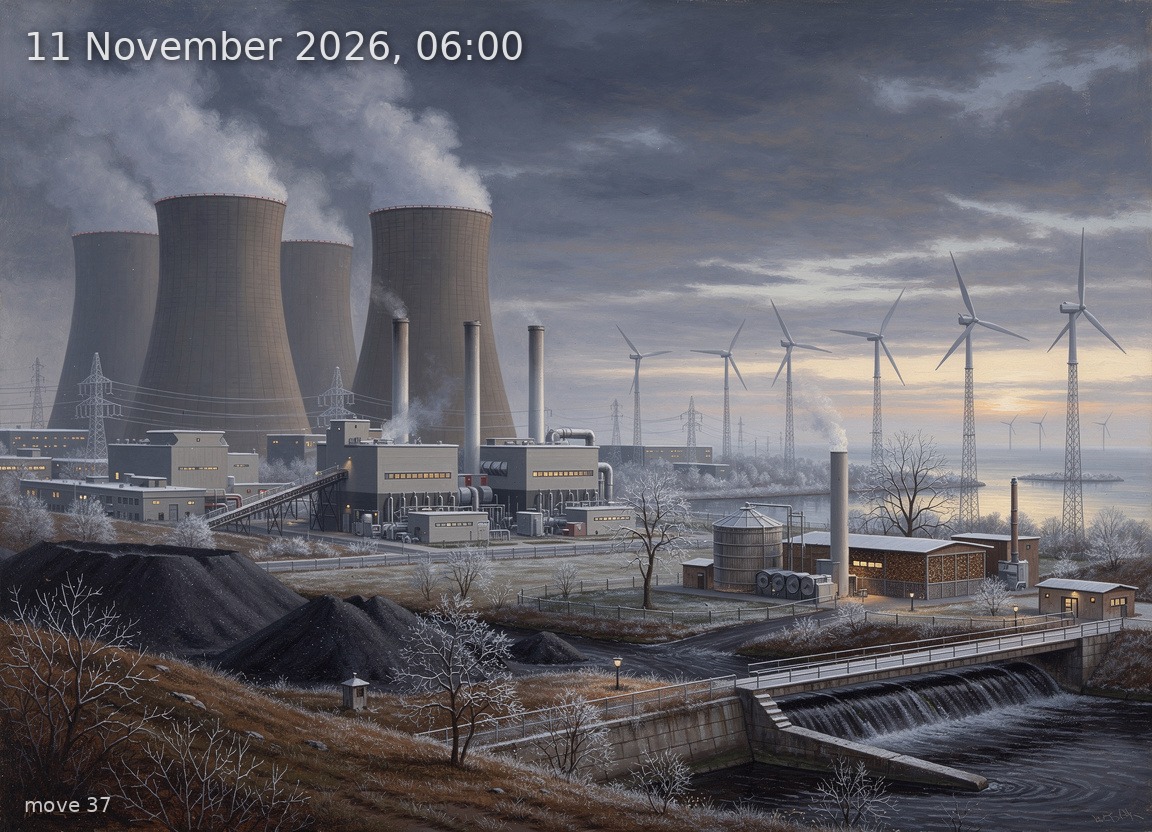
Brown coal, gas, and hard coal dominate a cold, dark, windless morning requiring 15.3 GW net imports.
Generation mix
Wind onshore 17%
Wind offshore 1%
Biomass 10%
Hydro 3%
Natural gas 26%
Hard coal 13%
Brown coal 30%
31%
Renewable share
8.3 GW
Wind (on + offshore)
0.0 GW
Solar
44.1 GW
Total generation
15.3 GW
Net import
250.0 EUR/MWh
Day-ahead price
1.3°C / 4 km/h
Temp / Wind speed
Open-Meteo, Kassel (51.3°N 9.5°E) · surface estimate from 100 m wind
100.0% / 0.0 W/m²
Cloud cover / Radiation
469
gCO₂/kWh
Image prompt
Brown coal 13.2 GW occupies the left third of the scene as a massive lignite power station complex with four hyperbolic cooling towers emitting thick white steam plumes into the frigid air; natural gas 11.4 GW fills the centre-left as three compact CCGT units with tall single exhaust stacks venting shimmering heat; hard coal 5.7 GW appears centre-right as a traditional coal plant with a large rectangular boiler house, conveyor belts, and a coal stockpile; onshore wind 7.6 GW spans the right portion as a row of roughly a dozen three-blade turbines on lattice towers barely turning in the still air; biomass 4.4 GW is rendered as a modest wood-chip-fired plant with a cylindrical silo and single stack near the wind turbines; hydro 1.1 GW appears as a small run-of-river station with a weir at the far right edge; offshore wind 0.6 GW is hinted as two distant turbines on the horizon line. Time is pre-dawn, 06:00 in November: the sky is deep blue-grey with the faintest pale luminescence at the eastern horizon, no direct sunlight, no solar panels visible anywhere. Temperature is 1.3°C — frost coats the bare-branched trees, dormant brown grass, and metal railings; breath-like condensation rises from every stack and tower. Cloud cover is total, a heavy unbroken overcast pressing down. Wind is nearly calm at 4 km/h — turbine blades are nearly motionless. The atmosphere is oppressive and heavy, reflecting the 250 EUR/MWh price — thick industrial haze, sulfurous tones in the low clouds lit from below by sodium-orange streetlights and the amber glow of plant windows. Painted in the style of a highly detailed 19th-century German Romantic oil painting — rich, dark palette of Prussian blue, raw umber, and burnt sienna, visible confident brushwork, atmospheric depth with sfumato haze around the cooling towers, meticulous engineering accuracy on every turbine nacelle, every lattice girder, every cooling tower's parabolic curve. No text, no labels.