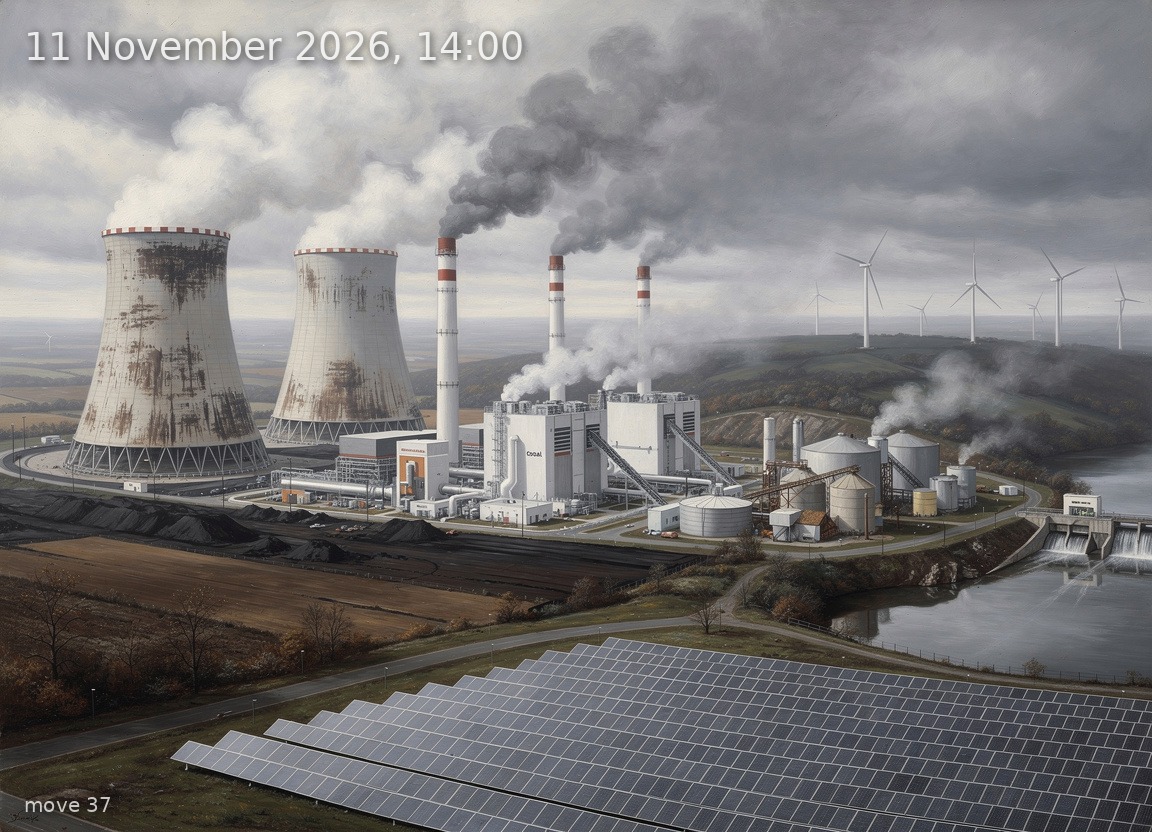
Brown coal, gas, and hard coal dominate as overcast skies, calm winds, and high demand drive 383 EUR/MWh prices.
Generation mix
Wind onshore 7%
Wind offshore 1%
Solar 9%
Biomass 9%
Hydro 2%
Natural gas 32%
Hard coal 12%
Brown coal 28%
28%
Renewable share
3.7 GW
Wind (on + offshore)
4.1 GW
Solar
47.4 GW
Total generation
15.1 GW
Net import
383.3 EUR/MWh
Day-ahead price
5.8°C / 3 km/h
Temp / Wind speed
Open-Meteo, Kassel (51.3°N 9.5°E) · surface estimate from 100 m wind
100.0% / 0.0 W/m²
Cloud cover / Radiation
476
gCO₂/kWh
Image prompt
Brown coal 13.2 GW dominates the left third of the scene as a vast complex of hyperbolic cooling towers belching thick white steam plumes into a low, oppressive overcast sky; natural gas 15.1 GW fills the centre as a dense row of modern combined-cycle gas turbine plants with tall single exhaust stacks venting heat shimmer and thin vapour; hard coal 5.8 GW appears centre-right as a pair of large coal-fired stations with rectangular boiler houses and squat chimneys trailing dark grey smoke; biomass 4.4 GW is rendered as a cluster of smaller industrial plants with rounded storage silos and wood-chip conveyors, modest steam rising; solar 4.1 GW appears as a field of aluminium-framed crystalline silicon panels in the right foreground, their surfaces dull and unreflective under the complete cloud cover, receiving no direct sunlight; wind onshore 3.3 GW stands as a sparse row of three-blade turbines on a distant ridge, their rotors barely turning in the near-still air; wind offshore 0.4 GW is suggested by a single turbine silhouette on the far horizon; hydro 1.1 GW is a small dam and powerhouse nestled in a valley on the far right. Time is 14:00 in November — full daylight but entirely diffuse, no shadows, a flat white-grey sky pressing down heavily. The landscape is late-autumn central German terrain: bare deciduous trees, brown and ochre fields, patches of frost on shaded ground, temperature near 6°C. The atmosphere feels heavy and expensive — a thick, suffocating ceiling of cloud weighing on the industrial sprawl below. Rendered as a highly detailed oil painting in the tradition of 19th-century German Romantic landscape painters such as Caspar David Friedrich and Carl Blechen, but depicting industrial infrastructure with meticulous engineering accuracy: visible turbine nacelles and lattice towers, precise cooling tower parabolic geometry, detailed CCGT exhaust assemblies. Rich, sombre colour palette of greys, umbers, and muted ochres with visible impasto brushwork, atmospheric perspective fading the distant turbines into haze, dramatic compositional depth from foreground panels to midground power stations to distant horizon. No text, no labels.