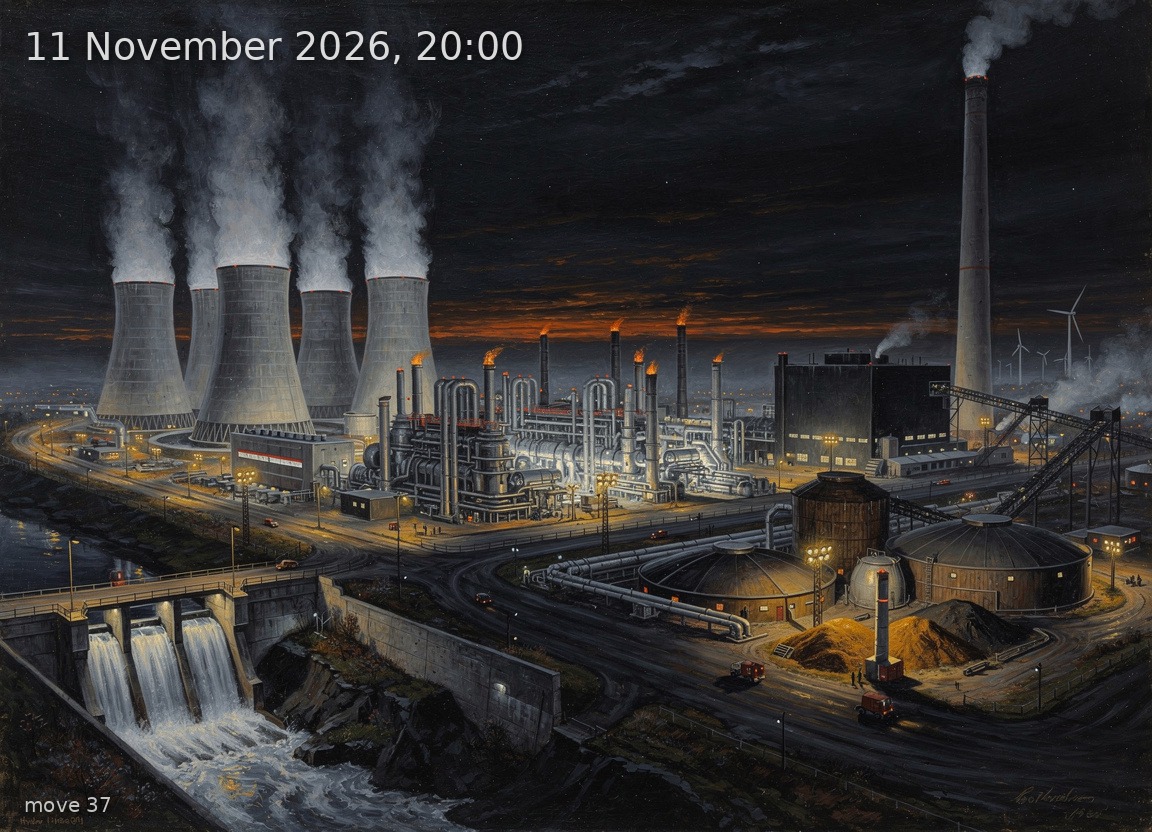
Cold, windless November night drives heavy fossil dispatch and large net imports at extreme prices.
Generation mix
Wind onshore 10%
Wind offshore 1%
Biomass 10%
Hydro 2%
Natural gas 34%
Hard coal 13%
Brown coal 29%
24%
Renewable share
5.0 GW
Wind (on + offshore)
0.0 GW
Solar
44.4 GW
Total generation
18.6 GW
Net import
351.8 EUR/MWh
Day-ahead price
5.7°C / 2 km/h
Temp / Wind speed
Open-Meteo, Kassel (51.3°N 9.5°E) · surface estimate from 100 m wind
100.0% / 0.0 W/m²
Cloud cover / Radiation
504
gCO₂/kWh
Image prompt
Brown coal 12.9 GW dominates the left third of the scene as a vast complex of hyperbolic cooling towers emitting thick white steam plumes into the black night sky; natural gas 15.2 GW fills the center as a sprawling array of CCGT combined-cycle gas turbine plants with tall single exhaust stacks glowing with orange flare tips and illuminated by sodium-yellow industrial floodlights; hard coal 5.8 GW appears center-right as a coal-fired power station with a large rectangular boiler house, conveyor belts, and a single tapered chimney trailing grey smoke; wind onshore 4.4 GW is represented by a sparse row of three-blade turbines on a distant ridge to the far right, their rotors nearly still in the calm air, red aviation warning lights blinking; wind offshore 0.6 GW appears as a faint cluster of tiny turbine silhouettes on the far-right horizon; biomass 4.4 GW is rendered as a mid-ground industrial facility with wood-chip storage domes and a modest smokestack; hydro 1.1 GW appears as a small dam structure with illuminated spillway at the far left edge. The sky is completely black with no twilight, no moon visible, heavy 100% overcast pressing down oppressively — a thick, suffocating ceiling of invisible clouds lit from below by the orange-sodium glow of the industrial installations. Temperature is 5.7°C: bare deciduous trees with skeletal branches, frost forming on metal structures, breath-like condensation around vents. The air is nearly dead still — no motion in flags or grass, smoke columns rising vertically. The atmosphere is heavy, tense, oppressive, reflecting the extreme electricity price. Foreground shows wet asphalt roads reflecting industrial lights, power lines carrying thick cable bundles stretching toward the viewer. Highly detailed oil painting in the tradition of 19th-century German Romantic landscape painters — Caspar David Friedrich meets industrial sublime — rich deep color palette of blacks, deep navy, burnt orange, and sulfurous yellow, visible confident brushwork, atmospheric depth with layers of steam and haze, meticulous engineering detail on all turbine nacelles, cooling tower geometries, and gas plant exhaust infrastructure. No text, no labels.