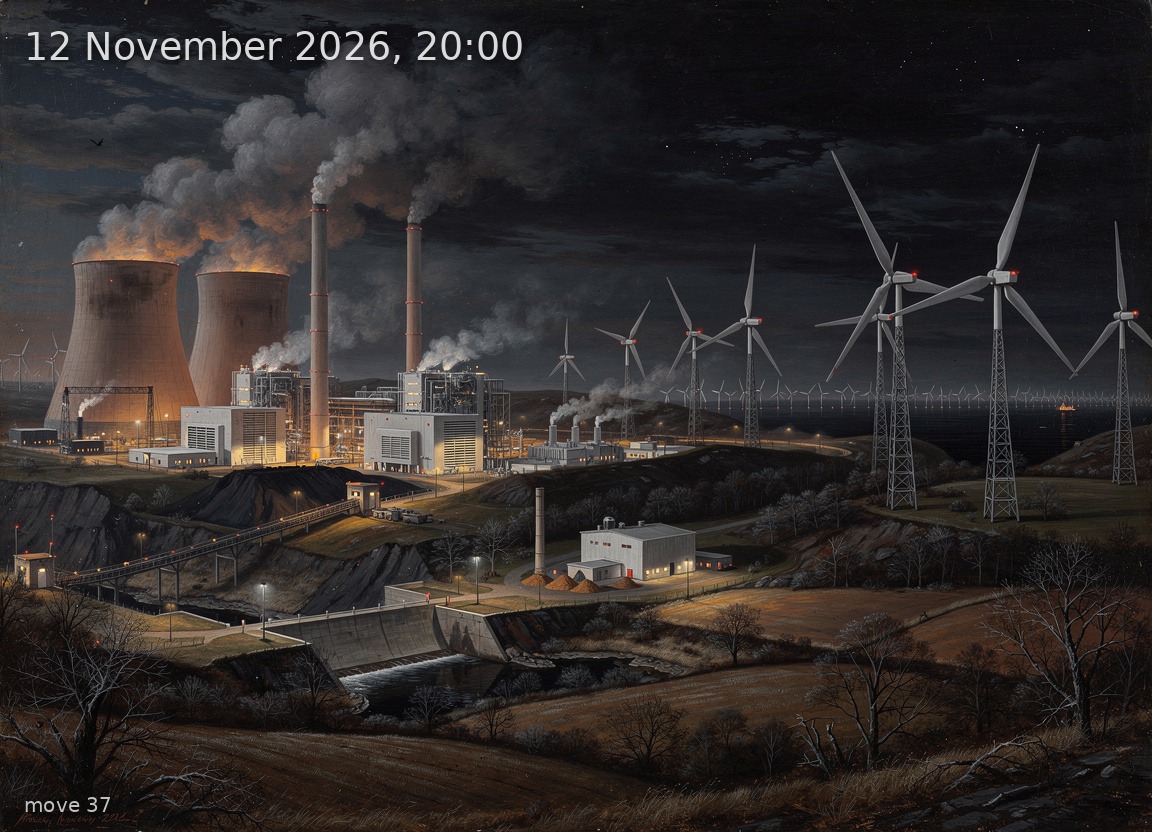
Strong onshore wind and firm thermal dispatch drive 6 GW net exports at elevated evening prices.
Generation mix
Wind onshore 42%
Wind offshore 9%
Biomass 6%
Hydro 2%
Natural gas 18%
Hard coal 6%
Brown coal 18%
59%
Renewable share
34.1 GW
Wind (on + offshore)
0.0 GW
Solar
67.2 GW
Total generation
+6.0 GW
Net export
192.0 EUR/MWh
Day-ahead price
3.4°C / 7 km/h
Temp / Wind speed
Open-Meteo, Kassel (51.3°N 9.5°E) · surface estimate from 100 m wind
44.0% / 0.0 W/m²
Cloud cover / Radiation
276
gCO₂/kWh
Image prompt
Wind onshore 28.0 GW dominates the right two-fifths of the scene as vast ranks of three-blade turbines on lattice towers stretching across dark rolling hills, red aviation warning lights blinking on nacelles; wind offshore 6.1 GW appears in the far-right background as a line of turbines standing in a black sea glimpsed through a gap in terrain; natural gas 12.1 GW fills the centre-left as a cluster of compact CCGT power stations with tall single exhaust stacks venting thin white plumes, lit by sodium-orange industrial floodlights; brown coal 11.9 GW occupies the left third as massive hyperbolic cooling towers emitting thick rolling steam clouds glowing faintly from interior furnace light, with conveyor belts of lignite visible below; hard coal 3.8 GW sits as a smaller conventional power station with twin stacks beside the lignite complex; biomass 4.2 GW appears as a modest wood-chip-fired plant with a low rectangular boiler building and single chimney at centre; hydro 1.1 GW is a small dam structure glimpsed in a valley in the mid-ground. The sky is completely dark, deep navy-black, no twilight, no horizon glow — full nighttime at 20:00 in November. Sparse stars peek through 44% broken cloud cover. The landscape is late-autumn central German terrain: bare deciduous trees, brown stubble fields lightly frosted at 3°C, patches of remaining dead grass. The atmosphere feels heavy and oppressive, reflecting the high electricity price — low dense clouds press down, steam and exhaust haze thicken the air around the thermal plants. Warm sodium-yellow and harsh white industrial lighting illuminates each facility, casting long pools of light across the frost. Painted in the style of a highly detailed 19th-century German Romantic oil painting — rich impasto brushwork, dramatic chiaroscuro, atmospheric depth receding into darkness — yet every engineering detail is rendered with meticulous accuracy: turbine blade pitch mechanisms, cooling tower parabolic curvature, gas turbine air intake louvers, coal conveyor gantries. No text, no labels.