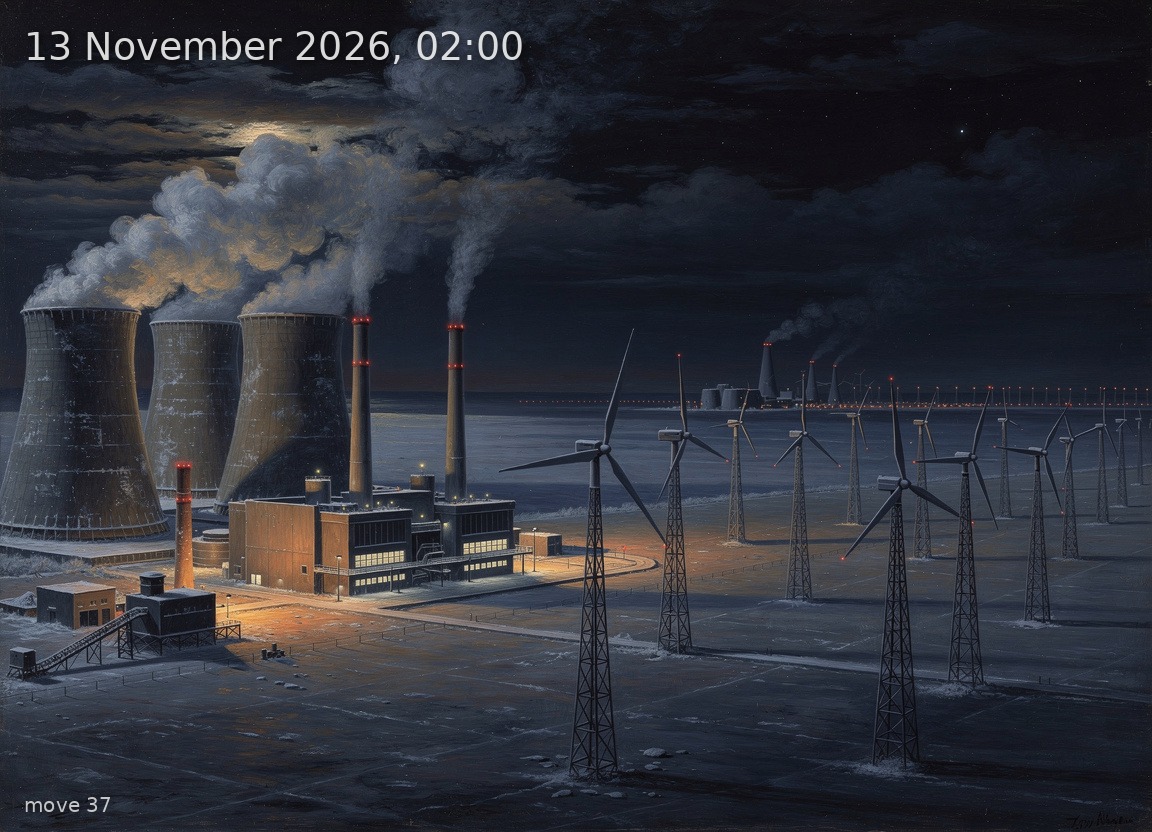
Strong overnight wind drives net exports of 9.9 GW while coal and gas maintain thermal baseload in sub-zero conditions.
Generation mix
Wind onshore 49%
Wind offshore 9%
Solar 0%
Biomass 7%
Hydro 2%
Natural gas 14%
Hard coal 6%
Brown coal 13%
67%
Renewable share
34.2 GW
Wind (on + offshore)
0.0 GW
Solar
58.7 GW
Total generation
+9.9 GW
Net export
137.6 EUR/MWh
Day-ahead price
-0.2°C / 8 km/h
Temp / Wind speed
Open-Meteo, Kassel (51.3°N 9.5°E) · surface estimate from 100 m wind
50.0% / 0.0 W/m²
Cloud cover / Radiation
221
gCO₂/kWh
Image prompt
Wind onshore 28.7 GW dominates the right two-thirds of the composition as vast rows of three-blade turbines on lattice towers stretching across a frozen, flat North German plain into the deep distance, rotors turning steadily; natural gas 8.3 GW appears in the centre-left as a cluster of compact CCGT power plants with tall single exhaust stacks emitting thin white plumes; brown coal 7.5 GW occupies the far left as a group of massive hyperbolic cooling towers releasing dense columns of steam that billow upward; wind offshore 5.4 GW is visible as a distant line of larger turbines on the far-right horizon above a frozen estuary; hard coal 3.6 GW appears as a smaller coal-fired station with a single tall chimney and conveyor belts near the brown coal complex; biomass 4.1 GW is rendered as a modest wood-chip-fed CHP plant with a squat cylindrical silo and low stack between the gas and coal facilities; hydro 1.0 GW appears as a small run-of-river weir with turbine house glimpsed in a river cutting through the foreground. TIME: 2 AM, completely dark — black sky with no twilight, no sky glow, only sodium-orange streetlights casting pools of amber on icy ground, lit industrial windows, and the red aviation warning lights blinking atop every turbine tower and smokestack. The atmosphere is heavy and oppressive despite the darkness, reflecting the anomalously high electricity price — low brooding clouds at 50% cover partially obscure faint stars, lit from below by industrial glow. Temperature is -0.2°C: frost coats every surface, grass is white with rime, thin ice edges the river, breath-like steam drifts from every warm exhaust. Bare winter trees with skeletal branches frame the scene. Painted in the style of a highly detailed 19th-century German Romantic oil painting — rich dark palette of deep navy, coal-black, warm amber, and cold blue-white — with visible, confident brushwork, meticulous engineering accuracy on every turbine nacelle, cooling tower curvature, and exhaust stack, atmospheric depth through layered industrial haze, evoking Caspar David Friedrich's sublime tension between nature and the engineered world. No text, no labels.