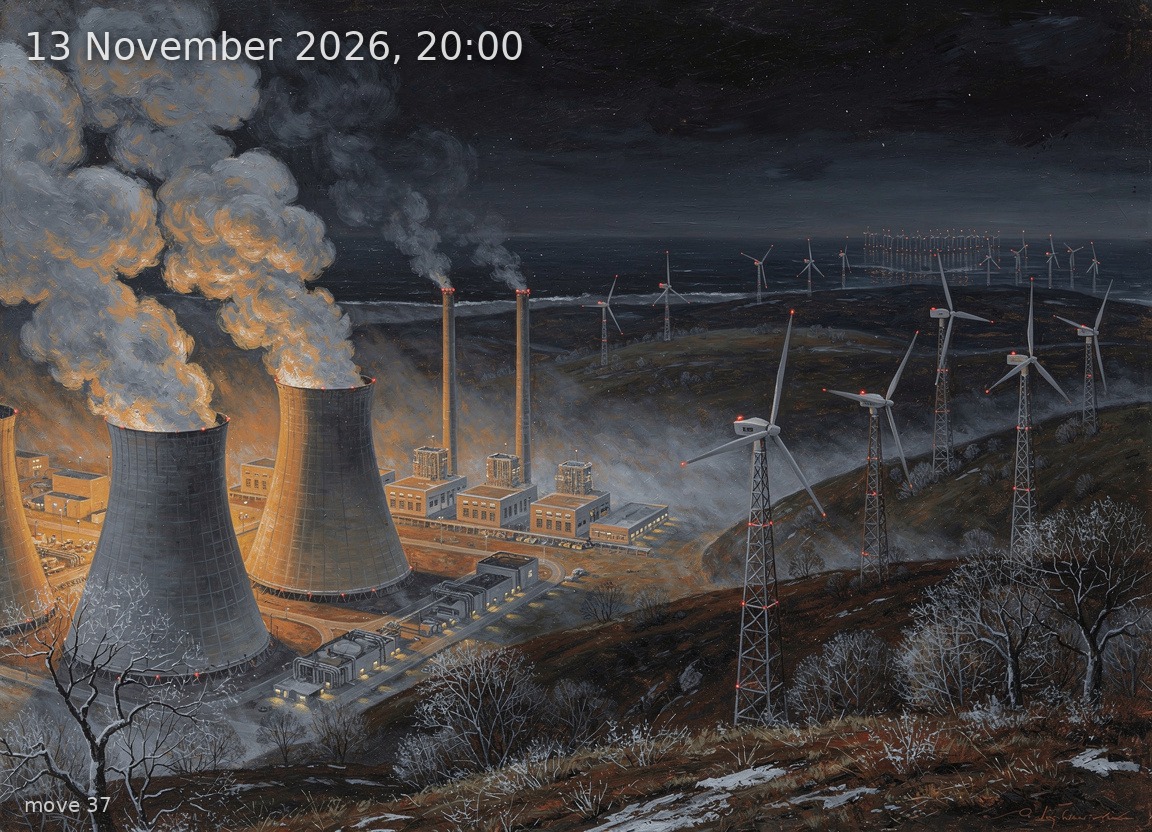
Strong wind leads generation at 31.9 GW but thermal plants and net imports cover evening peak demand at elevated prices.
Generation mix
Wind onshore 42%
Wind offshore 10%
Biomass 7%
Hydro 2%
Natural gas 18%
Hard coal 7%
Brown coal 13%
62%
Renewable share
31.9 GW
Wind (on + offshore)
0.0 GW
Solar
60.7 GW
Total generation
1.9 GW
Net import
200.9 EUR/MWh
Day-ahead price
3.7°C / 14 km/h
Temp / Wind speed
Open-Meteo, Kassel (51.3°N 9.5°E) · surface estimate from 100 m wind
80.0% / 0.0 W/m²
Cloud cover / Radiation
249
gCO₂/kWh
Image prompt
Wind onshore 25.5 GW dominates the right half and background as dozens of three-blade turbines on tall lattice towers stretching across rolling hills into the darkness, red aviation lights blinking on nacelles; wind offshore 6.4 GW appears as a distant cluster of turbines on the far-right horizon over a sliver of dark sea. Brown coal 8.2 GW occupies the left foreground as three massive hyperbolic cooling towers releasing thick white steam plumes lit from below by sodium-orange industrial lights. Natural gas 10.8 GW fills the centre-left as a row of compact CCGT power stations with tall single exhaust stacks emitting thin heat shimmer, brightly illuminated by floodlights. Hard coal 4.2 GW sits behind the gas units as a smaller coal plant with a single squat cooling tower and conveyor belts visible. Biomass 4.5 GW appears centre-right as a cluster of industrial buildings with wood-chip silos and a modest chimney with a pale exhaust plume. Hydro 1.2 GW is rendered as a small dam structure in the lower right with water gleaming faintly under artificial light. The sky is completely dark — deep black to navy, no twilight, no sky glow — overcast at 80% cloud cover so no stars are visible, only a heavy oppressive blanket of invisible clouds reflecting the faint orange industrial glow from below. Temperature is near freezing at 3.7°C: bare deciduous trees with frost on branches, dead brown grass, patches of frost on the ground. Wind at 14.2 km/h animates the turbine blades and bends bare branches slightly. The atmosphere is heavy and oppressive, reflecting the 200.9 EUR/MWh price — a brooding, tense industrial night. No solar panels anywhere. Highly detailed oil painting in the tradition of 19th-century German Romantic landscape painters — Caspar David Friedrich meets industrial sublime — rich deep colour palette of navy, black, burnt orange, and sulfurous yellow, visible impasto brushwork, atmospheric depth with fog and steam, meticulous engineering detail on every turbine nacelle, cooling tower, and exhaust stack. No text, no labels.