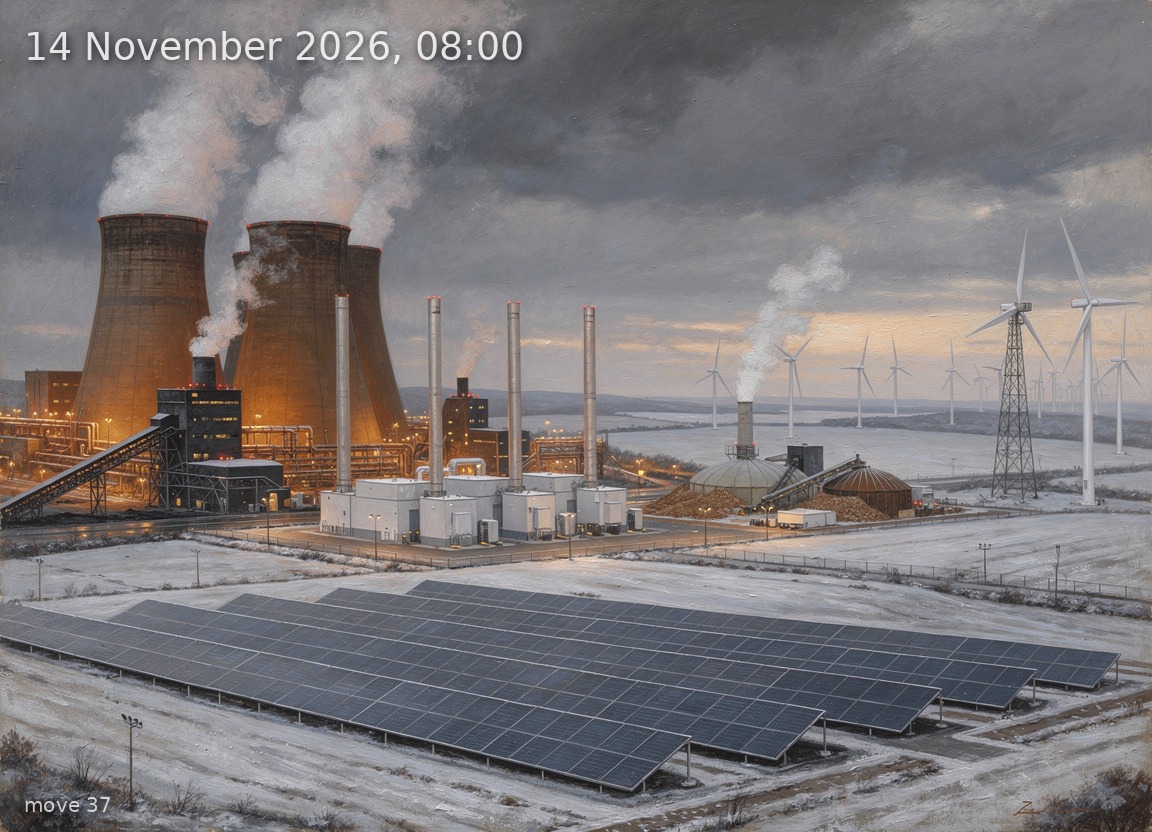
Wind leads at 19.7 GW but cold-driven 54.5 GW demand requires coal, gas, and 3.9 GW net imports.
Generation mix
Wind onshore 28%
Wind offshore 11%
Solar 11%
Biomass 8%
Hydro 2%
Natural gas 17%
Hard coal 6%
Brown coal 18%
60%
Renewable share
19.7 GW
Wind (on + offshore)
5.4 GW
Solar
50.6 GW
Total generation
3.8 GW
Net import
220.1 EUR/MWh
Day-ahead price
1.7°C / 15 km/h
Temp / Wind speed
Open-Meteo, Kassel (51.3°N 9.5°E) · surface estimate from 100 m wind
66.0% / 0.3 W/m²
Cloud cover / Radiation
271
gCO₂/kWh
Image prompt
Brown coal 8.9 GW dominates the left quarter as a massive lignite power station with four hyperbolic cooling towers trailing heavy white steam plumes into the grey sky; natural gas 8.6 GW fills the centre-left as a row of compact CCGT units with tall single exhaust stacks venting thin heat shimmer; wind onshore 14.0 GW spans the right half of the composition as dozens of three-blade turbines on lattice and tubular towers receding across rolling frost-covered fields, blades turning steadily in moderate wind; wind offshore 5.7 GW appears in the far-right background as a cluster of turbines standing in a grey sea visible on the horizon; solar 5.4 GW is rendered as a modest field of aluminium-framed crystalline silicon panels in the centre foreground, their surfaces dull and unreflective under overcast skies; biomass 4.1 GW appears as a mid-sized industrial facility with a wood-chip storage dome and single smokestack near the gas plant; hard coal 3.0 GW is a smaller coal station with a single cooling tower and coal conveyor belt on the far left; hydro 1.0 GW is suggested by a small concrete dam and penstock in a valley in the distant centre background. Time is 08:00 in mid-November: the sky is a cold, heavy, oppressive overcast in layered steel-grey and slate tones with 66 percent cloud cover, the sun barely suggested as a faint pale disc low on the eastern horizon casting weak diffuse light, direct radiation nearly zero. Temperature is near freezing: frost covers grass, bare deciduous trees with skeletal branches, breath-mist visible near structures, patches of ice on puddles. The atmosphere feels heavy and oppressive reflecting a 220 EUR/MWh price — low dense clouds press down on the landscape. Highly detailed oil painting in the tradition of 19th-century German Romantic landscape painters such as Caspar David Friedrich and Carl Blechen, with rich impasto brushwork, atmospheric depth, dramatic chiaroscuro between the warm orange glow of industrial facilities and the cold blue-grey winter dawn, meticulous engineering detail on every turbine nacelle, cooling tower, and panel frame, the composition panoramic and monumental. No text, no labels.