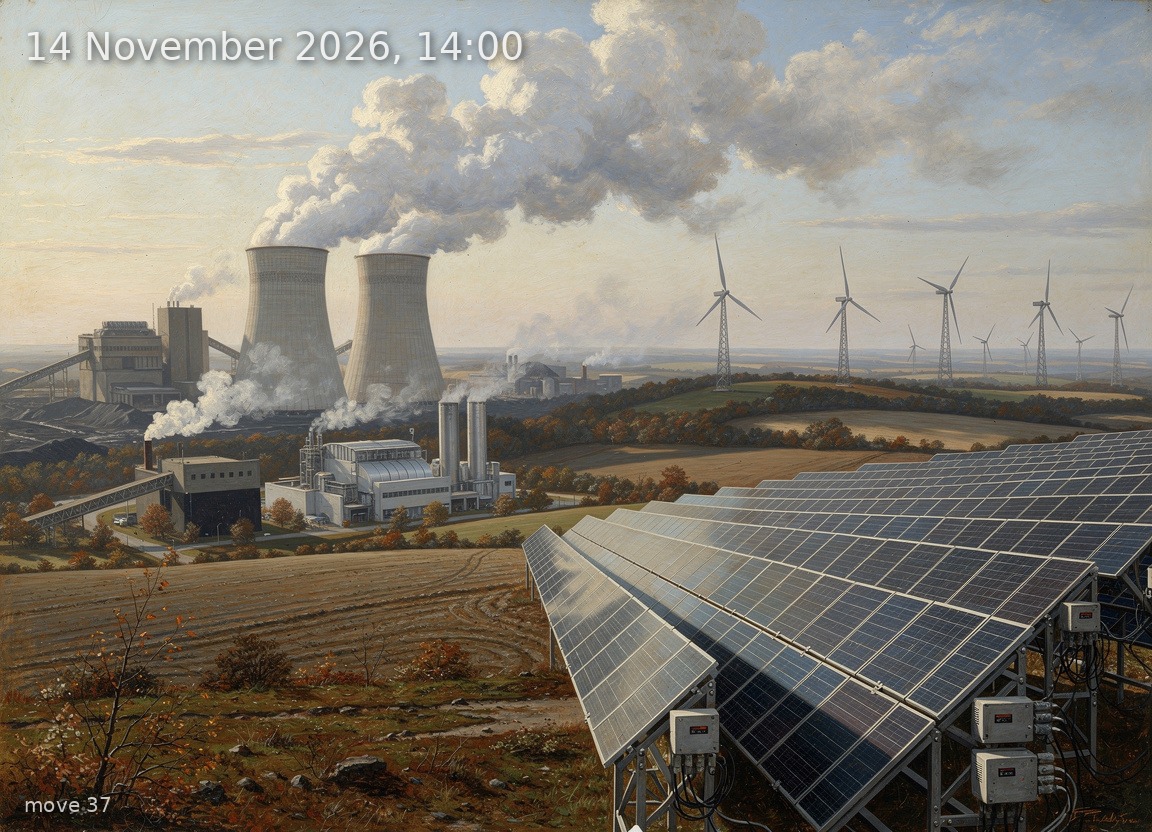
Solar leads at 16.3 GW with strong wind support, but lignite and gas persist under elevated prices and tight supply.
Generation mix
Wind onshore 15%
Wind offshore 11%
Solar 30%
Biomass 8%
Hydro 2%
Natural gas 14%
Hard coal 4%
Brown coal 17%
65%
Renewable share
14.0 GW
Wind (on + offshore)
16.3 GW
Solar
54.6 GW
Total generation
0.7 GW
Net import
189.6 EUR/MWh
Day-ahead price
5.8°C / 9 km/h
Temp / Wind speed
Open-Meteo, Kassel (51.3°N 9.5°E) · surface estimate from 100 m wind
13.0% / 171.3 W/m²
Cloud cover / Radiation
238
gCO₂/kWh
Image prompt
Solar 16.3 GW dominates the right third of the scene as vast fields of aluminium-framed crystalline silicon photovoltaic panels angled toward a low November sun, their surfaces glinting sharply. Brown coal 9.3 GW occupies the left quarter as a massive lignite power station with three hyperbolic cooling towers emitting thick white steam plumes that drift heavily across the sky. Wind onshore 8.1 GW appears as a long ridge of three-blade turbines on lattice towers stretching across the middle distance, blades turning slowly in moderate wind. Wind offshore 5.8 GW is suggested by a cluster of taller, slimmer turbines visible far on the horizon above a grey-blue band of sea. Natural gas 7.4 GW fills the centre-left as a compact CCGT facility with twin cylindrical exhaust stacks releasing thin transparent heat shimmer. Biomass 4.2 GW appears as a modest wood-clad industrial plant with a single squat smokestack and a pile of woodchip feedstock beside it. Hard coal 2.4 GW is a smaller coal-fired station with a single rectangular stack near the lignite plant. Hydro 1.0 GW is a small concrete run-of-river dam visible in a valley stream in the foreground. Time is 14:00 in mid-November central Germany: the sun is low in the southern sky at roughly 20° elevation, casting long shadows; the sky is nearly cloudless at 13% cover, pale blue fading to hazy white near the horizon. Temperature is 5.8 °C — bare deciduous trees with last brown leaves, frost lingering in shaded hollows, dormant grey-brown fields. The atmosphere feels oppressive and heavy despite the clear sky, with a brooding amber-tinged quality to the light reflecting the high electricity price. Style: highly detailed oil painting in the tradition of 19th-century German Romantic landscape painters such as Caspar David Friedrich and Carl Blechen — rich, layered colour with visible impasto brushwork, atmospheric perspective with distant haze, dramatic interplay of industrial forms against the natural landscape. Meticulous engineering detail on all infrastructure: nacelle housings, rotor blade pitch mechanisms, panel junction boxes, cooling tower ribbing, steam condensation physics. No text, no labels, no people prominent.