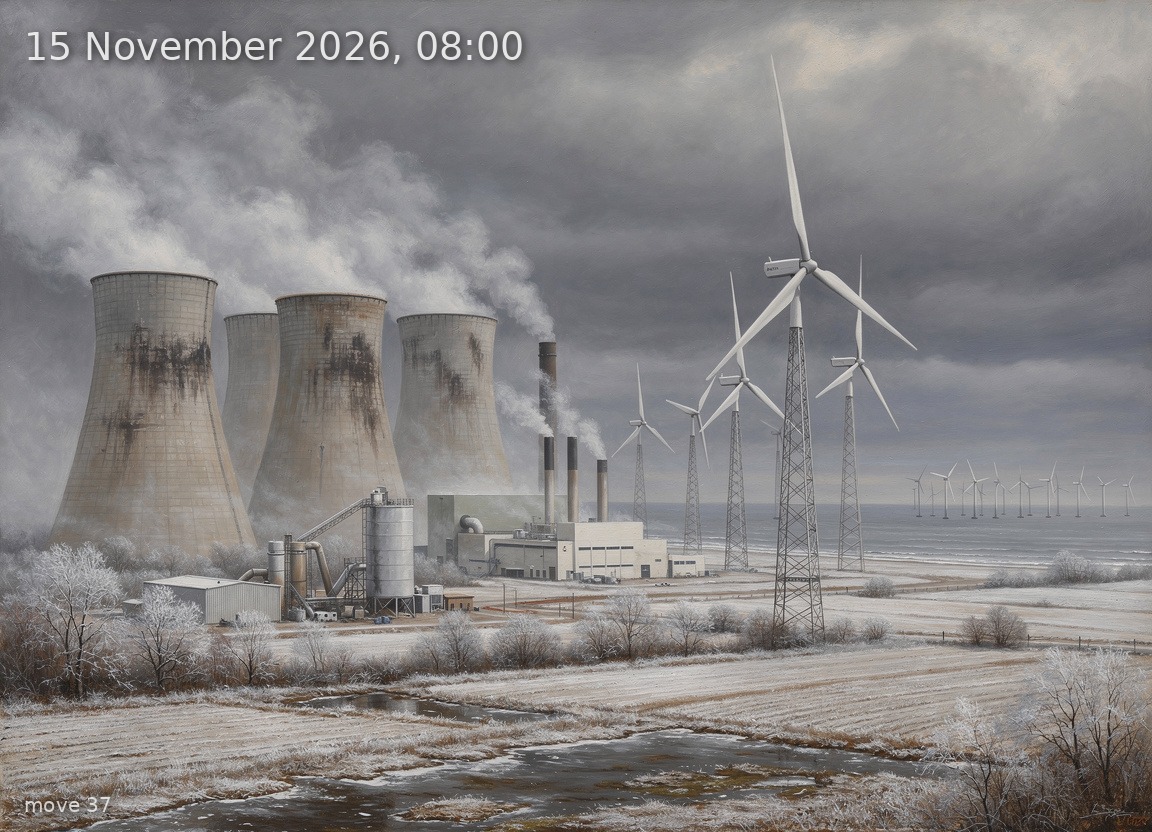
Strong onshore wind dominates at 24.5 GW alongside 8.3 GW brown coal under freezing, fully overcast November skies.
Generation mix
Wind onshore 47%
Wind offshore 9%
Solar 8%
Biomass 8%
Hydro 2%
Natural gas 7%
Hard coal 3%
Brown coal 16%
74%
Renewable share
29.3 GW
Wind (on + offshore)
4.0 GW
Solar
51.8 GW
Total generation
+1.4 GW
Net export
121.9 EUR/MWh
Day-ahead price
-2.1°C / 13 km/h
Temp / Wind speed
Open-Meteo, Kassel (51.3°N 9.5°E) · surface estimate from 100 m wind
99.0% / 0.0 W/m²
Cloud cover / Radiation
188
gCO₂/kWh
Image prompt
Wind onshore 24.5 GW dominates the right two-thirds of the scene as dozens of tall three-blade turbines with white nacelles and lattice towers stretching across a frozen, frost-covered North German plain, blades turning steadily; brown coal 8.3 GW occupies the left quarter as a massive lignite power station with four hyperbolic cooling towers emitting thick white steam plumes that merge into the heavy overcast; wind offshore 4.9 GW appears as a distant line of turbines visible on a grey North Sea horizon at the far right; natural gas 3.7 GW is rendered as a compact CCGT plant with twin exhaust stacks and a thin heat shimmer, positioned between the coal complex and the onshore turbines; biomass 4.2 GW appears as a mid-sized industrial facility with a cylindrical silo and modest steam exhaust near the coal station; hard coal 1.5 GW is a smaller conventional plant with a single square stack trailing grey smoke behind the lignite towers; solar 4.0 GW is represented by a large field of aluminium-framed crystalline silicon panels in the mid-ground, but they are dull and inactive, reflecting only the flat grey sky with no sunlight falling on them; hydro 0.8 GW is a small run-of-river weir with a modest powerhouse barely visible at the far left beside a dark winter river. Time is 08:00 in mid-November: the sky is fully daylight but entirely overcast at 99% cloud cover, a uniform pewter-grey ceiling pressing low with no direct sun, no blue patches, creating a flat diffused cold light across the landscape. Temperature is minus two degrees Celsius: bare deciduous trees with frost-rimed branches, thin ice on puddles, pale frozen stubble fields, breath-like vapour rising from every exhaust. The atmosphere is heavy and oppressive reflecting the high 121.9 EUR/MWh electricity price — the air feels dense, the clouds thick and unyielding, pressing down on the industrial panorama. Style: highly detailed oil painting in the tradition of 19th-century German Romantic landscape painters such as Caspar David Friedrich and Carl Blechen — rich muted earth tones, visible confident brushwork, atmospheric depth with layers of mist and steam, meticulous engineering detail on every turbine nacelle, cooling tower curvature, and panel frame. The scene conveys the sublime tension between nature's cold power and industrial necessity. No text, no labels.