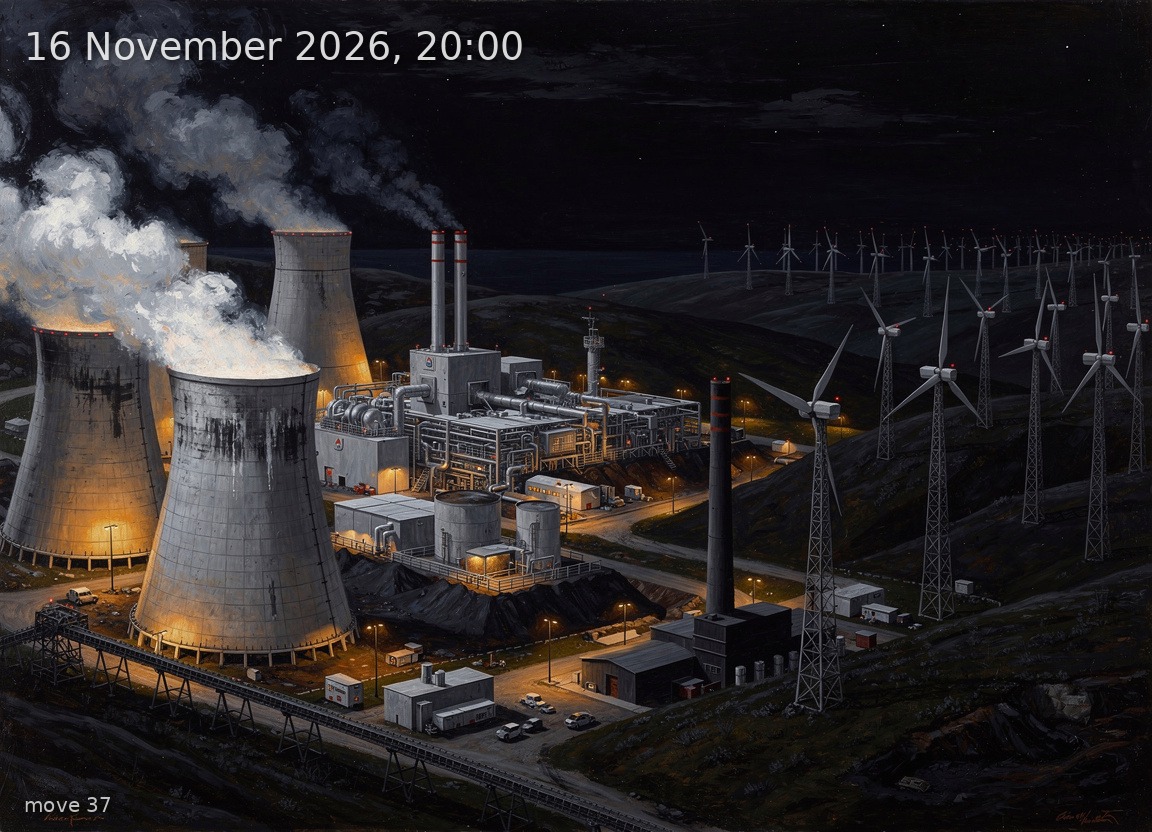
Strong wind and substantial coal and gas thermal generation meet peak evening demand under cold, clear November skies.
Generation mix
Wind onshore 45%
Wind offshore 7%
Biomass 8%
Hydro 1%
Natural gas 19%
Hard coal 5%
Brown coal 15%
61%
Renewable share
31.5 GW
Wind (on + offshore)
0.0 GW
Solar
60.2 GW
Total generation
3.8 GW
Net import
235.8 EUR/MWh
Day-ahead price
4.5°C / 14 km/h
Temp / Wind speed
Open-Meteo, Kassel (51.3°N 9.5°E) · surface estimate from 100 m wind
5.0% / 0.0 W/m²
Cloud cover / Radiation
252
gCO₂/kWh
Image prompt
Wind onshore 27.4 GW dominates the right half and background as vast ranks of three-blade turbines on lattice towers stretching across dark rolling hills, rotors visibly turning in moderate wind; wind offshore 4.1 GW appears as a distant cluster of taller turbines along a far horizon line over a dark sea glimpsed through a gap in the hills; natural gas 11.2 GW fills the centre-left as a complex of compact CCGT power plants with tall single exhaust stacks venting pale plumes lit from below by sodium-orange industrial lights; brown coal 9.3 GW occupies the left foreground as massive hyperbolic cooling towers emitting thick white steam clouds, lit from within by a dull amber glow, with conveyor belts and lignite stockpiles visible at their base; biomass 4.6 GW appears as a mid-ground cluster of smaller industrial buildings with short chimneys and wood-chip storage domes, warmly lit; hard coal 2.9 GW is rendered as a single large stack and boiler house beside the brown coal complex, slightly smaller; hydro 0.8 GW is suggested by a small dam and turbine house in a valley in the far right middle ground, with a thin waterfall catching faint light. TIME: 20:00 in mid-November — full night, completely black sky with a few cold stars visible through a nearly cloudless 5% cloud cover, no twilight whatsoever, no sky glow on the horizon. All structures illuminated only by artificial light: sodium streetlamps casting orange pools, red aviation warning lights on turbine nacelles and stacks, white security floodlights on plant perimeters. The atmosphere feels heavy and oppressive despite the clear sky, reflecting the very high electricity price — a subtle haze of steam and industrial vapor hangs low, trapping the artificial light into a brooding amber pall over the industrial landscape. Temperature 4.5°C: bare deciduous trees, frost on grass, breath-visible cold suggested by the crispness of light edges. Foreground shows frozen stubble fields. Style: highly detailed oil painting in the tradition of 19th-century German Romantic landscape painters such as Caspar David Friedrich and Carl Blechen — rich dark palette of deep navy, amber, burnt sienna, and cold grey; thick visible brushwork; dramatic chiaroscuro between pools of industrial light and surrounding darkness; atmospheric depth with receding layers of turbines vanishing into the dark distance. Meticulous engineering detail on every technology — turbine nacelles with anemometers, three-blade rotors with correct proportions, aluminium-clad CCGT housings, reinforced-concrete cooling tower shells with condensation dripping. No text, no labels, no human figures.