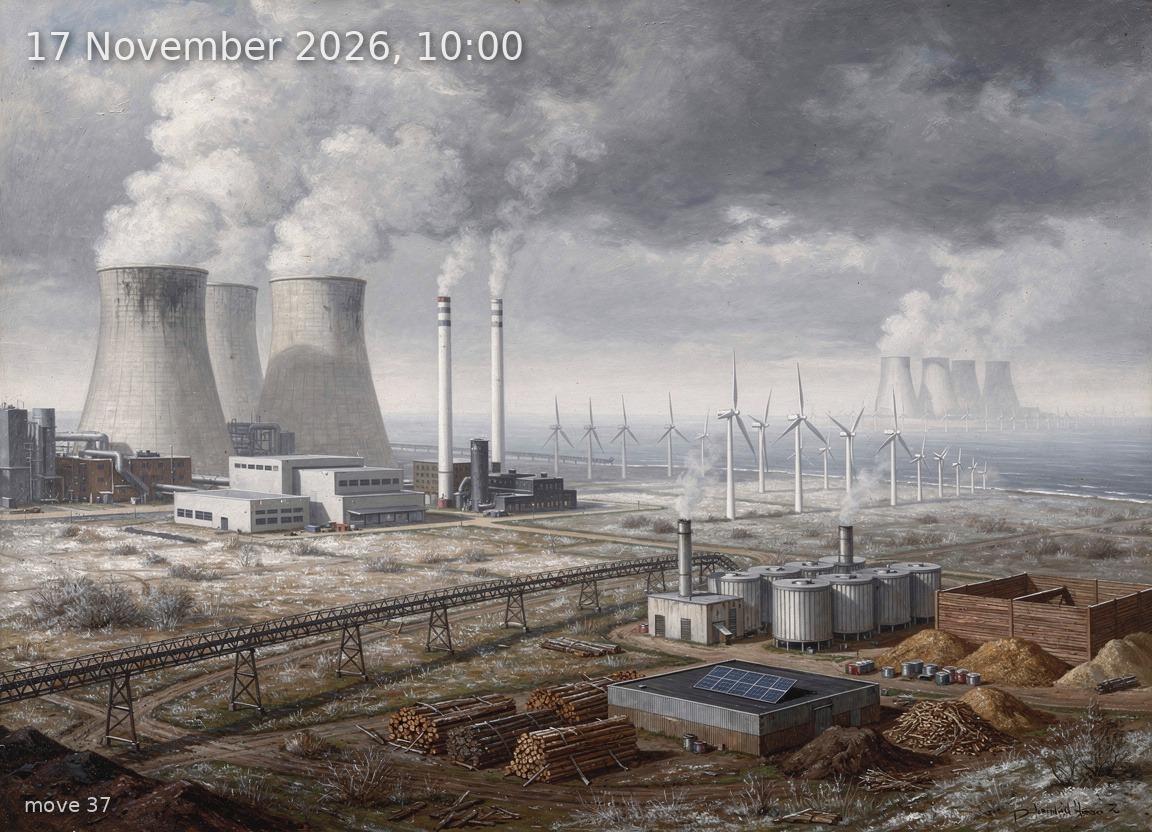
Wind leads at 26.6 GW but cold overcast demand at 67.4 GW forces heavy thermal dispatch and net imports.
Generation mix
Wind onshore 37%
Wind offshore 8%
Solar 6%
Biomass 8%
Hydro 2%
Natural gas 18%
Hard coal 6%
Brown coal 16%
60%
Renewable share
26.5 GW
Wind (on + offshore)
3.8 GW
Solar
59.6 GW
Total generation
7.8 GW
Net import
249.5 EUR/MWh
Day-ahead price
2.2°C / 5 km/h
Temp / Wind speed
Open-Meteo, Kassel (51.3°N 9.5°E) · surface estimate from 100 m wind
100.0% / 0.0 W/m²
Cloud cover / Radiation
264
gCO₂/kWh
Image prompt
Wind onshore 21.9 GW dominates the right half of the scene as dozens of three-blade turbines with white tubular towers and grey nacelles stretching across a flat, frost-dusted North German plain toward the horizon; wind offshore 4.7 GW appears as a distant cluster of larger turbines barely visible through haze on the far right edge near a grey sea. Brown coal 9.7 GW occupies the left foreground as a massive lignite power station with four hyperbolic concrete cooling towers emitting thick white-grey steam plumes that merge into the overcast; natural gas 10.7 GW fills the left-centre as a row of compact CCGT plants with tall single exhaust stacks and thin heat shimmer. Hard coal 3.5 GW appears as a smaller coal plant with a single squat cooling tower and conveyor belts behind the gas units. Biomass 4.5 GW is rendered as a mid-ground cluster of wood-chip-fed boiler plants with modest chimneys and steam wisps near timber storage yards. Solar 3.8 GW appears minimally as a few aluminium-framed crystalline silicon panels on a warehouse roof in the mid-ground, their surfaces dark and reflecting only grey sky — no sunshine. Hydro 1.0 GW is a small run-of-river weir with a powerhouse visible along a cold river cutting through the foreground. The sky is 100% overcast, a uniform heavy pewter-grey ceiling pressing down oppressively, no blue visible anywhere, diffuse flat daylight of a 10 AM November morning — bright enough to see clearly but entirely without shadows or warmth. Temperature 2.2°C: bare deciduous trees with black branches, patches of frost on brown grass, breath-fog from a few tiny human figures near the coal plant. The atmosphere feels heavy and expensive — thick, dense air, muted colours, a sense of industrial burden. Painted in the style of a highly detailed 19th-century German Romantic oil painting — rich impasto brushwork, atmospheric depth with receding layers of industrial infrastructure fading into grey mist, meticulous engineering detail on every turbine nacelle, cooling tower, and exhaust stack, the colour palette dominated by slate grey, raw umber, and cold titanium white with accents of rust and industrial green. No text, no labels.