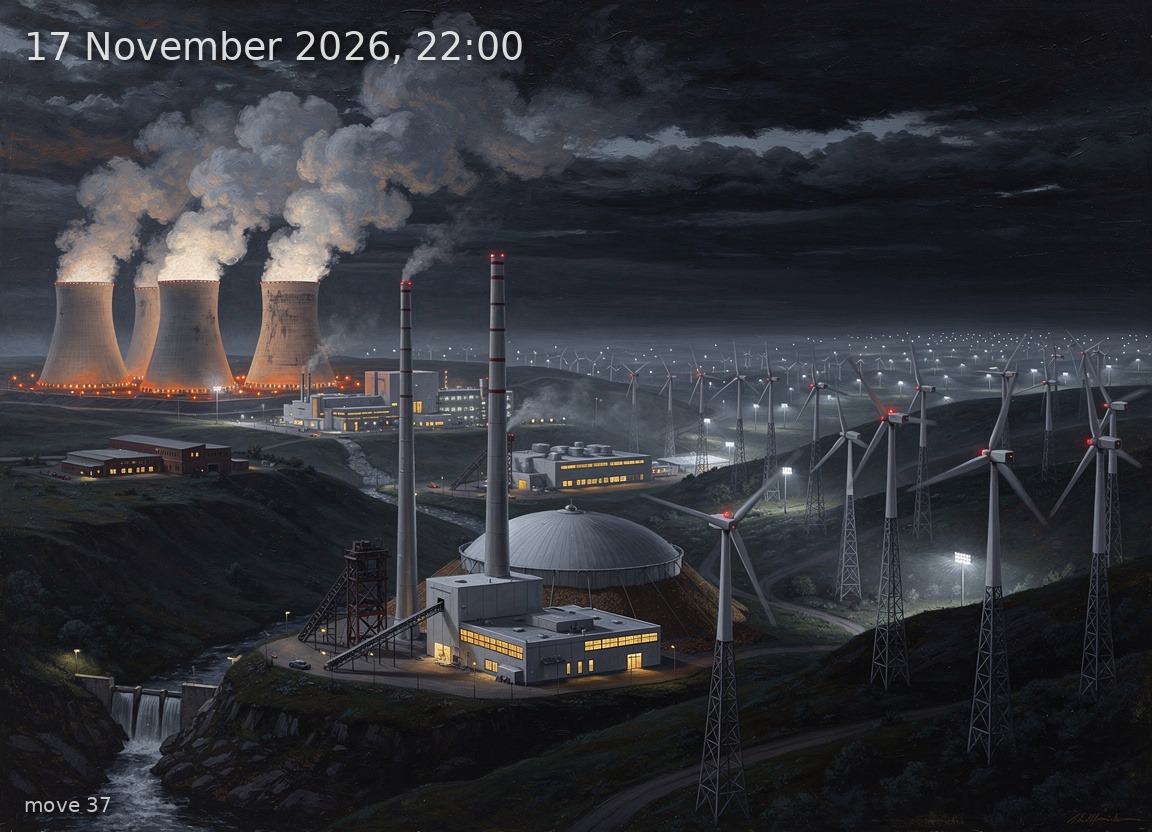
Strong onshore wind at 34 GW leads generation; brown coal and gas provide thermal baseload on a mild, overcast night.
Generation mix
Wind onshore 54%
Wind offshore 7%
Biomass 7%
Hydro 1%
Natural gas 12%
Hard coal 4%
Brown coal 15%
70%
Renewable share
38.3 GW
Wind (on + offshore)
0.0 GW
Solar
63.0 GW
Total generation
+6.4 GW
Net export
168.7 EUR/MWh
Day-ahead price
10.1°C / 24 km/h
Temp / Wind speed
Open-Meteo, Kassel (51.3°N 9.5°E) · surface estimate from 100 m wind
100.0% / 0.0 W/m²
Cloud cover / Radiation
208
gCO₂/kWh
Image prompt
Wind onshore 34.0 GW dominates the right two-thirds of the scene as vast ranks of three-blade turbines on lattice towers, rotors spinning visibly in strong wind, stretching deep into the composition across rolling dark hills; brown coal 9.3 GW occupies the left background as a cluster of massive hyperbolic cooling towers emitting thick white-grey steam plumes lit from below by orange sodium lamps; natural gas 7.3 GW appears in the left-centre as a compact CCGT plant with tall single exhaust stacks venting thin heat shimmer, its turbine hall windows glowing warm amber; biomass 4.6 GW is rendered as a mid-ground industrial plant with a wood-chip storage dome and a single modest smokestack; hard coal 2.5 GW appears as a smaller power station with a rectangular boiler house and conveyor belts, dimly lit; hydro 0.9 GW is suggested by a small dam structure in the far left valley with a thin silver ribbon of water. Time is 22:00 — the sky is completely black, no twilight, no sky glow, a deep navy-to-black overcast ceiling of 100% cloud cover blocking all stars. All illumination comes from artificial sources: sodium-orange streetlights line a road in the foreground, industrial floodlights cast pools of harsh white light on plant structures, red aviation warning lights blink atop turbine nacelles and smokestacks. The atmosphere feels heavy and oppressive, reflecting the high electricity price — low-hanging clouds press down, steam from the cooling towers merges into the dark cloud base. Temperature is mild at 10°C: late-autumn landscape with bare deciduous trees and damp, dark-green grass. Wind is strong — turbine blades show motion blur, clouds appear to race, bare branches bend. Style: highly detailed oil painting in the tradition of 19th-century German Romantic landscape painters such as Caspar David Friedrich and Carl Blechen, with rich impasto brushwork, dramatic chiaroscuro between artificial light sources and deep shadow, atmospheric depth achieved through layered mist and steam. Each energy technology rendered with meticulous engineering accuracy — turbine nacelles with three-blade rotors, aluminium-clad CCGT housings, hyperbolic concrete cooling tower geometry. The scene conveys industrial sublime: the vast nocturnal energy infrastructure of a modern nation, painted as a Romantic masterwork. No text, no labels.