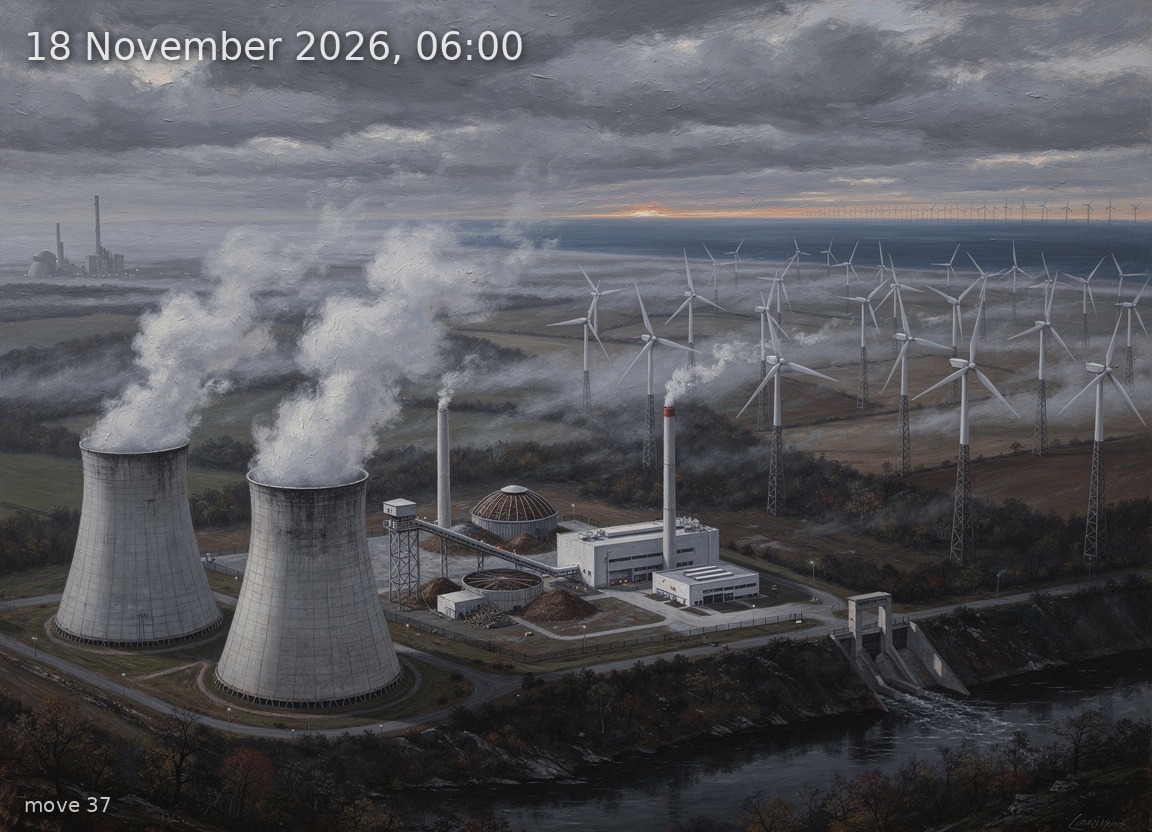
Strong onshore wind at 37.4 GW drives 82% renewable generation into a nearly balanced, moderately priced predawn grid.
Generation mix
Wind onshore 65%
Wind offshore 9%
Solar 0%
Biomass 7%
Hydro 2%
Natural gas 7%
Hard coal 3%
Brown coal 8%
82%
Renewable share
42.5 GW
Wind (on + offshore)
0.0 GW
Solar
57.7 GW
Total generation
0.4 GW
Net import
116.2 EUR/MWh
Day-ahead price
7.6°C / 21 km/h
Temp / Wind speed
Open-Meteo, Kassel (51.3°N 9.5°E) · surface estimate from 100 m wind
100.0% / 0.0 W/m²
Cloud cover / Radiation
120
gCO₂/kWh
Image prompt
Wind onshore 37.4 GW dominates the scene, filling the right two-thirds of the canvas with dozens of massive three-blade wind turbines on lattice and tubular towers receding across rolling central German hills, their rotors spinning visibly in strong wind, blades catching faint pre-dawn light. Wind offshore 5.1 GW appears as a distant line of turbines on the far-right horizon, silhouetted against a sliver of deep steel-blue sea. Brown coal 4.6 GW occupies the left foreground as two hyperbolic cooling towers emitting thick white-grey steam plumes that merge into the low overcast. Biomass 4.1 GW sits as a mid-ground industrial facility with a wood-chip storage dome, conveyor belts, and a single stack venting thin pale exhaust. Natural gas 3.9 GW appears as a compact CCGT plant with a single tall exhaust stack and a visible heat shimmer, positioned between the cooling towers and the turbines. Hard coal 1.7 GW is a smaller coal-fired station in the far left background, its single stack barely visible through haze. Hydro 1.0 GW is suggested by a small dam and penstock structure nestled in a wooded valley in the middle distance. The sky is completely overcast at 100% cloud cover, a heavy oppressive ceiling of layered grey stratus pressing down — no stars, no clear sky visible — reflecting the high 116.2 EUR/MWh price. The time is 06:00 in mid-November: pre-dawn light only, a faint cold blue-grey luminance along the eastern horizon, no direct sunlight, the landscape mostly in deep shadow with sodium-orange streetlights glowing in a small village below the turbines and amber industrial lighting illuminating the power plants. Temperature is a cool 7.6 °C: bare deciduous trees, brown autumn grass, patches of frost on fields. Wind at 21 km/h bends the remaining dead leaves and ripples puddles on dirt roads. No solar panels anywhere. Rendered as a highly detailed oil painting in the tradition of Caspar David Friedrich and Carl Blechen — rich impasto brushwork, atmospheric depth with layered mist between the turbines and the coal plants, dramatic Romantic composition contrasting industrial sublime against the vast dark sky, meticulous engineering accuracy on every nacelle, rotor hub, cooling tower shell, and gas turbine exhaust detail. No text, no labels.