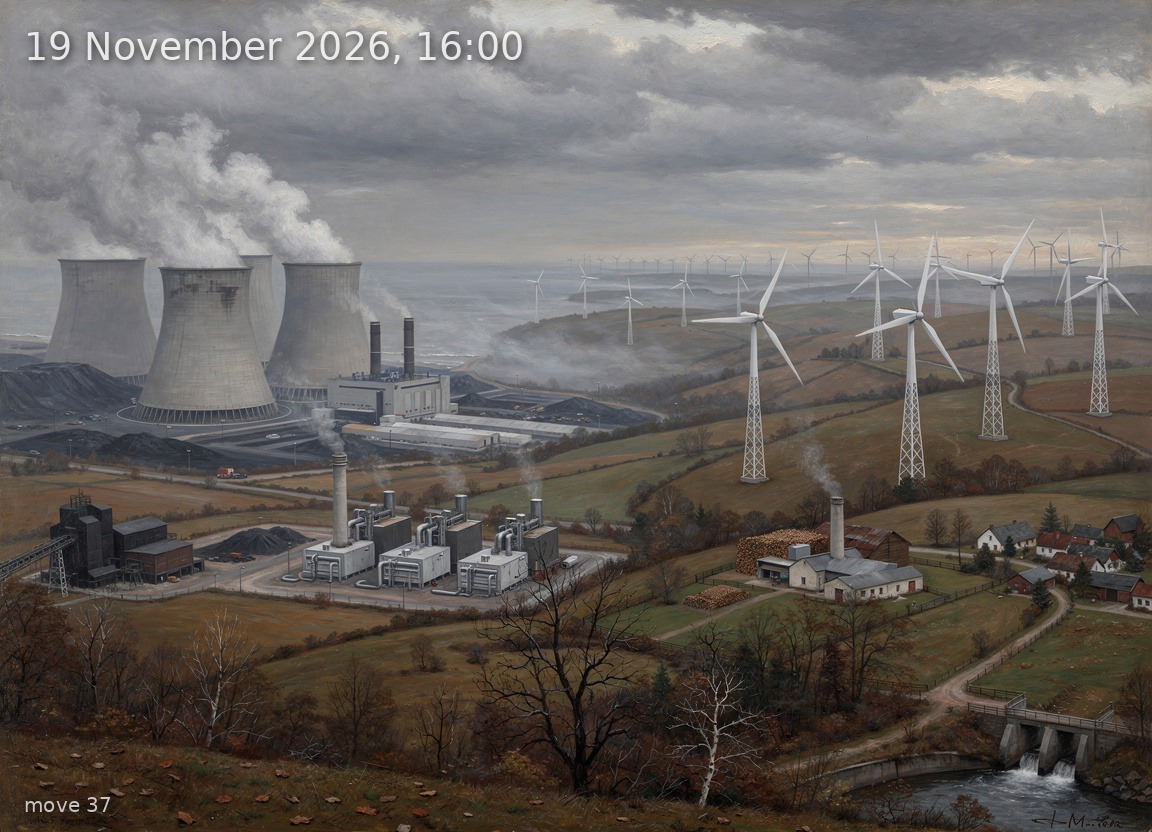
Strong wind and heavy thermal dispatch still leave a 9.7 GW net import gap under peak November demand.
Generation mix
Wind onshore 41%
Wind offshore 6%
Solar 0%
Biomass 7%
Hydro 2%
Natural gas 21%
Hard coal 7%
Brown coal 16%
56%
Renewable share
27.6 GW
Wind (on + offshore)
0.2 GW
Solar
59.5 GW
Total generation
9.8 GW
Net import
262.8 EUR/MWh
Day-ahead price
9.6°C / 23 km/h
Temp / Wind speed
Open-Meteo, Kassel (51.3°N 9.5°E) · surface estimate from 100 m wind
100.0% / 0.0 W/m²
Cloud cover / Radiation
288
gCO₂/kWh
Image prompt
Wind onshore 24.1 GW dominates the right two-fifths of the scene as dozens of tall three-blade turbines with white lattice towers stretching across rolling central German hills, rotors spinning vigorously in strong wind. Brown coal 9.2 GW occupies the left quarter as a cluster of massive hyperbolic cooling towers with thick white-grey steam plumes billowing sideways in the wind, alongside conveyor belts feeding lignite into boiler houses. Natural gas 12.7 GW fills the centre-left as a row of compact CCGT power plants with tall single exhaust stacks venting thin plumes, their metallic structures catching dim light. Hard coal 4.5 GW appears behind the gas plants as a single large coal-fired station with twin stacks and a coal yard. Biomass 4.1 GW is rendered as a modest wood-chip-fueled plant with a short stack and woodpile, nestled at the edge of a small village. Wind offshore 3.5 GW is glimpsed in the far background as a line of turbines on a grey horizon suggesting the North Sea coast. Hydro 1.2 GW is a small dam and reservoir in a valley at the far right edge. Solar 0.2 GW: no solar panels visible, no sun whatsoever. Time is 16:00 in late November — the last grey daylight fading, sky entirely overcast with thick low stratus clouds in oppressive layers of slate-grey and charcoal, pressing down on the landscape. No sunlight breaks through. The atmosphere feels heavy, dense, and costly, with a brooding weight suggesting high electricity prices. Bare deciduous trees with skeletal branches, dull brown grass, temperature around 10°C. Wind visibly bends the grass and scatters leaves. Highly detailed oil painting in the tradition of 19th-century German Romantic landscape painters — Caspar David Friedrich meets industrial sublime — rich muted earth tones, visible impasto brushwork, atmospheric depth and haze, meticulous engineering accuracy on every turbine nacelle, cooling tower curvature, and CCGT exhaust configuration. No text, no labels.