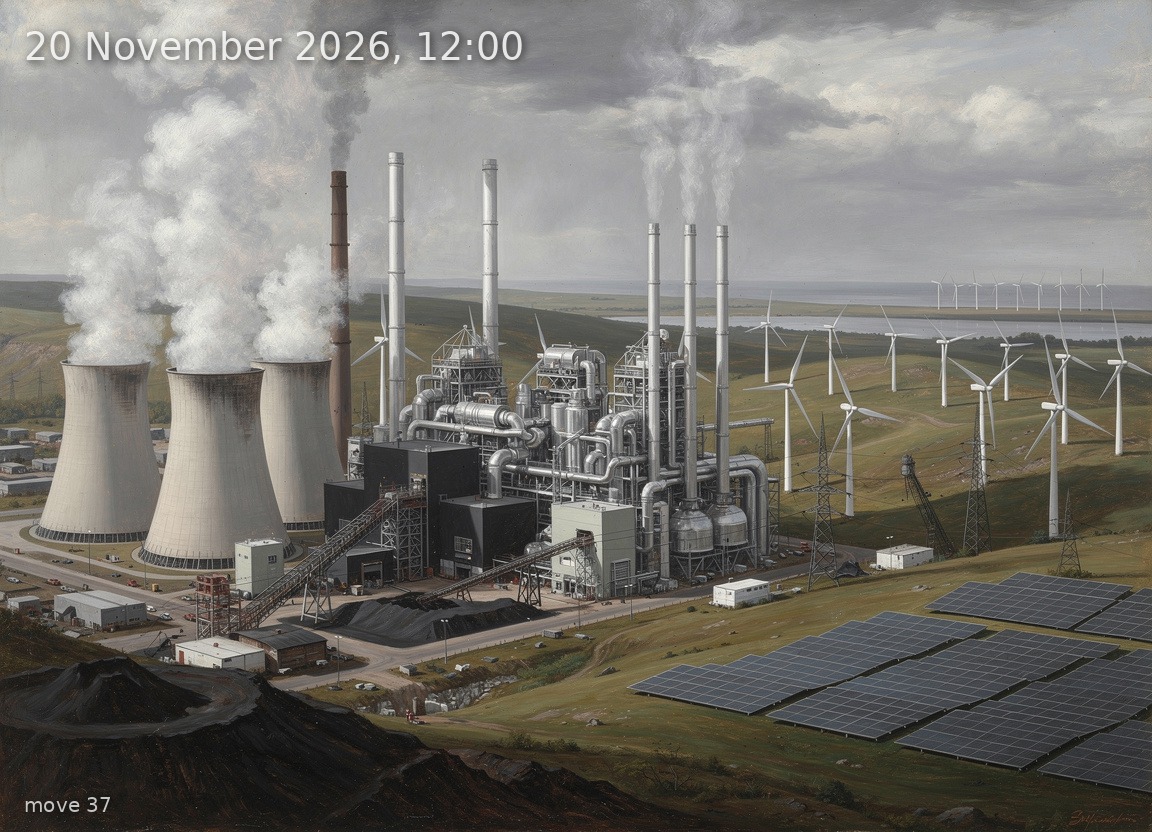
Gas leads at 16 GW alongside 16 GW wind and 13.3 GW coal, with 8 GW net imports covering an overcast November demand peak.
Generation mix
Wind onshore 21%
Wind offshore 5%
Solar 17%
Biomass 7%
Hydro 2%
Natural gas 26%
Hard coal 8%
Brown coal 14%
52%
Renewable share
16.0 GW
Wind (on + offshore)
10.2 GW
Solar
61.1 GW
Total generation
8.1 GW
Net import
205.5 EUR/MWh
Day-ahead price
7.3°C / 4 km/h
Temp / Wind speed
Open-Meteo, Kassel (51.3°N 9.5°E) · surface estimate from 100 m wind
100.0% / 0.0 W/m²
Cloud cover / Radiation
300
gCO₂/kWh
Image prompt
Natural gas 16.0 GW dominates the centre of the composition as a sprawling complex of combined-cycle gas turbine units with tall slender exhaust stacks emitting heat shimmer and thin vapour plumes; brown coal 8.3 GW occupies the left foreground as massive hyperbolic cooling towers releasing dense white steam columns into the grey sky; hard coal 5.0 GW sits behind the lignite plant as a smaller cluster of rectangular boiler houses with conveyor belts and a single large smokestack; wind onshore 12.6 GW stretches across the right half and into the background as dozens of modern three-blade turbines on lattice and tubular towers dotting gentle rolling hills, blades turning slowly in light wind; wind offshore 3.4 GW is suggested on the far right horizon as a row of turbines standing in a strip of grey sea barely visible through haze; solar 10.2 GW appears as large fields of aluminium-framed crystalline silicon panels in the mid-ground right, their surfaces dull and reflecting only flat grey light — no sun visible, no glare; biomass 4.5 GW is rendered as a mid-sized industrial facility with a wood-chip storage dome and a modest smokestack near the centre-right; hydro 1.1 GW appears as a small concrete run-of-river weir with a powerhouse on a river winding through the foreground. The sky is fully overcast at 100% cloud cover — a heavy, oppressive, uniform blanket of pewter-grey stratus pressing low, suggesting the elevated 205.5 EUR/MWh price with atmospheric weight and tension. Lighting is diffuse November midday daylight, shadowless and flat, colour temperature cool. The landscape is late-autumn central German terrain: bare deciduous trees with a few clinging brown leaves, faded tawny grass, damp earth, temperature around 7°C conveyed by mist lingering near the river and a sense of chill dampness. Overhead high-voltage transmission lines on steel lattice pylons cross the scene left to right, symbolising the import flows. Style: highly detailed oil painting in the tradition of 19th-century German Romantic landscape masters — rich impasto brushwork, atmospheric depth with layered recession into haze, Caspar David Friedrich's brooding scale combined with Adolph Menzel's industrial precision. Each technology rendered with meticulous engineering accuracy: turbine nacelles, rotor hubs, cooling tower parabolic profiles, PV cell grid patterns. No text, no labels, no people prominent — the machines and the leaden sky are the subject.