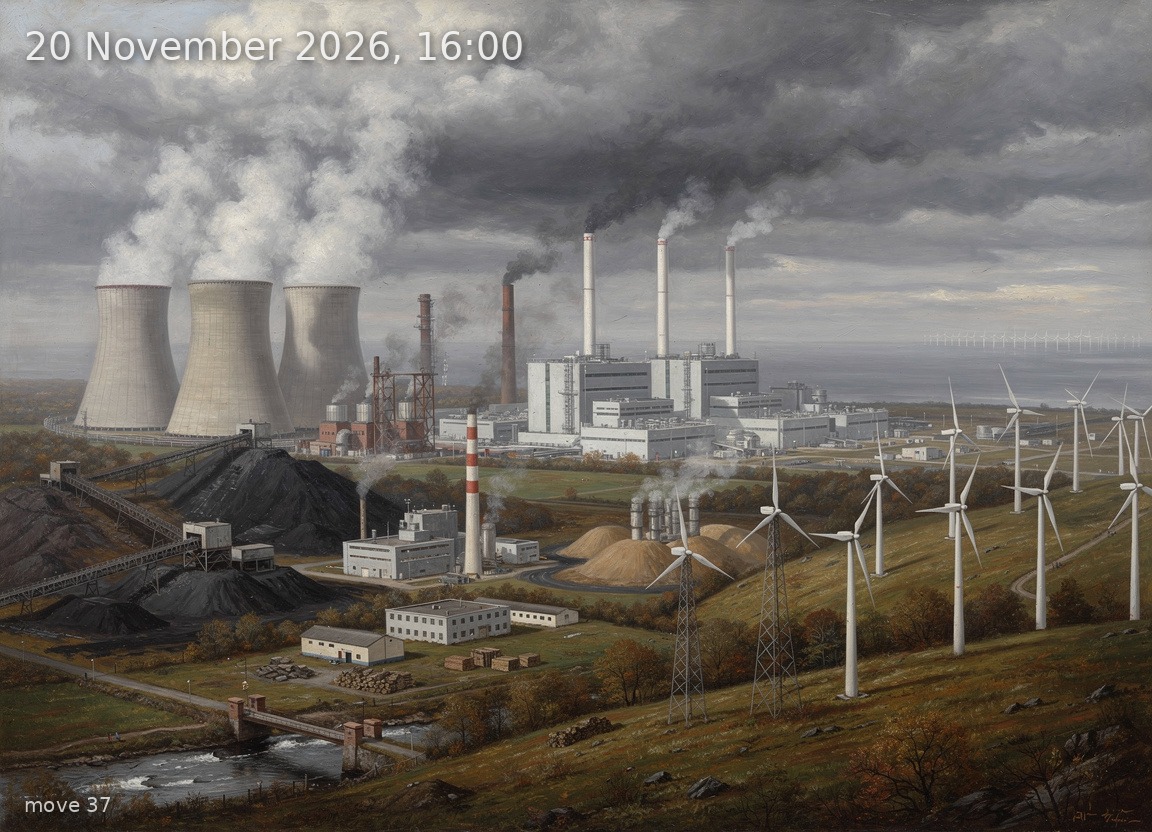
Gas, coal, and wind carry a 67 GW load under heavy overcast, with 15 GW of net imports filling the gap.
Generation mix
Wind onshore 25%
Wind offshore 9%
Solar 0%
Biomass 8%
Hydro 2%
Natural gas 29%
Hard coal 10%
Brown coal 17%
44%
Renewable share
17.7 GW
Wind (on + offshore)
0.2 GW
Solar
52.3 GW
Total generation
15.1 GW
Net import
250.0 EUR/MWh
Day-ahead price
6.2°C / 11 km/h
Temp / Wind speed
Open-Meteo, Kassel (51.3°N 9.5°E) · surface estimate from 100 m wind
98.0% / 0.3 W/m²
Cloud cover / Radiation
353
gCO₂/kWh
Image prompt
Natural gas 15.1 GW dominates the centre-right as a sprawling complex of CCGT combined-cycle gas turbine units with tall slender exhaust stacks venting thin white plumes; brown coal 9.0 GW occupies the left foreground as massive hyperbolic cooling towers with billowing steam columns rising into the grey sky, alongside conveyor belts of dark lignite; hard coal 5.0 GW appears just left of centre as a cluster of smaller coal-fired power station chimneys with darker smoke; wind onshore 13.1 GW fills the right third and extends into the background as dozens of three-blade turbines on lattice and tubular towers, rotors turning moderately in the breeze across rolling low hills with dormant brown-green late-autumn grass; wind offshore 4.6 GW is suggested on the far-right horizon as a line of turbines standing in a grey sea barely visible through haze; biomass 4.2 GW appears as mid-ground wood-chip-fed generating stations with compact stacks and stored timber piles; hydro 1.1 GW is a small run-of-river plant along a dark stream in the lower left corner; solar 0.2 GW is entirely absent — no panels visible. The sky is 98% overcast, a heavy oppressive ceiling of dense stratiform cloud in shades of pewter, slate, and charcoal, pressing down on the landscape. The time is 16:00 in late November in central Germany — the last traces of cold grey daylight are fading, with the horizon showing no sun at all, the light flat and diffuse and already dimming toward dusk. Temperature is 6°C: bare deciduous trees, frost-edged puddles, figures in heavy coats near plant gates. The atmosphere is heavy and brooding, reflecting the 250 EUR/MWh price — a sense of industrial strain, every plant running, smoke and steam merging into the low cloud base. Rendered as a highly detailed oil painting in the tradition of 19th-century German Romantic landscape art — rich impasto brushwork, deep chiaroscuro, atmospheric perspective with mist and industrial haze layered across the depth of field, Caspar David Friedrich meets industrial sublime. Meticulous engineering accuracy on turbine nacelles, cooling tower parabolic curves, CCGT stack geometry. No text, no labels.